Strong disposition: record settlements in national currencies will keep the ruble strong for a long time
- Статьи
- Economy
- Strong disposition: record settlements in national currencies will keep the ruble strong for a long time


One of the reasons for such a strong ruble was the transition to national currencies in payments — their share in payments by the end of the year exceeded 85%, and the ruble occupies more than 53%, follows from the data of the Central Bank, which was analyzed by Izvestia. Reducing the economy's dependence on "toxic" currencies has made the national currency more stable. Additionally, the exchange rate may support the rise in oil prices against the background of the conflict in the Middle East, which will increase the filling of the NWF. Experts expect the ruble to weaken by 5-10% against the background of a decrease in the cut-off price in the budget rule, however, de-dollarization and a high key rate will keep the exchange rate from a deep drawdown.
Why has the ruble become the main currency in foreign trade
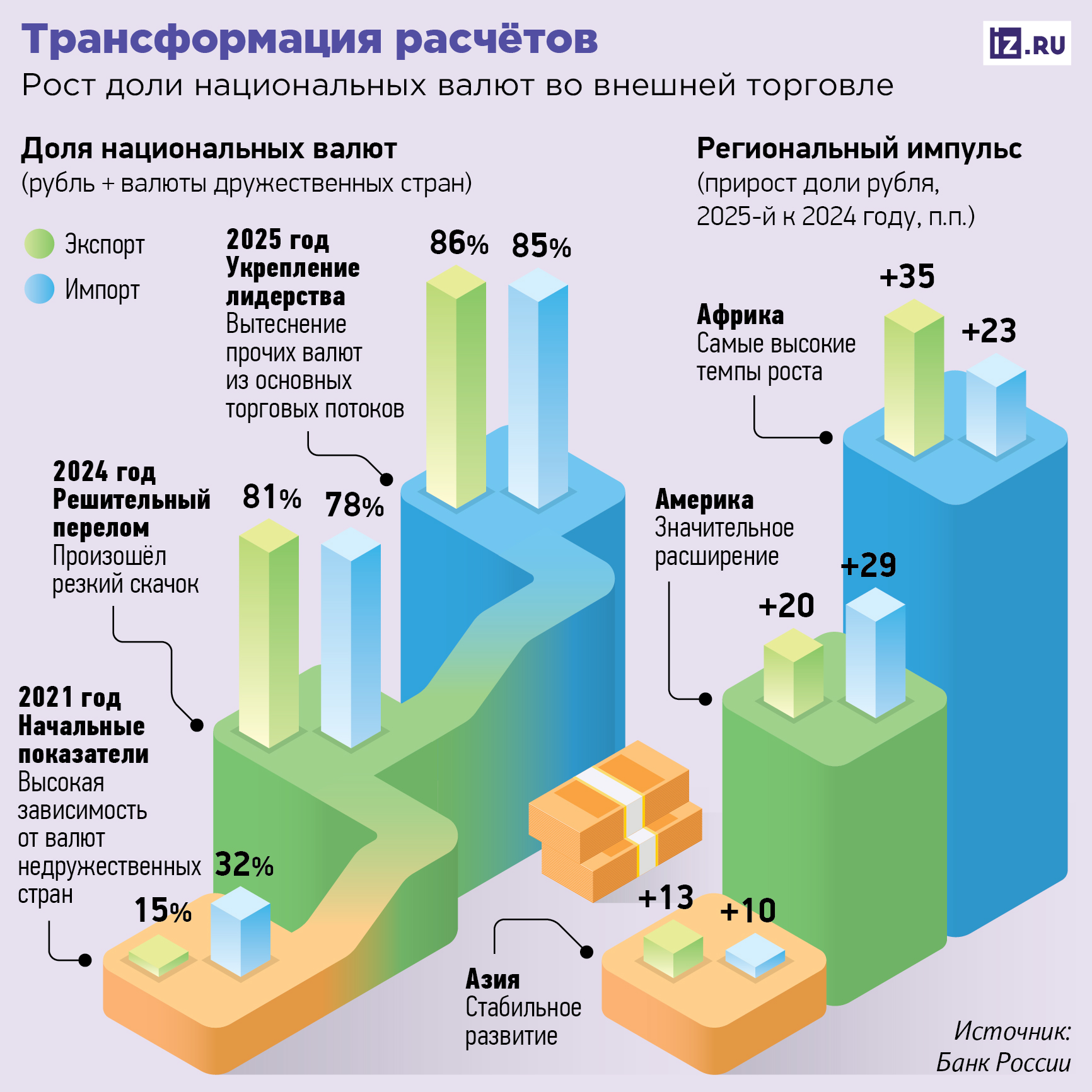
By the end of 2025, the share of the ruble in export payments reached 53.7%, according to the regulator. Over the year, it increased by 12.4 percentage points. In imports, the ruble took 54.4% against 43.2% a year earlier. At the same time, the share of currencies of friendly countries (yuan, rupee, dirhams and others) in the calculations turned out to be above 30%. Thus, the combined share of national currencies in export and import payments exceeded 85% for the first time in a year.
The Ministry of Economic Development confirmed the stability of the trend to Izvestia. Thus, in four years, the share of national currencies in exports increased by 71 percentage points, and in imports by 53 percentage points. This makes it possible to ensure the stability of trade operations in the face of sanctions pressure from Western countries, the ministry noted.
The "toxic" dollar and euro in settlements with Russia, on the contrary, sank to their lowest values: in exports — up to 14.4% (against 18.5% in 2024), in imports — up to 15% (against 21.9% a year earlier). For comparison, in 2021, before the sanctions were imposed, Western currencies accounted for almost 85% of exports.
The record growth of the ruble's share in foreign trade operations is a direct result of sanctions and infrastructure reconfiguration, explained Vladimir Chernov, analyst at Freedom Finance Global. It has become easier and more reliable for businesses to conduct transactions in rubles than to keep chains in dollars and euros, where the risk of blockages and delays is higher. According to him, de-dollarization in trade already looks like a steady trend, although it will depend on the sanctions regime, the geography of trade and commodity prices.
Back in the spring of 2025, the share of the ruble was 50%, and by the end of the year it reached a historic high, which indicates the potential for growth to 60% or more. Sanctions have minimized the ability to settle in currencies of unfriendly countries, and the ruble has become more profitable than friendly currencies due to the absence of conversion losses, added financial adviser, founder of Rodin.Capital Alexey Rodin.
At the same time, Vladimir Chernov explained the decline in the share of the yuan, the rupee and other currencies of friendly countries after the peak of 2024 with pragmatics: these currencies are not always convenient as a means of accumulation and settlement for third countries, some of them have restrictions on the movement of capital. In practice, the ruble often turns out to be more convenient — it can be immediately credited to counter shipments without creating unnecessary currency balances.
The Ministry of Economic Development of the Russian Federation explained that the trend towards replacing the currencies of friendly countries with the ruble cannot be considered negative. According to them, both the ruble and friendly currencies are equally effective in fulfilling the main task of reducing dependence on the dollar and the euro.
The agency also noted that in the second half of 2025, the share of currencies of friendly countries stabilized, while the ruble continued to strengthen its position by further displacing "toxic" money. The most active transition to rubles last year was observed in trade with Africa (+35 percentage points in exports and +23 percentage points in imports), America (+20 percentage points and +29 percentage points) and Asian countries (+13 percentage points and +10 percentage points).

What keeps the ruble exchange rate strong
One of the reasons for the strong exchange rate was the transition to national currencies, experts say. Against this background, the ruble strengthened from 101.7 per "American" at the beginning of 2025 to 78.2 rubles on January 1, 2026. At the end of last month, it updated multi-year lows, falling below 76. By March 2, the official exchange rate was 77.1 rubles.
The growth of payments in rubles reduces the short-term volatility of the exchange rate, as the need for businesses to constantly buy and sell foreign currency for each delivery decreases, explained Vladimir Chernov.
An increase in the volume of ruble transactions gives stability to the national currency, making it less vulnerable to international economic shocks, the press service of the Ministry of Economic Development told Izvestia. When a significant proportion of trade is carried out in rubles, external shocks (such as changes in oil prices or sanctions) have less impact on the domestic market. In addition, the expansion of the use of the ruble stimulates the development of financial infrastructure, including the foreign exchange market, payment systems and tools for working with ruble assets, the department explained.
Previously, the ruble could be easily exchanged for dollars anywhere in the world, but now it "works" mainly inside Russia and in settlements with a narrow circle of partners. This makes it resistant to external crises, but prevents it from being a full-fledged means of accumulation in the international arena, explained Olga Gogaladze, an economist and expert on financial markets.
In addition to the settlement structure, the ruble is supported by other factors. Alexey Rodin highlights a significant trade surplus (excess of exports over imports, ensuring a stable inflow of foreign currency), weak imports, tight monetary policy and large-scale sales of foreign currency by the Ministry of Finance.
The foreign exchange market in terms of foreign trade turnover in 2025 decreased by almost 4.5 times compared to 2022 and amounted to $127 billion, said Natalia Pyrieva, head of the analytical department of Digital Broker. Capital inflows and outflows have almost disappeared due to the sanctions regime. According to her, exporters bring all foreign exchange earnings to the country, placing it at high interest rates in conditions of tight pre-payment and protection against the risks of blocking on foreign accounts.
External factors can also support the ruble. Ivan Taskin, financial market analyst at Vector Capital IC, noted that the escalation of the conflict in the Middle East and the threat of blocking the Strait of Hormuz have already led to a jump in world oil prices, as up to 20% of global supplies pass through this artery. This has a positive effect on the ruble: although there is no question of further strengthening, with consistently high prices, the national currency will definitely not weaken, as previously expected amid talks about adjusting the budget rule.
Yelena Marchuk, Deputy Chairman of the Board of National Savings Bank JSC, explained that the oil market reacts not so much to facts as to risks. The very threat of disruptions in the Strait of Hormuz forces traders to put a premium on uncertainty in the price of a barrel. The connection with oil still works for the ruble, but it is no longer so straightforward due to the high proportion of payments in national currencies. This reduces the economy's dependence on the dollar and the euro, but it does not negate the basic mechanics: the higher the commodity margin, the easier it is for the ruble to hold on.

How will the reduction in the cut-off price affect the ruble
The course may be negatively affected by the upcoming change in the budget rule. Anton Siluanov, the Finance Minister, announced plans to reduce the oil cut-off price in the near future. He did not specify the specific parameters, but noted that they would be known within a couple of weeks.
The cut-off price is the threshold that the authorities focus on when replenishing the National Welfare Fund (NWF). If the price of export raw materials is higher than the cut—off price ($59 per barrel this year), then the surpluses are sent to the "pot" - they are used to buy currency (now it is mainly yuan). That is, oil windfalls allow you to accumulate a "safety cushion". However, if the price of Russian Urals crude oil is lower than the cut-off price, then the currency is sold from the NWF, on the contrary.
Ivan Taskin from Vector Capital noted that under the current conditions, the adjustment of the budget rule may be postponed or even canceled, which will remove additional pressure from the ruble. In his opinion, it is the decision of the Ministry of Finance that will become decisive in the coming months.
If the authorities still adhere to the original plan and reduce the cut-off price, then in Russia they will buy more currency and sell it less, this will increase pressure on the ruble. Because of this, the national currency may weaken by 5-10%, experts predict.
A record share of settlements in national currencies will soften this blow and keep the exchange rate from falling significantly. If it were not for this, against the background of declining export revenues, the ruble could already be 15-20% cheaper than current values, Olga Gogaladze noted. A significant part of the trade turnover is outside the foreign exchange market, which makes the exchange rate less sensitive to external shocks.
Artur Leer, Vice President of the Association of Exporters and Importers, managing partner of Lex Alliance Law Firm, explained: when 54% of revenue comes in rubles, exporters simply do not have a currency to convert, which means there is no pressure on the exchange rate through its sale. Without ruble payments, exporters would have kept their foreign exchange earnings even more actively without repatriating them (that is, without returning them to Russia), and the ruble could have gone to 100-105 per dollar in the first half of 2026.
In addition to the currency structure, the national currency is held by a high key rate, noted Artur Leer. Now it is at the level of 15.5%, which makes ruble deposits more profitable than any alternative. However, as the rate drops to about 13% by the end of the year, ruble savings will become less attractive, credit will revive, imports will grow and demand for foreign currency will increase. If at the same time sales from the NWF decrease due to the new budget rule and the external oil situation does not improve, a weakening of the ruble to 88-92 per dollar by the end of the year will be the base scenario, the expert believes.
A more optimistic forecast was given by Vladimir Chernov from Freedom Finance Global. In his opinion, in the second half of 2026, the dollar will be in the range of 80-86 rubles. However, by the end of the year, he did not rule out an increase to 90 rubles.
The ruble exchange rate will steadily fall against the basket of world currencies until the end of 2026, Natalia Pyrieva agreed. This will begin to happen as the key interest rate decreases and demand for foreign currency from imports and the population recovers.
Elena Marchuk, in turn, stressed that the budget rule at high oil prices works as a deterrent — the state withdraws excess profits into reserves through purchases of foreign currency and gold, which extinguishes part of the positive effect for the ruble. Lowering the cut-off price, if the authorities go for it, will enhance this effect by channeling more revenue into reserves.
However, the ruble-denominated payments, the high share of the national currency in foreign trade payments and tight monetary policy are able to keep the national currency stronger and longer than expected in early forecasts. If geopolitical tensions in the Middle East persist and continue to push oil prices up, the ruble will receive a "cushion" for the coming months, and the trajectory for 2026 will be determined by the balance between expensive oil and a tight rate, the expert concluded.
Переведено сервисом «Яндекс Переводчик»
