
The highest degree of wisdom: an American looks reverently at Tolstoy's novel

The book by American Tolstoy scholar Andrew D. Kaufman, analyzing the most memorable episodes of "War and Peace", does not so much tell our reader something new about Tolstoy's epic, as it amuses our readers with the peculiarities of foreign optics and curious angles from which a Russian reader might never have thought of looking at certain characters. the novel. Critic Lidia Maslova presents the book of the week, especially for Izvestia.
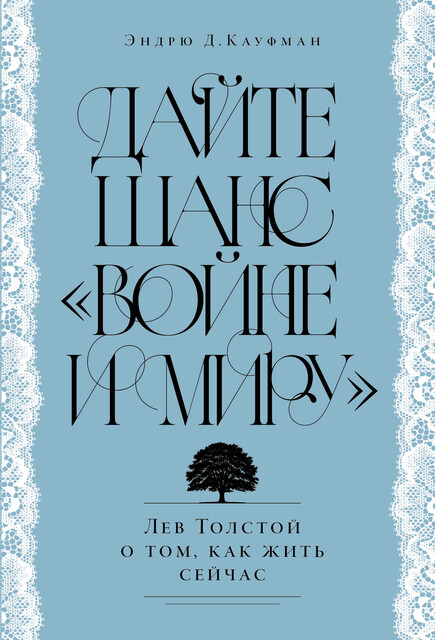
Andrew D. Kaufman
"Give War and Peace a chance": Leo Tolstoy on how to live now"
M.: Alpina Publisher, 2026. — Translated from English — 334 p.
The very title of the book, "Give a Chance to War and Peace," may seem dubious at first glance: one of the greatest recognized masterpieces in the history of literature does not seem to need any "chances" for a long time and, like Gioconda, he can choose who is given the right and deep perception, and to whom "No," I said. But as you read the book, which is based on a thematic principle (chapters "Plans", "Creativity", "Insight", "Success", "Ideals", "Happiness", "Love", "Family", "Courage", "Death", "Perseverance", "Truth"), you do not they follow the chronological sequence), it gradually becomes clear what meaning Kaufman really meant in such a title, and this is not at all a call for a negligent student to force himself to master at least a couple of chapters (what if it drags on?) Tolstoy's opus magnum.
In this case, "Give me a chance" is rather a suggestion to let "War and Peace" not only into your rational mind, coolly analyzing the design of the work, its advantages and disadvantages, the system of characters and ideas, but also into your soul, treat the book as a living interlocutor, even if it causes contradictory feelings. and sometimes — confusion and misunderstanding. This is what the American Slavist seems to have in mind when he writes: "I have given War and Peace a chance to enter my life, and I hope that you will do the same."

Kaufman makes this confession after telling about his acquaintance with the curator of manuscripts at the State Museum of Leo Tolstoy, who shocked the American with such a humane attitude towards Tolstoy's drafts, as if they were her children or grandchildren. Kaufman enthusiastically develops the idea of a museum employee that books are actually alive: "They love when they are not just "studied", but interact with them on a deeply personal level, completely devoting themselves to reading; at the same time, both the space of the reader's "I" and the world of books expand to such an extent that which one is hard to imagine." Instead of destroying a literary work in the process of analysis, splitting it into elements "for the sake of promoting one's ideological or professional attitudes," the American Tolstoy scholar suggests perceiving the book in its entirety as a "living, breathing being."

The State Museum of Leo Tolstoy in Moscow
For Kaufman, interacting with "War and Peace" on a personal level means, first of all, the opportunity to overcome American positivism and pragmatism, with its belief in the possibility of effectively organizing life, putting it on the shelves and building all kinds of plans, strategies and roadmaps on a daily basis, without which further existence seems ridiculous and unthinkable. Life constantly destroys arrogant human plans and makes radical adjustments to them, the author of the book never tires of reminding, starting with a personal recollection of how he began learning Russian at a Michigan high school on the advice of far-sighted businessman parents who anticipated the emergence of new commercial opportunities in the Soviet Union after Gorbachev's arrival, but the decision was made to For purely pragmatic reasons, the decision eventually marked the beginning of Kaufman's "main spiritual journey" of his entire life. The spiritual engine for the Slavist was his love for Tolstoy, who captivated Kaufman with a paradoxical combination of skepticism and hope and the "childish curiosity with which he looks at the world, perfectly understanding who is who and what is what."
Outlining the historical context in which "War and Peace" was created, the researcher notes that the 1860s were a turbulent and troubled time for Russia, which lost the Crimean War and embarked on large-scale reforms, when "the social fabric thinned to the limit." This, according to Kaufman, makes "War and Peace" a useful relevant read in our turbulent times, and not only for Tolstoy's compatriots: "In an era when the United States is experiencing the most serious financial difficulties since the Great Depression, when we too often see the familiar ghost of war, and the future remains vague for many. we are beginning to understand the existential longing of Tolstoy and his characters." Russian Russians, including the famous Arzamas Horror, describe the individual, family, and spiritual context in which the Russian giant of thought (including the famous Arzamas horror) existed, as well as his ambiguous moral character: "The bearded Russian sage, whose works served as a source of inspiration for Mahatma Gandhi and Martin Luther King, did not shy away from either not a bloody bayonet fight, not a brutal duel with an old friend who insulted him, a writer. This moralist, who preached complete abstinence even in marriage, was distinguished by an insatiable sexual appetite and had an illegitimate child with a local peasant girl...> The man who preached sobriety got drunk until he lost consciousness in the company of Gypsies and Bashkirs," and to top it all off, "having warned people against the temptations of fame for many years, he gained worldwide fame by the end of his life."

But it is largely due to the complexity of Tolstoy's nature, Kaufman believes, that we still have a lot to learn "from a writer who made one mistake after another; from a writer who went through the crucible of life and survived." Moreover, a person, including such a great one, is not something static, once and for all determined and unchangeable in good or evil. As proof, Kaufman cites Tolstoy's diary entry: "A man flows, and he has all the possibilities: he was stupid, became smart, was angry, became kind, and vice versa. This is the greatness of man." The American professor quotes Tolstoy's diaries quite often, besides attracting other works of his favorite writer, which he found useful for his students, not only from a philological, but also from a pedagogical point of view. Thus, the most expressive passages of the chapter "Success" are dedicated to Pakhom, the hero of Tolstoy's short story "How much does a man need earth?", written almost 20 years after "War and Peace" and in a certain sense continuing the reflections that Tolstoy gave to the heroes of the novel, about the vanity of earthly goods and the pursuit of career success (the most a striking example is Prince Andrew, rethinking his priorities, lying on the battlefield under the sky of Austerlitz).

Professor Kaufman, not without wit, adapts the wealthy, but still unhappy with the fate of the peasant Pahom for his course "Books behind bars: Life, Literature and Leadership," intended for minors in a correctional center. Moreover, Tolstoy's non-possessive story fell in love not only with delinquent teenagers, but also with quite prosperous members of the organization, which unites company executives under the age of 50, who read about Pakhom as part of the annual education improvement program. Kaufman was told about this by a brother who was part of the organization — it was Tolstoy who prompted him to "talk to colleagues about important things that young leaders rarely talk about publicly."

However, the seemingly paradoxical interest of American managers in Tolstoyism does not surprise Kaufman at all. In essence, he still does not cease to be an American pragmatist, and from this position he sees Tolstoy as a kind of free psychotherapist who helps businessmen with their stressful lifestyles sometimes to relax their souls, maintain inner balance and confidence in a well‑chosen life course: "At some point, like Tolstoy's heroes, we will have to face the understanding that we are part of something bigger than ourselves. We should not think about how to climb to the next step, but about whether we are climbing the ladder and whether we are living the life we would like to live."
Переведено сервисом «Яндекс Переводчик»
