Important inheritance: the Kurchatov Institute talked about cryocomputers and underwater gas carriers
- Статьи
- Science and technology
- Important inheritance: the Kurchatov Institute talked about cryocomputers and underwater gas carriers


The Kurchatov Institute National Research Center spoke about the advanced scientific developments that are currently being developed in Russia. This includes the next generation of nuclear submarines for civil and military purposes, computer technology that works on new physical principles, and the innovative use of thermonuclear reactors. The report by SIC President Mikhail Kovalchuk was dedicated to the anniversary of the birth of Academician Anatoly Alexandrov, whose work made these achievements possible in many ways. The presentation took place at a joint meeting of leading scientific and expert structures: the Presidium of the Scientific and Expert Council of the Russian Maritime Collegium, the Presidium of the Russian Academy of Sciences, and the Presidium of the Scientific Council of the Kurchatov Institute Research Center. The Atomic Marshal exhibition dedicated to the academic's scientific feat was also opened at the Alexandrov House of Scientists.
Alexandrov's Legacy
The capital celebrated the 123rd anniversary of the birth of the outstanding physicist, three‑time Hero of Socialist Labor, academician Anatoly Alexandrov. The key event was a meeting at the Kurchatov Institute's House of Scientists, which brought together representatives of the Presidium of the Scientific and Expert Council of the Russian Maritime Collegium, the Russian Academy of Sciences and the Scientific Council of the Kurchatov Institute Research Center.
In his keynote address at the meeting, NIC President Mikhail Kovalchuk presented an overview of the most promising Russian research projects. "Russian scientists are at the forefront of modern science in many areas. In particular, in the creation of space engines with a nuclear power source, nuclear shipbuilding and the development of new—generation computing equipment," Mikhail Kovalchuk noted.
At the same time, he stressed that many of the current achievements were laid down by great predecessors. One of them is academician Anatoly Alexandrov.
— If you have a strategy, you win the future. Anatoly Pavlovich was such a strategist who looked decades ahead. The reality we live in is largely built by him. We have to create a new future based on this colossal foundation," Mikhail Kovalchuk added.
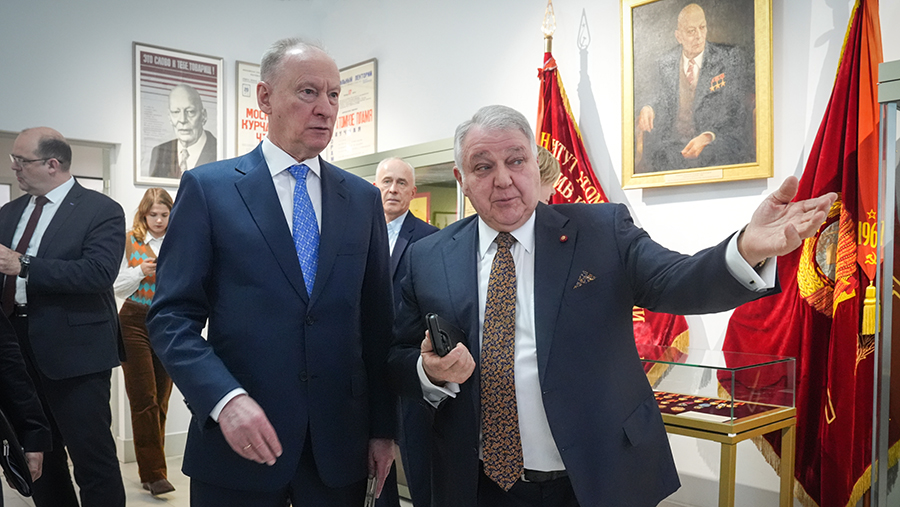
Nikolai Patrushev, Assistant to the President of Russia and Chairman of the Russian Maritime Board, emphasized Anatoly Alexandrov's contribution to the development of the fleet in his speech.
— Under his scientific leadership, three generations of nuclear submarines were created. This allowed our country to achieve strategic force parity with the United States. Alexandrov also initiated the use of atomic energy for peaceful transportation purposes. In total, eight nuclear icebreakers and a lighter carrier were built with his participation, which provided leadership in the development of the Arctic," he said.
"Alexandrov was able to unite talented people around him, lead them and implement large—scale projects," said Gennady Krasnikov, President of the Russian Academy of Sciences. — So were other scientists of that generation — Mstislav Keldysh, Igor Kurchatov… These people opened new chapters in the history of mankind, laying the foundation for the development of nuclear, space and other industries.
For power engineering and the navy
As Mikhail Kovalchuk emphasized in his report, Russia is the only country that possesses a set of technologies for creating "nature-like" nuclear energy. We are talking about a closed cycle, where waste from energy production becomes fuel again. This project is currently being developed under the scientific supervision of the Kurchatov Institute in cooperation with Rosatom structures.
In total, more than 650 nuclear reactors for various purposes have been built in our country. And now Russian specialists are turning a new page by designing an electrical installation for the lunar station.
This and similar projects are based on advanced technologies for the direct conversion of nuclear energy into electricity without an intermediate coolant, Mikhail Kovalchuk noted. They make it possible to create compact and reliable power supplies for long-term space exploration and planetary exploration missions.
Such technologies are also in demand in the navy. In particular, the Kurchatov Institute, together with a number of Russian enterprises, is currently designing new, fifth-generation nuclear submarines. The engines installed on them based on the principles of direct energy conversion will reduce vibrations and increase stealth.
New nuclear—powered ice-class vessels are also being built in Russia - the "descendants" of the first nuclear-powered vessel Lenin, which was created by Academician Alexandrov. Among them is the scientific research vessel Akademik Evgeny Velikhov, a carrier of robotic complexes and underwater vehicles. His tasks will include year-round exploration of the Arctic seas. Another significant project is the creation of an underwater nuclear gas carrier.
Mega installations and computers of the future
The program to create a network of neutron and synchrotron sources can also be considered a continuation of the projects initiated by Academician Alexandrov. According to Mikhail Kovalchuk, the Siberian Ring Photon Source (SKIF) in Novosibirsk and the first 20 experimental stations of the PIK Research Nuclear reactor at the Kurchatov Institute Research Center in Gatchina will be commissioned this year.
Another area in the development of which Alexandrov played a major role is microelectronics. "For example, one of the enterprises within the Kurchatov Institute manufactures trusted chips and processors for any purpose — from oil exploration to space exploration," Mikhail Kovalchuk said.
Today, specialists from the Kurchatov Institute Research Center are developing innovative solutions in the field of power electronics, where diamonds are used instead of silicon. These technologies can withstand higher voltages and temperatures. Scientists have also made progress in the development of cryocomputers, devices in which the computing infrastructure consists of superconductors cooled to almost absolute zero. The signal is transmitted through them using quantum effects without energy loss. Work is underway to create neuromorphic computers, devices that reproduce the principles of the brain. The use of neuromorphic technologies will make it possible to fundamentally reduce the energy consumption of the "computers of the future".
The Atomic Marshal
On the occasion of the academician's birthday, an exhibition dedicated to his life and scientific heritage was opened in the House of Scientists of the Kurchatov Institute, named after Anatoly Alexandrov. The exposition builds a chronology of the scientist's fate through ten thematic tablets. Each of them is a unique stage of a long journey: rare photographs, archival documents and other evidence of the era. Together, they form a holistic account of Alexandrov's scientific feat and its significance for the development of Russian science.
The concept of the exhibition is built around three significant anniversaries for the scientist:
- The 90th anniversary of the start of work on demagnetization of ships — this technology saved dozens of ships and thousands of lives during the Great Patriotic War, and Academician Alexandrov himself called it the most important work of his life.;
- The 80th anniversary of the presentation of Anatoly Alexandrov's historic report, which marked the beginning of the program for the creation of nuclear power plants for the navy and aviation;
- The 70th anniversary of the launch of the shipboard nuclear reactor test stand in Obninsk is a key event in the creation of the nuclear fleet.
The exhibition does not just record the facts of Alexandrov's biography — it allows you to see the personality behind them. The academician combined the talent of a researcher, an organizational gift, a breadth of interests and a great human charm. Through the materials of the exhibition, visitors have the opportunity to touch the history of science in its human dimension.
Переведено сервисом «Яндекс Переводчик»
