Break and build: icebreaker attachment will ensure river navigation even in cold weather
- Статьи
- Science and technology
- Break and build: icebreaker attachment will ensure river navigation even in cold weather


Russian engineers have proposed a project for a modular icebreaking attachment capable of navigating even frozen rivers. Unlike traditional river icebreakers, which leave behind a narrow channel that is quickly covered with ice, the new system will allow for a wide waterway through which vessels can pass for a long time, the authors of the invention reported. Currently, river transport may be delayed due to thick ice, and some berths are closed. According to experts, the introduction of technology could make navigation easier in such conditions.
Modular icebreaking console
The author of the alternative icebreaker design proposed a project for a modular attachment designed to ensure river navigation in winter. The technology can be a solution to delays in river transport due to the thick ice layer. The device consists of two modules: connected together, they pave a wide passage in the riverbed, and separately they are used to clear the approach to the pier, explained the author of the project, adviser to the All-Russian Society of Inventors and Innovators Yuri Chashkov.
— The icebreaker tugboats used, in particular, on the Moskva River are too narrow: the passage they leave behind is quickly covered with ice again. Our console can be powered by the same tugboats, it forms a 15-20 m wide corridor — this is enough for two river trams to separate. At the same time, the ice floes shift to the sides under the ice cover, so that the main channel remains for a long time. And for work at the pier, the console is divided in half so that it is convenient to create wormwood for mooring," the inventor explained.
The use of the prefix will also reduce fuel costs for tugboats, which use a lot of energy to push and crush the ice. It will take several months to build a working copy of the system. And its cost will range from 15 million to 30 million rubles, depending on the specific river on which it will be used.
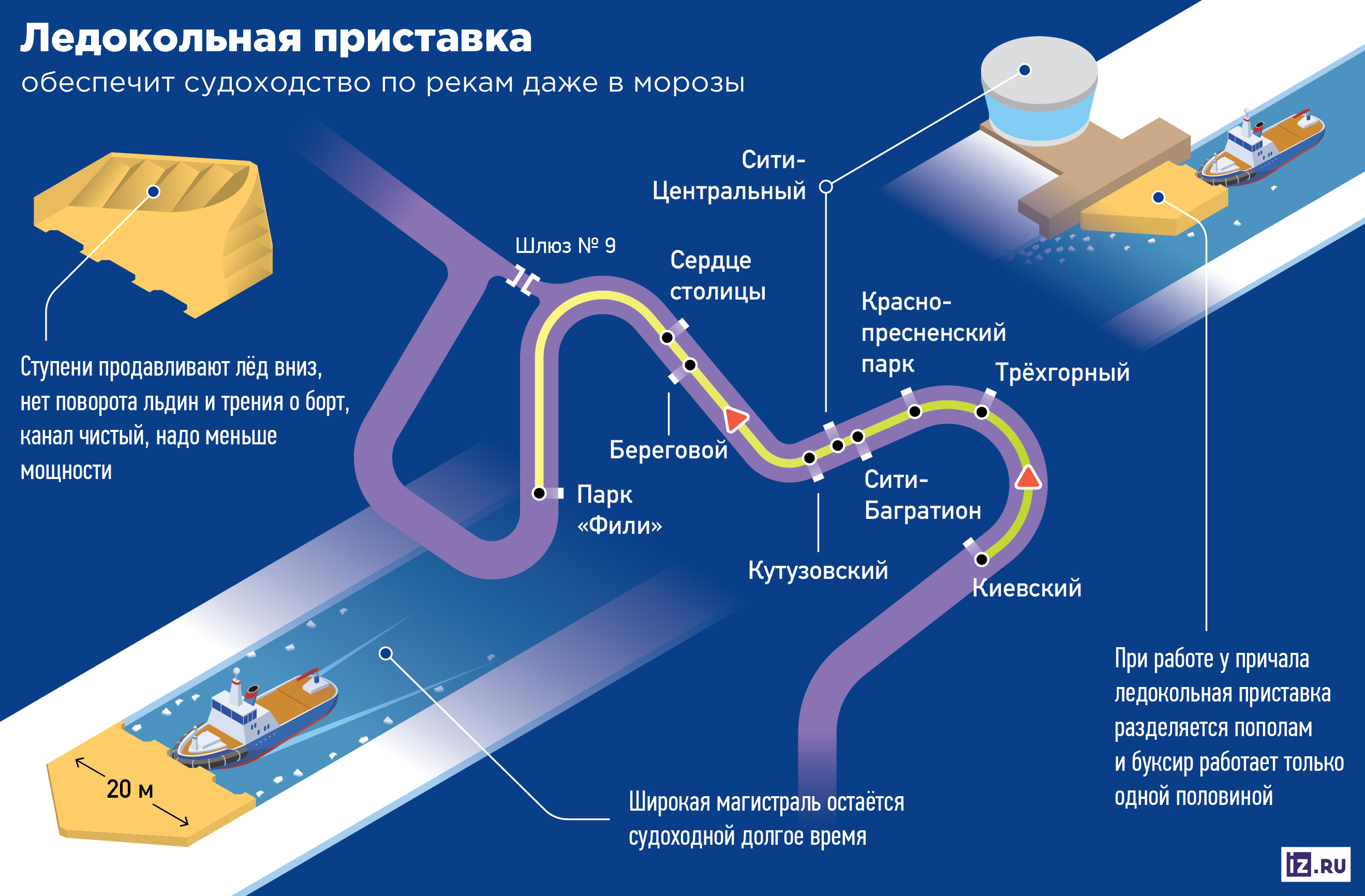
The difficulties caused by the ice situation in the operation of regular river electric vessels plying the Moskva River have been reported by the media since the beginning of February. Despite the operation of five icebreakers, problems arise during mooring. Ships are often unable to lower a special ramp for passengers due to accumulated ice. As reported to Izvestia in the Information Center of the Moscow Transport Complex, restrictions on the operation of berths remain.
The idea of using icebreaking consoles on rivers appeared back in the Soviet Union. Such a device was first created in the 1970s. Until recently, the technology was used at the Nizhnekamsk reservoir to pave a path through ice 70-90 cm thick. The developer proposed the modern version a few years ago, and now he has refined his design, making it more versatile due to the separable modular system.

Technologies for shipping in winter
According to Vasily Povazhny, a researcher of the Arctic and a participant in many ice expeditions, an icebreaker of a special design is already being used in the port of St. Petersburg, which leaves behind a wider and cleaner clearance compared to conventional analogues. And it really makes the work of ship crews easier.
— From an engineering point of view, a composite structure with a prefix is by definition less reliable than a single-component ship. But the main problem is that it is almost impossible to make a channel that would last for a long time in the conditions of the river flow. This can only be imagined on the lake. The hike on the Moskva River will need to be supported all the time," he said.
When developing technologies for navigation in winter, it is necessary to take into account the hydrodynamics of a particular reservoir. The attachment drives fine ice under a solid cover, but a strong current is able to wash these fragments back into the channel, said Alexander Berlev, a representative of the Pella shipyard.
— In the Moskva River, where the current is quite calm and the water area allows maneuvering, the use of such systems will be very effective. However, the situation is different on rivers such as the Neva. In St. Petersburg, tugboats have to constantly clear the way before large-tonnage vessels enter, but due to the powerful flow, the channel is instantly clogged with ice chips," he explained to Izvestia.
Nevertheless, the price of the device of 30 million rubles is small in the industry, and the opportunity to use the modernized Soviet experience gives a good chance of success of the project in suitable climatic and geographical areas, the specialist concluded.
Переведено сервисом «Яндекс Переводчик»
