That's the question: did Mark Rozovsky assign the role of Hamlet to an actress


An actress in the role of Hamlet. This is exactly the move Mark Rozovsky proposed in his new interpretation of Shakespeare's masterpiece, shocking both the invited performer and the audience. How the director explains his idea, why he decided to take the risk and what other surprises await the audience in the new production of the theater "At the Nikitsky Gate" — in the material of Izvestia.
Princess Elsinore
Playing Hamlet today means going on stage after Vysotsky, Smoktunovsky, and Paul Scofield; staging Shakespeare's most famous play means competing with Kozintsev, Lyubimov, Peter Brook, and thousands of its interpretations around the world.
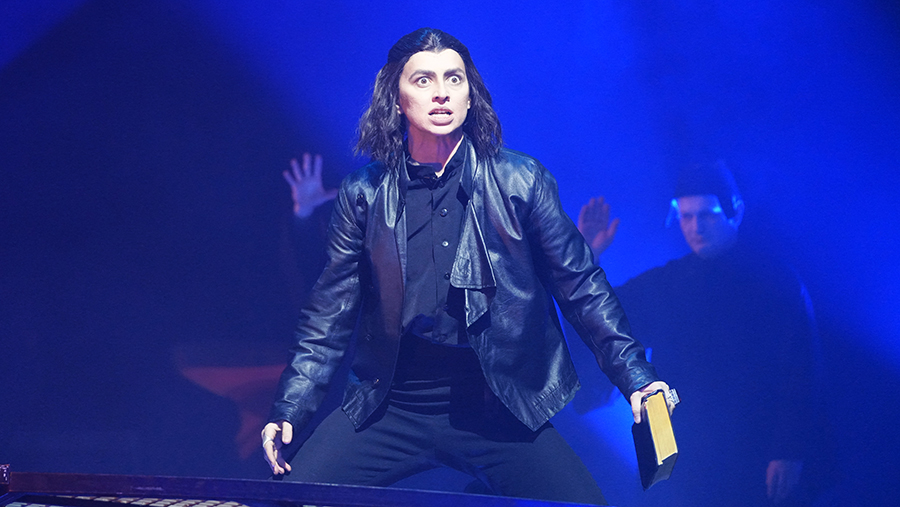
Mark Rozovsky has his own interpretation, and this is one of the highest-grossing performances of the Nikitsky Gate Theater. "The New Hamlet" is an updated version of it, where most of the cast has been replaced and the meaning of the tragedy has been sharpened. The director believes that great texts are not museum exhibits, but living, pulsating entities. And he proves this theorem to the audience radically by inviting actress Yana Prygankova to the main role.
"Of course, my first reaction was shock," the actress confessed to Izvestia. — But our artistic director and director always suggests non-standard solutions and wants the artist to go beyond his role. He says: we need to take a wrestling grip and do it. I never give up roles and try to complete any task. Especially when Mark Grigorievich himself believes in me.
Rozovsky himself explained to Izvestia that such an artistic decision was not shocking, but an attempt to penetrate the spiritual substance of the character.
— It is important to understand who Hamlet is in the perception of people of the 21st century and even earlier, — he specified. At the beginning of the 20th century, English actor and director Edward Gordon Craig staged this play at the Moscow Art Theater at the invitation of Konstantin Stanislavsky. He surprised the Russian artists by saying, "Hamlet is not a man. It's spirit, and everything else in Elsinore is matter."
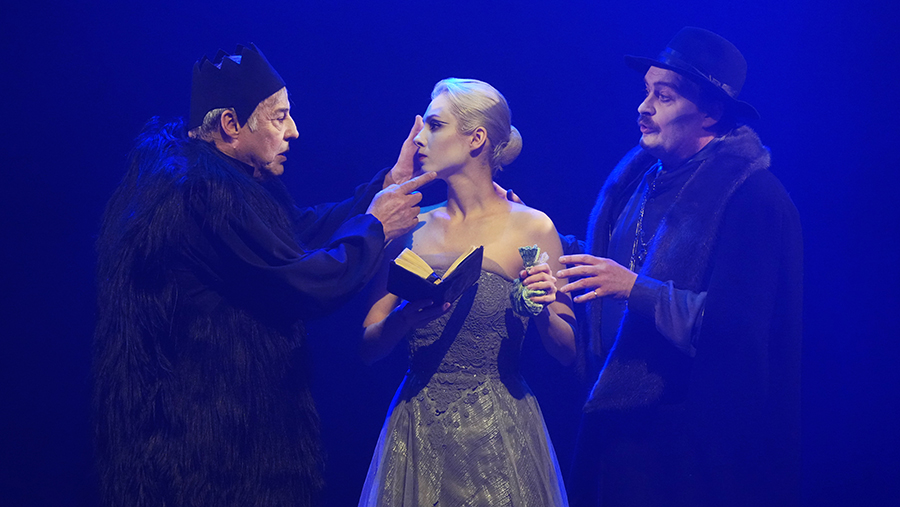
Rozovsky makes it clear: "Prygankova is not playing a female Hamlet, but a young man who matures during the performance and becomes a courageous being." This idea doesn't sound like a fashionable theatrical ploy, but like a real dramatic move that sets the whole action in motion. At the same time, one can see here a reference to the theatrical realities of Shakespeare's time: then, on the contrary, even the female roles were played by men. And it could hardly have caused any misconceptions. After all, until the middle of the 17th century, women were officially forbidden to perform on stage in England.

Iron circles and the bloody backstage
After the second bell, the audience is hurriedly herded into the hall and seated in their seats. The lights are on, and there are two iron circles on the stage. One is fixed on the floor, the second hangs over it vertically, on the left is a bright red curtain, on the right is a metal spotlight on a tripod.
While the audience is finishing reading the information in the program and checking whether the phones are turned off, suddenly actors — not the heroes of the play - walk through the auditorium onto the stage. In the play, they will then present a traveling troupe, which Hamlet uses as a tool to expose Claudius and Gertrude. And only at this moment the third bell rings. The lights go out. Shakespearean characters appear on the stage.
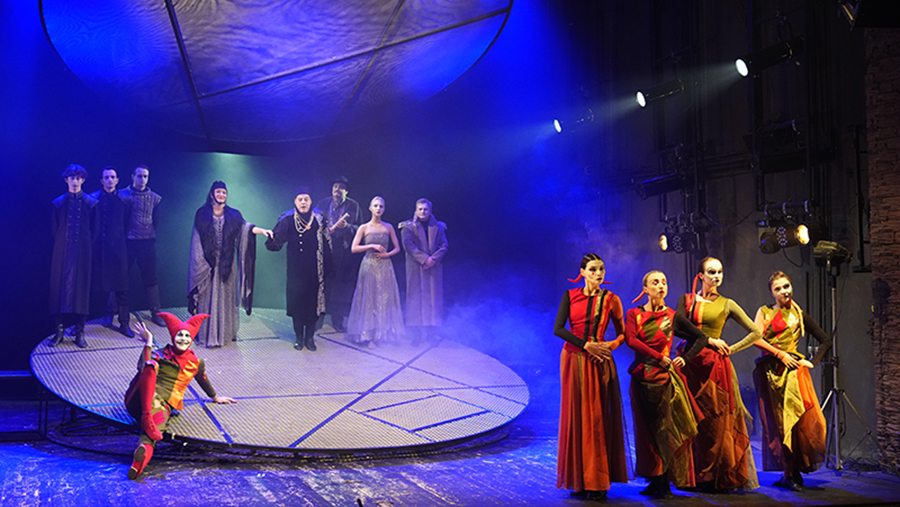
Almost everyone knows the text of "Hamlet", and the famous "to be or not to be" has long gone down to the people. But the performance is not designed for superficial recognition. There is not a single random detail or decorative symbol here: every object, object and gesture has meaning. And this is a great achievement of the set designer Alexander Lisyansky.
The first thing that catches the eye is makeup. All the characters, with the exception of Hamlet, hide their faces under a layer of whitewash. It is impossible to see the true emotions behind the paint, and therefore the soul. The only "clean" one is the main character.
Even Ophelia, whom Hamlet was chasing into the wings, eventually died. Curiously, her coffin was a giant metal rose. It was with this flower in her hands that she talked to the hero every time. Their love also remained cold, with a taste of iron in their mouths.
And the two moving steel circles become a symbol of the cyclical nature of life, violence, betrayal, and the endless repetition of identical scenarios from which it seems impossible to escape.
The words are not of a boy, but of a husband
Mark Rozovsky significantly updated the cast of his hit, but he set the task of increased complexity specifically for Yana Prygankova. At the beginning of the performance, the viewer experiences an ambivalent feeling: he sees that in front of him is an actress who plays a male role and corresponds to the stage image.
In the first scenes, the mind is still trying to grasp the familiar features, but in the course of the action, it is the male character who looms in front of the audience. His gait becomes harsh, his gaze heavy, and the young man turns out to be a cruel and courageous man overcome with pain and thirst for revenge.
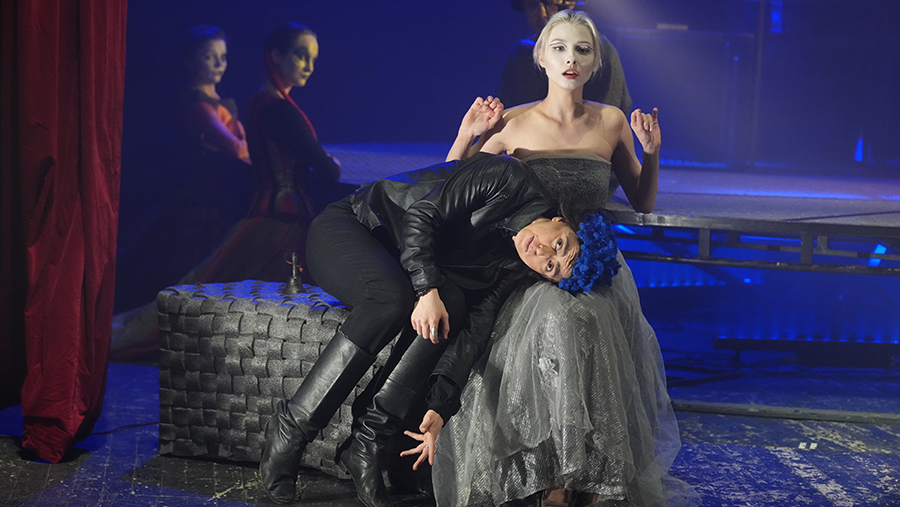
The scenes of Hamlet and Ophelia deserve special attention. Perhaps they are the most dangerous in the play. But Mark Rozovsky maintains a balance. There is no "shock for shock's sake" effect, vulgarity and ambiguity. In many ways, their relationship takes place in words, not allowing for free interpretation by the audience. The director does not argue with tradition — he talks to it on equal terms.
"The New Hamlet" is a poetic and sometimes grotesque, but at the same time internally assembled and conceptually verified performance. There are no random effects and empty provocations here: every decision is motivated, any deviation from the canon has a semantic basis. Of course, not everyone will accept such directorial decisions. But Mark Rozovsky calmly replies to them: "Come and see."
Переведено сервисом «Яндекс Переводчик»
