
Expiration date: the UN called for a flexible format of arms control

The world is on the verge of a nuclear vacuum. A few days before the START Treaty expires, the UN indicated the highest risk of using this type of weapon in decades. The office of the Secretary General of the organization told Izvestia that now it is necessary to create an arms control regime appropriate to the rapidly changing situation. So far, there is no constructive dialogue on this topic between Moscow and Washington. The other members of the "nuclear five" are in no hurry to join the negotiations. But experts from Russia and NATO countries are discussing the future of strategic arms control. The most likely option may be data exchange with less stringent quantitative restrictions.
The world is coming to the end of the START Treaty
The year 2026 is rapidly approaching February 5 — it is on this day that the Strategic Offensive Arms Reduction Treaty (START or START-3), signed by Dmitry Medvedev and Barack Obama on April 8, 2010, expires.

Barack Obama and Dmitry Medvedev during the signing of the START-3 Treaty in Prague
The UN considers this a very "dark moment for peace and security." Indeed, if the parties do not reach an agreement in the coming days, for the first time in more than half a century, the world will face the absence of any mandatory restrictions on the strategic nuclear arsenals of the Russian Federation and the United States, the two states with the vast majority of the world's stockpile of this type of weapon.
— This gap between decades of achievements could not have happened at a worse time — the risk of using nuclear weapons is now the highest in recent decades. And yet, even in this moment of uncertainty, we must look for hope. This is an opportunity to reboot and create an arms control regime appropriate to the rapidly changing environment," UN Secretary General's deputy spokesman Farhan Haq told Izvestia.

On September 22 last year, at a meeting with the Security Council, Russian President Vladimir Putin made an important statement: after the START Treaty expires, Russia is ready to adhere to quantitative restrictions for another year. The head of the Russian Federation made a reservation: this measure is viable only if a similar step is taken by the United States. All this time, the American administration has been sending mixed signals. At first, Donald Trump limited himself to demonstrative approval of the proposed initiative, and three weeks ago he used his favorite technique — intrigue. "If it expires, it will expire," the US president told reporters on January 9 about the START Treaty. "We'll just make a better agreement."
So far, we can only guess what "better" means in the understanding of the head of the White House. Moreover, there is no constructive dialogue between Moscow and Washington on the START Treaty.

— Washington does not consider this agreement useful for itself. And the practice of recent decades (withdrawal from missile defense, the INF Treaty, etc.) indicates that the United States has fundamentally adjusted its approach to policy in this extremely sensitive area," Natalia Kharitonova, a professor at the RANEPA under the President of the Russian Federation, chief researcher at the Russian State University of Economics, pointed out in a conversation with Izvestia.
Trump's other statements also add fuel to the fire. At the end of October 2025, just before meeting with Chinese leader Xi Jinping at the APEC forum, the American president announced the resumption of nuclear testing after more than 30 years. This does not mean a direct correlation with the expiration of the START Treaty, but an alarming trend is emerging. Having stirred up the entire world community, a few days later he confirmed his intentions, but again it is unclear whether it was about nuclear explosions or test launches of missiles with nuclear installations. In response, Vladimir Putin instructed to study the feasibility of such tests by Russia.
As a result, there may be a situation when negotiations on the START Treaty are not underway, and nuclear tests will begin. The Comprehensive Nuclear Test Ban Treaty Organization (CTBTO) clarified to Izvestia that they could not force events in any way.
"The organization is not authorized to mediate arms control agreements, including regarding the status of other agreements or bilateral commitments, such as START—3," they said.

However, do not exaggerate. As the Financial Times reported on February 2, citing a White House official, the Donald Trump administration is still interested in maintaining restrictions in this area.
"It is encouraging that the presidents of both countries have made it clear that they understand the destabilizing effects of the nuclear arms race and the need to prevent the return of rampant proliferation of nuclear weapons," Farhan Haq told Izvestia. — Now the world expects the Russian Federation and the United States to move from words to deeds. The Secretary-General urges both States to return to the negotiating table immediately and agree on a coherent framework that will restore verifiable constraints, reduce risks, and strengthen our common security.

What if the START Treaty is not extended
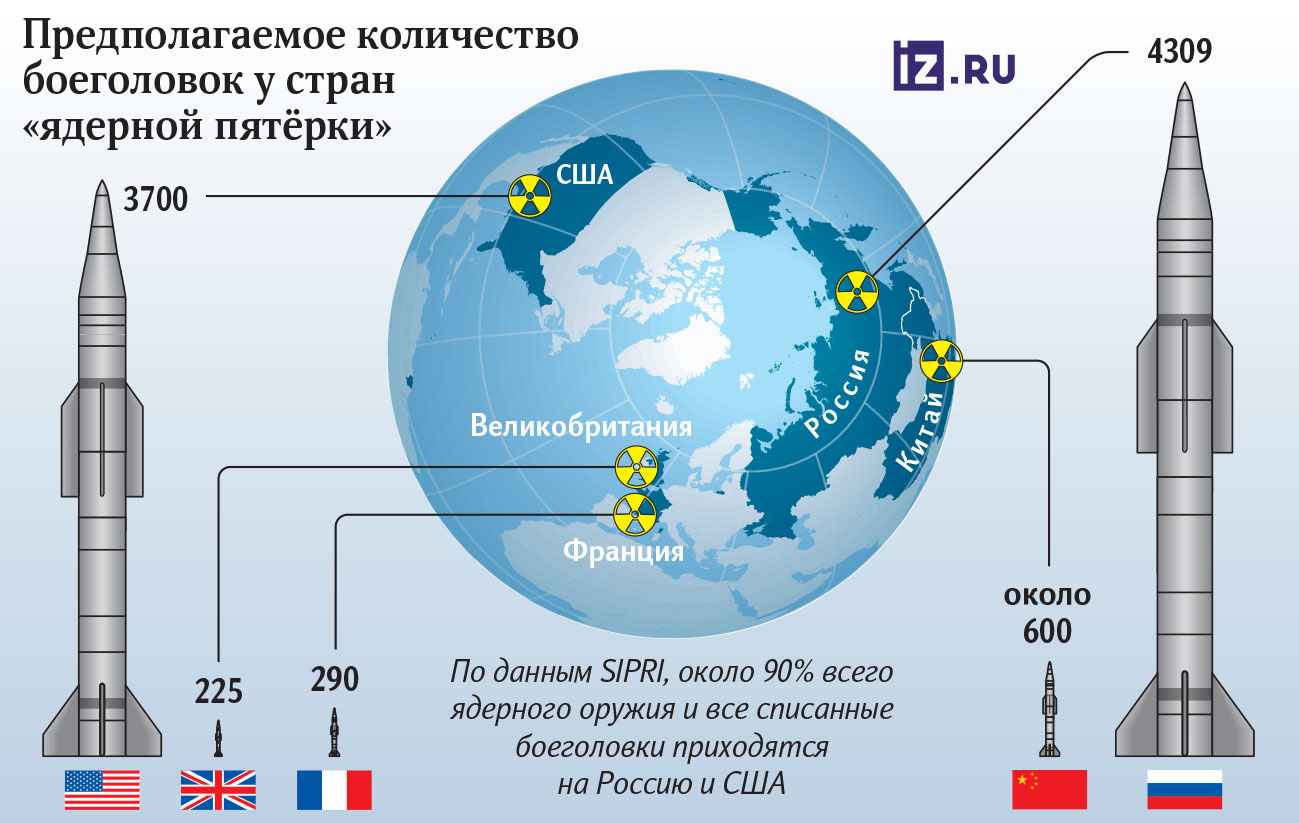
The expert community is confident that the START Treaty in its current form no longer meets the realities. It is not enough to comply with quantitative restrictions for Russia and the United States, it is necessary to involve the entire "nuclear five" (or P5). And there is a conflict of interests here: Moscow has repeatedly stressed the need to take into account the combined nuclear potential of NATO, which is provided not only by the United States, but also by Great Britain and France. Now it exceeds 2,000 warheads, while Russia has almost one and a half times fewer of them.

Washington is clinging to China's amazing productivity. According to the Stockholm International Peace Research Institute (SIPRI), the republic is increasing its potential the fastest, with 100 warheads per year. According to American analysts, China will reach approximate parity with the United States and Russia in terms of the number of deployed nuclear warheads by the mid-2030s. However, now the Chinese arsenal is still incomparable with the Russian or American arsenal, which official Beijing has repeatedly drawn attention to.
London and Paris are understandably not active. At the end of January, the French Foreign Ministry, taking advantage of Chinese rhetoric, stated that they saw no point in joining the negotiations, since the country's nuclear arsenal was not comparable to Russia and the United States. The British comment on nuclear disarmament very obliquely, most often pointing to the bilateral nature of the START Treaty. However, London continues to participate in discussions on strategic security and non-proliferation of nuclear weapons, including in dialogue with Russia within the framework of the P5 process, the Embassy of the kingdom in Moscow explained to Izvestia in November 2025.
— I don't think that the UN or any other international organization will be able to play a significant role in finding solutions to this issue. The START treaty series is the result of bilateral efforts by the two States, and after a sensitive crisis that almost led to an exchange of nuclear strikes (the Caribbean Crisis). Accordingly, this practice can only be continued through the efforts of Moscow and Washington. Those countries that the United States and the Russian Federation would like to see as signatories are not in the mood to participate in this practice," Kharitonova said.

It is obvious that the situation with the START Treaty has reached an impasse. Therefore, a fundamental new solution is needed.
— The question is no longer about an extension, but about a possible modification of the very concept of limiting nuclear weapons. It is unclear because everyone has different approaches: we, the Americans, the Chinese, the French and the British," diplomat Andrei Baklanov told Izvestia.

If the parties do not seem ready to seek common ground at the official level, at least possible formats are being proposed at the expert level. For example, online discussions are underway between the Institute of the USA and Canada and Stanford, various initiatives are being discussed between Russian specialists and a group of analysts from NATO countries, Andrei Kortunov, an expert at the Valdai Club, tells Izvestia. The following aspects are on the agenda: the possibility of an informal extension, the principles of the new START-4 treaty, verification problems, taking into account the potentials of third countries and the Golden Dome missile defense system — Trump's attempt to revive the Reagan idea of American mega-defense will seriously complicate compliance with the START Treaty clauses.
One of the most viable options may be to focus on mutual information with more flexible quantitative restrictions, says Dmitry Stefanovich, a researcher at the IMEMO RAS Center for International Security.

— If and when we reach new agreements, I think there will be less strict quantitative limits. In addition, it is possible to agree on more detailed and public information provided in various UN formats on the current state and prospects for the development of strategic forces. It is more likely that there will be some kind of mutual data exchange, that is, such an intermediate step," he argues.
According to Stefanovich, in the absence of restrictions, it will be easier to "pull up" the third nuclear powers — China, France, and the United Kingdom. Perhaps some solutions will be developed or announced at the NPT Review Conference, which is scheduled for April-May 2026.
Переведено сервисом «Яндекс Переводчик»
