- Статьи
- Science and technology
- Under sardine: Far Eastern fish lipid will help restore the brain after injury

Under sardine: Far Eastern fish lipid will help restore the brain after injury

A substance derived from omega—3 fatty acid, which is found in Far Eastern sardines, reduces neuroinflammation and promotes the restoration of brain structures after mild traumatic brain injury, scientists told Izvestia. In addition, in animal studies, treatment using this complex of substances was accompanied by a decrease in anxiety behavior. The compound may become the basis for drugs used in the treatment of the effects of head injuries. For more information, see the Izvestia article.
Sardine substances help to heal the brain
Scientists from the A.V. Zhirmunsky National Scientific Center for Marine Biology of the Far Eastern Branch of the Russian Academy of Sciences investigated the effect of N-stearidonoylethanolamide, an omega-3 derivative, in a model of mild traumatic brain injury in mice.

Simulation of mild traumatic brain injury in a mouse
The source for synthesis was the lipid extract of the Far Eastern sardine Sardinops melanostictus, better known as iwasi. The researchers assessed the animals' behavioral responses, the level of neuroinflammation, the activity of neurogenesis, the process of forming new neurons, as well as the structure and molecular composition of synapses in the hippocampus several weeks after injury.
The hippocampus is a paired, curved structure in the brain, key to memory, learning, emotion, and spatial navigation, responsible for translating short—term memories into long-term ones. Synapses in the hippocampus are specialized interneuronal connections that provide the transmission of nerve impulses necessary for learning, the formation of episodic memory and cognitive processes. The key feature is considered to be synaptic plasticity, that is, the ability to change one's strength and effectiveness in response to activity, which serves as the basis for learning and memory.
According to scientists, mild traumatic brain injury remains one of the most common forms of brain injury and often leads to delayed emotional and cognitive impairments. Moreover, even in the absence of pronounced neuron death in the hippocampus, long-term disorders of the neuroinflammatory response and synaptic plasticity may persist. Astrocytes, neuroglial cells, play an important role in these processes. After injury, they become reactive and can disrupt the functioning of synapses and neural networks.
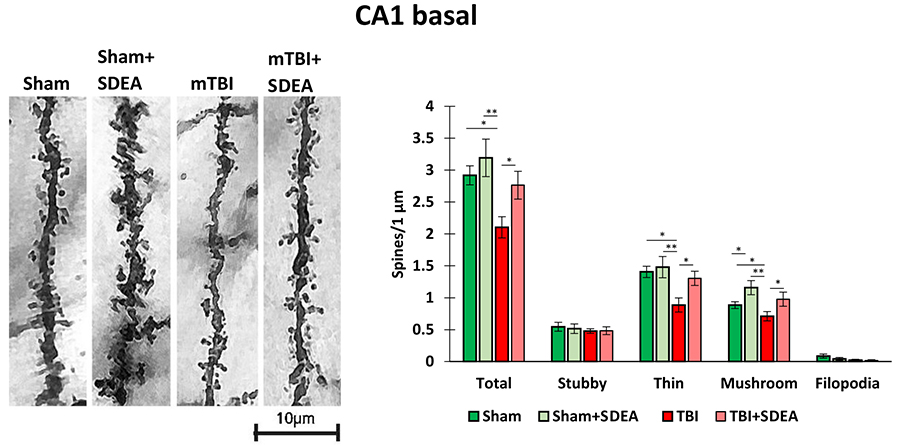
It turned out that after traumatic brain injury, the animals developed pronounced astrocyte reactivity and decreased the density of dendritic spines, structures that transmit signals between neurons, in the pyramidal neurons of the CA1 region of the hippocampus. In addition, the expression of proteins responsible for the stability and functioning of synapses decreased, as well as the activity of a gene associated with the experiment-dependent plasticity of neural networks. At the same time, the introduction of lipid led to a weakening of astrocytic activation, restoration of synaptic structure, and normalization of a number of molecular markers of plasticity.
Behavioral tests showed that the treatment also reduced anxiety behavior in animals after injury, while basic cognitive functions such as recognizing new objects were preserved.

— Our results show that omega-3 ethanolamides are able to simultaneously affect several key links of post-traumatic disorders: neuroinflammation, synaptic structure and functional activity of neural networks. This makes such compounds promising candidates for the development of multi-purpose approaches to the treatment of the effects of mild traumatic brain injury," said Anna Tyrtyshnaya, senior researcher at the A.V. Zhirmunsky National Scientific Center for Marine Biology of the Far Eastern Branch of the Russian Academy of Sciences.

What is the danger of minor brain injuries?
Any harmful factor — injury, even mild, infection, intoxication, stress, or even a banal lack of sleep — is accompanied by activation of brain microglia and triggering the process of neuroinflammation, which inevitably leads to delayed death of neurons, market expert at NTI Neuronet, scientific director of the FEFU medical complex, chief researcher at the Sechenovsky Institute of Personalized Oncology told Izvestia. Igor Bryukhovetsky, Professor of the Russian Academy of Sciences.
According to him, the mechanism is quite simple: microgliocytes— the defenders of the brain, begin to secrete endoperoxides, nitric oxide, reactive oxygen species and inflammatory cytokines that support the inflammatory process. This leads to the oxidation of the lipid membranes of cells, which lose their properties like rancid oil, and as a result, the cells die.

Photo of the authors of the study against the background of an installation for modeling mild TBI
— The process is long, stretched over decades. It inevitably leads to a decrease in the number of neurons, a decrease in the area of intercellular contacts, a deterioration in the production of mediators, a disruption in the formation of new neurons and neural connections, and eventually a loss of intelligence," said the professor. — The life of living creatures in the ocean is associated with very strong stress, which exists always and everywhere. By adapting to these conditions, they have developed unique brain protection mechanisms, including through the presence of special substances.
According to the scientist, the described compounds act as a very powerful antioxidant and neuroprotector that suppresses neuroinflammation and protects the brain. Therefore, the use of the substance is extremely promising.
N-stearidonoyl ethanolamide is no longer just a "raw material" from a set of fats, as in Soviet fish oil or popular dietary supplements, but a specific signal molecule, an omega—3 derivative. It can be standardized, precisely dosed and studied as a medicinal candidate, rather than as a dietary supplement, said Albert Rizvanov, head of the Center for Excellence "Personalized Medicine" at Kazan (Volga Region) Federal University, corresponding member of the Academy of Sciences of the Republic of Tatarstan.

— Hence the difference in the logic of application: Soviet fish oil is about general prevention and closure of deficiencies, and "one molecule" is about potentially more targeted effects on specific mechanisms (for example, inflammation and cellular signaling pathways), which is fundamentally important if we are discussing the consequences of mild traumatic brain injury, — said the expert.

The studied compound can become the basis for drugs used in the treatment of the effects of mild traumatic brain injury, one of the most common forms of brain damage, which often leads to delayed emotional and cognitive impairments, said the head of the Smart Supply Chain segment of the FoodNet working group NTI Sergey Kosogor.
— It can be assumed that studying the behavioral effects and the effect of N-stearidonoylethanolamide in the future may become the basis for the prevention of other diseases such as depression and neurodegenerative disorders such as Alzheimer's disease, Parkinson's disease or dementia. This makes research especially promising, since the fight against neurodegenerative disorders is of critical importance for maintaining the quality of life," the expert said.
The results of the study, supported by a grant from the Russian Science Foundation (RSF), are published in the International Journal of Molecular Sciences.
Переведено сервисом «Яндекс Переводчик»
