Nuclear invitation: Russia demands London and Paris to join in disarmament


The new Strategic Offensive Arms Treaty (START Treaty) should include the full potential of NATO, including those of France and the United Kingdom, not just the United States. Paris and London should join negotiations on nuclear disarmament, and not in the indefinite future, but as things move towards a new agreement, Mikhail Ulyanov, Permanent Representative of the Russian Federation to international organizations in Vienna, told Izvestia. However, Western countries have not yet entered into a dialogue, although there are less than two weeks left before the START Treaty expires. At the same time, experts are confident that the United States will only worsen its strategic position by abandoning the existing framework.
Start-up replacement agreement
The START Agreement will expire on February 5. There is no dialogue between the Russian Federation and the United States on its extension yet.
— Although, let me remind you, Russia offered to extend the key quantitative parameters of the START Treaty for at least a year. There is no answer," Mikhail Ulyanov, Russia's permanent representative to the international organizations in Vienna, told Izvestia.
In September 2025, Vladimir Putin announced that Moscow was ready to voluntarily comply with the START Treaty limits after the expiration of the contract. But only if the United States does the same. Donald Trump called it a good idea, but it did not go beyond a positive assessment of the Russian initiative. Therefore, there is a high risk that the agreement signed in 2010 by Dmitry Medvedev and Barack Obama will cease to exist. This seems especially realistic considering Trump's other statement. "It will expire, so it will expire. We'll just conclude a better agreement," the head of the White House commented on January 8, approaching the end of the START Treaty.
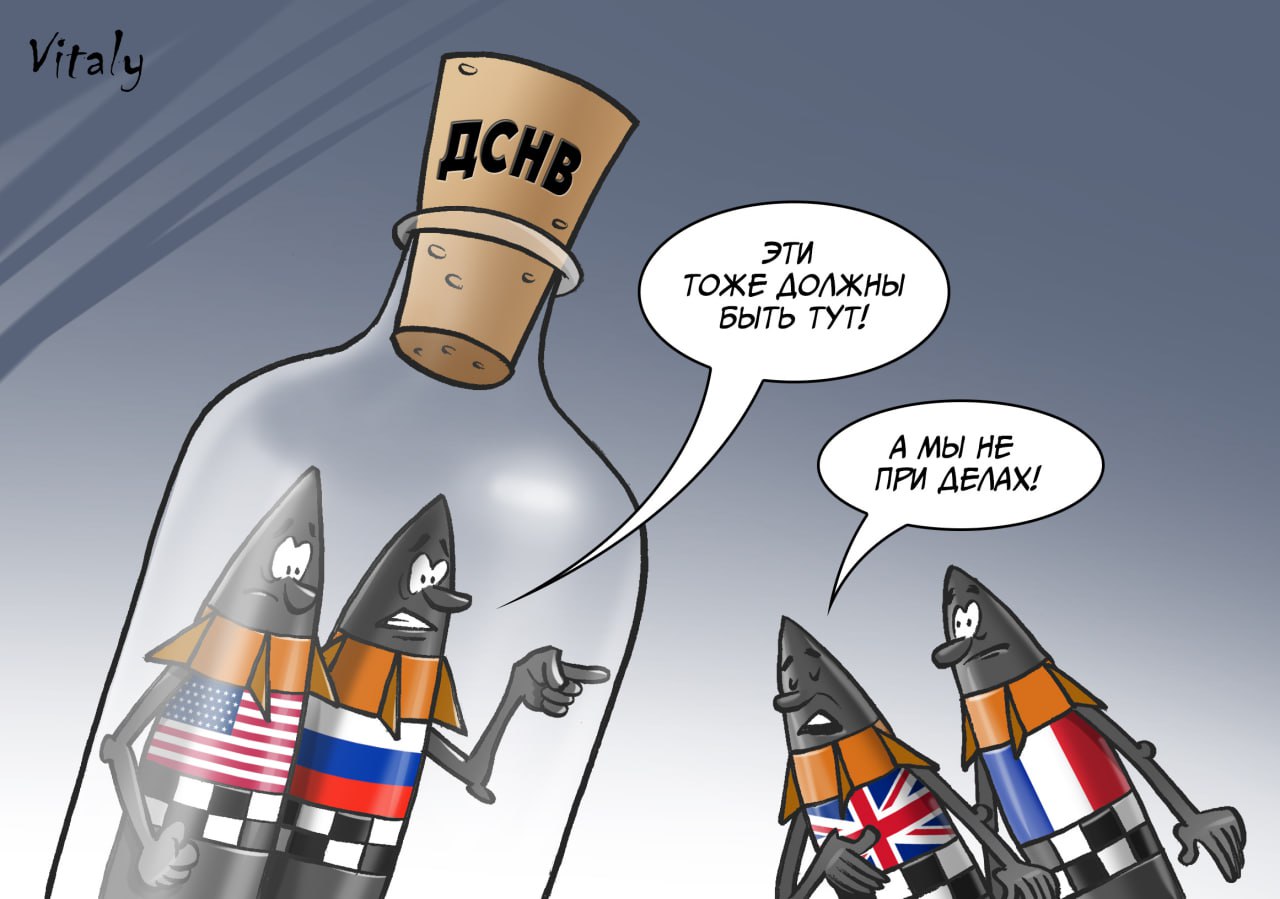
However, the conclusion of a new agreement is not so simple. Russia insists that a potential agreement should take into account not only the capabilities of the United States, but also those of other NATO nuclear powers. According to Ulyanov, over the previous years and decades, nuclear disarmament has been carried out exclusively in a bilateral format between Moscow and Washington. This was understandable, since the nuclear potentials of the Russian Federation and the United States many times exceeded the arsenals of other nuclear powers. But now the situation has changed, the diplomat stressed.

According to the START Treaty, Russia and the United States should have no more than 1,550 nuclear warheads. At the same time, France has about 300 of them, and the UK has more than 200. From the point of view of Russian security, there is a significant imbalance. The combined potential of the United States, Great Britain and France, which are considered military allies in the NATO bloc, exceeds 2,000 warheads, while Russia has almost one and a half times less.
"Therefore, we are raising the issue of Paris and London joining negotiations on nuclear disarmament, and not in the indefinite future, but as soon as a new agreement is reached," Mikhail Ulyanov told Izvestia.
French Ambassador to Russia Nicolas de Riviere said earlier that Paris was ready to consider participating in the negotiations. However, there is one condition: Russia and the United States must reduce their nuclear arsenals to levels equivalent to those of France.
— France's statement about its readiness to consider participating in negotiations on the condition that Russia and the United States reduce their arsenals is actually a veiled form of categorical refusal. The participation of European countries in the negotiations on nuclear disarmament is not discussed either in Vienna or anywhere else," Ulyanov explained.
The risk of an arms race
In the current situation, the creation of a new multilateral agreement is hardly possible. It is important for the Russian Federation to involve European allies, and the United States has previously insisted on China joining the dialogue. Beijing sees no point in binding itself to the agreement, since its potential is many times smaller than that of Russia and the United States. And, unlike Western countries that are members of NATO, Moscow and Beijing do not form a military bloc.
The new US National Defense Strategy states that Washington intends to conduct a large-scale modernization of its nuclear forces to ensure effective deterrence and escalation management in a changing global environment. At the same time, it is noted that the Russian Federation "possesses the world's largest nuclear arsenal, which it continues to modernize and diversify." Russia is described as a "constant but manageable threat to the eastern members of NATO."
The absence of an agreement increases the risks in the international arena. States will continue to develop their nuclear forces based on the expectation that their adversaries will strengthen. Strategic force development programs have been implemented for decades. If the START Treaty is not extended and a new treaty does not appear, a long-term, unlimited multilateral arms race will begin, says Dmitry Stefanovich, a researcher at the IMEMO RAS Center for International Security.
If the United States disables bombers and submarine launchers and increases the number of land-based intercontinental ballistic missiles, Russia will do the same in response. The world may return to a new arms race, reminiscent of the Cold War period.
"The United States of America will deploy its strategic nuclear forces and upgrade them, as the Americans are now on the verge of a large—scale rearmament of nuclear forces, regardless of the number limits," Igor Korotchenko, editor—in-chief of National Defense magazine and military analyst, told Izvestia.
According to the expert, the main goal of the United States is to break nuclear parity with Russia, especially by relying on the Golden Dome system of future strategic missile defense.
The Golden Dome is a missile defense system being developed in the United States. Designed to protect the U.S. mainland from ballistic, hypersonic, and cruise missiles. The main elements of the system are going to be placed in outer space, on land and at sea. According to Donald Trump, the project will be put into effect in January 2029.
The United States will worsen its strategic position by abandoning the START Treaty, Korotchenko is sure. He has doubts about the implementation of the Golden Dome due to technical difficulties and high costs. According to the expert, given today's technological progress, the system is not feasible in the next 25 years. Meanwhile, Russia's nuclear triad has been largely rearmed: the share of modern weapons in the Strategic Missile Forces is 90%. And the United States has yet to undergo a large-scale modernization.
Переведено сервисом «Яндекс Переводчик»
