- Статьи
- Society
- There is no money for it: in the Russian Federation, they may limit paid places in colleges

There is no money for it: in the Russian Federation, they may limit paid places in colleges

Russian colleges may be limited in their ability to teach students on a fee-based basis. The authorities want to reduce the number of commercial jobs in humanitarian and economic areas. The bill is planned to be developed and submitted to the State Duma before the end of the spring session in July 2026. It will act by analogy with the law on the restriction of paid places in universities. The expert community warns that this approach may affect the financial situation of colleges, and some applicants will consider going abroad to study. About why the innovation will help the authorities to combat the shortage of personnel and how the new law will work — in the material of Izvestia.
Limitation of the number of paid places in universities is extended to colleges
Large-scale reforms in the field of education are continuing in Russia. They are related to the fact that today the labor market is experiencing an acute shortage of skilled workers and engineering professions. To change the situation, last year the State Duma passed a law that gives the government the right to limit the number of paid places in universities. The regulation primarily affected legal and economic areas. The idea was to reduce the flow of humanities graduates, giving preference to techies and those in need of the labor market.
It is planned to extend this practice to colleges in the near future. Such a bill will be developed and submitted to parliament before the end of this convocation in July 2026, Deputy Speaker of the State Duma Victoria Abramchenko told Izvestia.
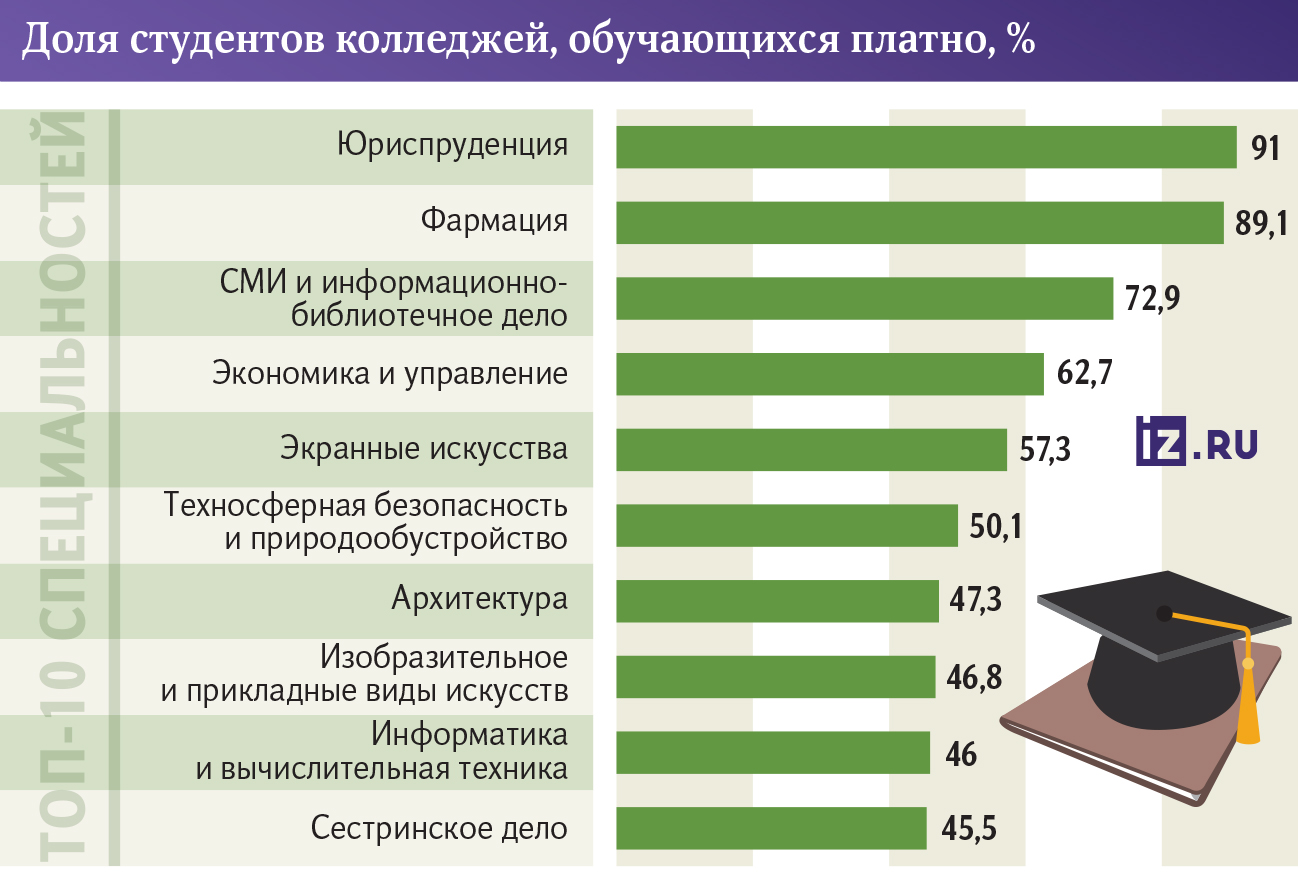
— The principles of regulation of paid admission, approved for universities, should be extended to colleges. In a number of fields, such as law, more than 80% of students study for a fee. Mass paid recruitment is most often found in programs popular with schoolchildren, but unclaimed in the labor market. At the same time, the real sector of the economy is experiencing a shortage of qualified workers and specialists," the deputy noted.

Currently, the initiative is being actively discussed within the working group on secondary vocational education (SPE), headed by Victoria Abramchenko. In addition to deputies from all factions, the group includes representatives of interested departments, including the Ministry of Education and the Ministry of Labor, as well as regional authorities.
At the beginning of the 2024/25 academic year, 3.8 million people received secondary vocational education in Russia. Of these, 37.1% (about 1.4 million people) studied for a fee, according to the Institute for the Development of Vocational Education (IRPE) of the Ministry of Education. The most popular commercial areas are now considered to be law, mass media and information and library science, economics and management, as well as screen arts. Obviously, they can all be subject to restrictions.

It is expected that in practice the law will act by analogy with its predecessor, which limited commercial places in universities. If today the number of paying students is determined by each college independently, then after the law comes into force, this right will pass to the government. It will create a list of specialties, for which it will then set a limit on the number of paid places. For example, in the case of universities, the list includes such areas as law, economics, journalism, philology, psychology, architecture, and others.

After that, the Ministry of Education will have to allocate places between colleges. Interestingly, the previous law affected both public and private universities.
However, the situation is more complicated in the case of colleges, since all public ones are funded from regional budgets, while private ones operate at the expense of fee—paying students. At the same time, the share of students who study at public colleges is about 64%. The remaining 36% are accounted for by private STR organizations.

Does the initiative have any drawbacks
The State Duma has begun developing initiatives to limit commercial jobs in universities and colleges on behalf of Vladimir Putin in order to "eliminate excessive paid recruitment in specialties for which there is no demand from the economy and the labor market." The authorities prefer applied professions.
— Our economy today is sorely lacking specialists in working professions. To increase the prestige and popularity of these areas, we will continue to establish partnerships between colleges and technical schools with employers," the president said in October 2024 at the congress of the Federation of Independent Trade Unions of Russia.

According to Prime Minister Mikhail Mishustin, the current shortage of workers with secondary vocational education is estimated at about 1.5 million people. To solve the problem, the authorities launched the Professionalism project, where it is planned to train about a million workers for the domestic light industry, pharmaceuticals, shipbuilding, aviation industry, machine tool manufacturing and electronic components.
The initiative to limit paid college places aims to redirect the flow of students from choosing humanities and economics to technical and medical fields. But experts see certain risks in such decisions.
"This causes tension not only for families, but also for experts, because we understand that such a decision may cause an outflow of applicants to other countries for education and further we face the risk of losing human capital," warns Irina Abankina, a professor at the HSE Institute of Education.

Another negative consequence may be a deterioration in the financial condition of colleges — they risk losing a significant part of the earnings that come from paying students. Most of the colleges in the regions face the problem of budget imbalance, as the regional authorities do not have enough funds to fully finance vocational education institutions. Colleges are trying to cover the deficit with money from commercial places, but with the adoption of the law they may face a shortage of funds.

Experts still believe that after a detailed discussion with the trade union community and departments, the bill will be developed and then adopted. In addition, the initiative to limit paid college places seems logical, given that the authorities had previously approved the same law for universities.
Переведено сервисом «Яндекс Переводчик»
