- Статьи
- Economy
- I don't feel sorry for the bird: the engines of the import-substituted Superjet 100 were tested by a "flock of birds"

I don't feel sorry for the bird: the engines of the import-substituted Superjet 100 were tested by a "flock of birds"

The engines of the import-substituted Sukhoi Superjet 100 have been tested on birds for the first time before certification scheduled by the end of summer. At the stands in Rybinsk, PD-8 engines were "fired" from pneumatic cannons with bird carcasses imitating crows and seagulls, and also tested for sudden separation of the fan blade. This is the penultimate cycle of bench tests, and flight checks are taking place at the same time. How fast is the import substitution in aviation and what other units have been replaced in domestic airliners — in the Izvestia article.
How the engine for the Superjet 100 was tested
The PD-8 engine for the Sukhoi Superjet 100 has passed the penultimate bench test cycle before certification. He was tested for performance in a collision with a flock of birds. They plan to certify the engine before the end of summer.
As the United Engine Corporation (UEC) told Izvestia, the tests took place at the open stand of the Rybinsk UEC-Saturn. During the PD-8's operation in maximum takeoff mode with a thrust of 8 tons, four carcasses were fired from a special four-barrel cannon mounted 5 m from the power plant in one second.

At the same time, the possible collision pattern was repeated — carcasses were thrown into the fan of the power plant, taking into account the flight speed of the aircraft during takeoff and landing — 103 m / s. They hit the most critical sections of the fan blades, as well as the aerodynamic fairing. For a visual assessment of the test results, the blades were painted yellow with special markings, the UEC reported.
Sergey Mosin, Deputy chief designer of the PD-8 for engine nacelle and integration with the ODK-Saturn aircraft, told Izvestia that the engine was not damaged during the simulation of an emergency and retained controllability.

"Tests have proved that in real—world conditions, encountering a flock of birds is not dangerous for him," he noted.
Checking modern engines for collisions with birds is part of the certification program, the editor—in-chief of the portal told Izvestia. Avia.ru aviation expert Roman Gusarov. Soviet aircraft of the 1970s and 80s were not certified in this way, in the 1990s there were checks for collisions with one bird. And the new turbofan twin-circuit engines are already being tested for a collision with a flock. Considering that the PD-8 is relatively small, its ability to withstand a direct hit from four birds at once is impressive, he added.

Before the bird tests, the engines were tested for water injection and for the separation of the fan blades. In December 2025, a pyrotechnic charge was placed in one of the fan elements, then the engine was put into takeoff mode and, after warming up, the charge was detonated. The blade collapsed and damaged the internal technical components, but the fragments did not penetrate the engine body.
"These tests test the ability of the structure to withstand destruction and hold debris inside the hull," Andrey Patrakov, founder of the RunAvia flight safety service and aviation expert, told Izvestia. — The scattering of blades and fragments of the engine can seriously damage the aircraft in the air.
According to Roman Gusarov, when fragments hit the fuselage and subsequent decompression, people on board receive serious barotrauma due to pressure drop. Therefore, it is so important that when large fan blades are detached, they remain inside the body and do not harm the aircraft.
— Naturally, with such damage, the engine stops working, but the aircraft continues to fly perfectly on one engine, — the expert noted.
As Rostec told Izvestia, during the tests the PD-8 confirms its effectiveness, reliability and other key parameters. It is planned to complete its certification in the near future in order to bring closer the supply of import-substituted Superjet 100s, which are scheduled to begin this year.
Oleg Panteleev, Executive Director of the Aviport agency, believes that the engine will be certified no later than the second quarter of 2026.

—Only six countries are capable of making passenger airliners, and there are only five engines for them,— Rostec noted. — The PD-14, as the first domestic fifth-generation engine, is being certified as part of the MC-21 medium-haul aircraft. His "younger brother" PD-8 for Superjet is in the final stage of certification flights.
What abnormal situations are simulated in the tests?
The tests conducted in Rybinsk simulate one of the most difficult ways for birds to get into the engine. An example of such cases is the "Miracle on the Hudson" in the United States — the emergency landing of a US Airways Airbus A320—214 aircraft on the Hudson River in New York on January 15, 2009 after a collision with a flock of Canadian Cossacks, when its engines completely lost thrust and the plane landed on the water. As well as the landing on the cornfield in Zhukovsky of the Ural Airlines Airbus 321 aircraft on August 15, 2019, noted Andrey Patrakov.

Until the 2000s, there were no uniform standards for testing birds. Now, depending on the size of the engine, there are tests for one large bird weighing from about 1.8 to 3.65 kg, up to seven medium-sized birds and up to 16 small birds in one test.

"Modern wide—chord blades are designed to successfully resist foreign objects entering the engine,— Oleg Panteleev told Izvestia. — In addition, the high-speed digital control system of the power plant allows you to instantly detect the output of engine operation parameters beyond the normal limits, after which retaliatory actions are taken.
As a result, even if there is a malfunction in the engine, it can be stopped quickly, the expert added.
The certification program includes other dangerous aspects when operating aircraft, including flying in a storm with heavy rain. In 1988, there was an aviation accident in the United States when, due to a hail storm, both engines of the Boeing 737-300 stalled and it made an emergency landing, said Andrey Patrakov. Since then, changes have been made to the tests and all new engines are checked for water intake, which can disrupt the stable combustion of fuel. Gorenje
How is import substitution going in aviation
The PD-8 is a domestic development that should replace the Russian-French Sam146 on the Superjet 100, said aviation expert Roman Gusarov. This is a modern technological engine that repeats many of the technical developments from the larger and more powerful PD-14 designed for the MS-21.
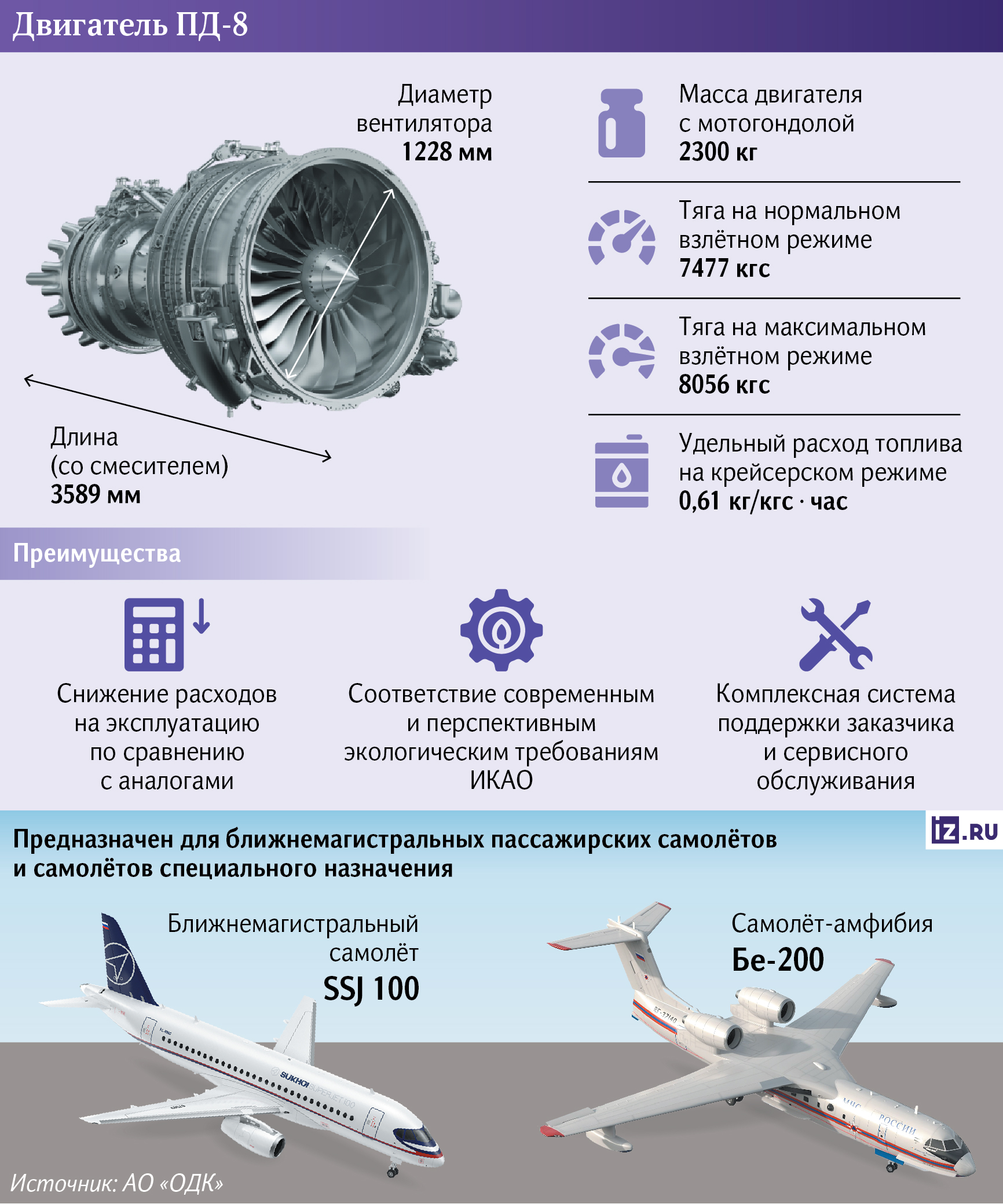
According to Andrey Patrakov, the PD-8 is even slightly superior to the SaM-146 in terms of design characteristics.: it has better traction, lower fuel consumption and is slightly lighter. But whether the claimed characteristics will be confirmed in practice, only intensive operation will show, he added.
— The development of a new engine usually takes at least 10 years. If we take into account that the PD-8 has been made since 2020, then it is possible that they will be able to bring the engine "to mind" by 2030, especially taking into account the complete import substitution of the aircraft design, the expert noted. — Maintenance intervals may be reduced in the early years of operation.
In general, the import-substituted SJ—100 is practically a new aircraft. It replaced not only the PD-8 engine, but also key systems: autopilot, avionics and related software, navigation, communication and display of flight information, the TCAS air collision avoidance system, domestic air conditioning and air control units in the cabin, the fuselage was modified to match domestic fasteners and assembly schemes of the units, the rack design was changed the chassis and so on, the expert noted.
According to him, the certification process is very complex and unpredictable. One requirement (for example, reliability and fault safety) can take years to work on. Therefore, if PD-8 is certified in the second half of 2026, it will be a great success, said Andrey Patrakov.
The PD-8 engine development program was launched in 2019. It was supposed to replace the French-Russian SaM146 for the Superjet 100 and Be-200 aircraft. In December 2022, flight tests of the engine began at the IL-76LL flying laboratory. It was planned to certify the engine in 2023, but the dates were postponed to 2024 and 2026. In March 2025, certification tests of the engine in the Superjet 100 aircraft began.
Переведено сервисом «Яндекс Переводчик»
