What's retail about: 2025 turned out to be the worst year for Russian retail in 10 years
- Статьи
- Economy
- What's retail about: 2025 turned out to be the worst year for Russian retail in 10 years


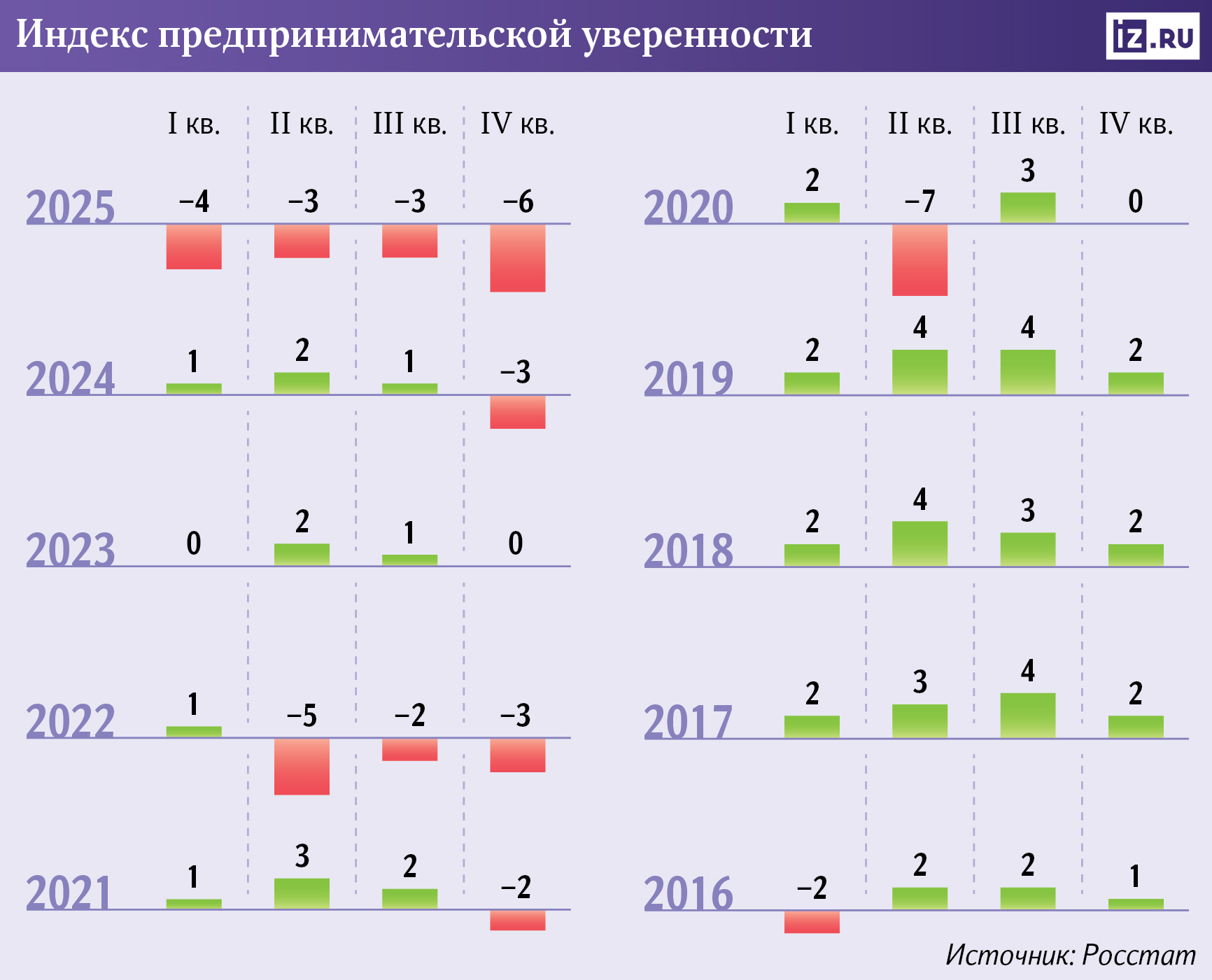
The index of business confidence in Russian retail in 2025 turned out to be the worst in the last 10 years, Izvestia learned. At the end of last year, the indicator dropped to -6. A negative value means that the share of companies assessing the situation as unfavorable exceeds the number of optimists. The reasons for the situation are a drop in consumer demand, an increase in costs and the cost of loans, as well as a significant redistribution of consumer preferences in favor of online trading, business representatives and experts say. See the Izvestia article about what retailers are waiting for in 2026.
How does trading feel?
Last year turned out to be the worst for Russian retail in the last 10 years. The index of business confidence in the industry was negative in all four quarters of 2025, according to Rosstat data for 2016-2025, which was reviewed by Izvestia. In the fourth quarter, the indicator dropped to -6. A lower value was recorded only in the second quarter of 2020, at the height of the COVID-19 pandemic, when the confidence level of Russian retailers dropped to -7, the document says.
The index is one of the key indicators of the state of the sector, reflecting the economic situation, investment attractiveness and business sustainability. It is calculated by Rosstat on the basis of balance sheets of estimates of the actual economic situation of organizations, the level of stocks and expectations regarding changes in business activity in the near future. A negative value indicates that the share of companies assessing the situation as unfavorable exceeds the number of optimists.
This trend is confirmed by retailers surveyed by Izvestia. The last quarter and December of 2025 were "difficult" for the entire industry, said Johannes Tolai, CEO of Metro Russia. The Lenta Group operated under conditions of "active changes in the competitive environment and high uncertainty," said its CEO Vladimir Sorokin. By the end of 2025, the Russian economy had almost stopped growing - GDP increased by only 0.1% year—on-year in November after growing by 1.6% in October, the Ministry of Economic Development reported on December 26. In just 11 months, this figure was 1%. In such an environment, any business "either adapts or becomes unsuccessful," he noted.
He actively influenced the retail situation and the flow of customers to marketplaces, Izvestia wrote. According to the Ministry of Industry and Trade, their share in the total retail trade by the end of 2024 was 15%. By 2030, this figure may rise to 30-35%.
Sales in various categories have been declining slightly but steadily since June last year, noted Johannes Tolai. Against this background, traditional retail is forced to tighten its dialogue with suppliers, Dmitry Tortev, a member of the expert council of the State Duma Committee for the Protection of Competition, added. The buyer maintains a savings-based consumption model and strives for rational spending, so he increasingly pays attention to discount stores, said a representative of X5 (Chizhik, Pyaterochka, Perekrestok). In the third quarter (the latest available data), the total revenue of discounters grew faster than in the FMCG (consumer goods) market as a whole — 28% versus 16%, according to data from the Infoline analytical agency.
According to Mikhail Lachugin, an independent consultant to retail chain suppliers and founder of the industry channel Product Media, the situation differs in different retail segments. Thus, the difficulties in the food sector are less pronounced than those of retailers from other areas.
In the DIY and Household segment, there was a decrease in demand and a slowdown in business activity in 2025, confirms the Director of Investor Relations at All Instruments.<url>" Alexey Lukyanov. One of the main factors of pressure last year was the high key interest rate, lower investment activity and clients' caution in capital and infrastructure spending, the top manager explained. Stagnation in the housing market, an increase in the cost of building materials with a decrease in their production, a slowdown in the growth rate of real incomes, as well as "structural problems" in the industry had a negative impact on the development of the segment, Marcel Sagetdinov, director of business efficiency at Leman PRO, listed.
In pharmacy retail, the economy has been affected to some extent by tax changes, increased rental costs, logistics, photo and personnel shortages, as well as the growth of e-commerce, said Boris Popov, CEO of the Rigla chain. These factors do not allow pharmacies, primarily regional and individual ones, to increase revenue and profitability, he said.
A Globus representative declined to comment. Magnit and Vkusville did not respond to inquiries.

What does retail expect in 2026
Almost every second (44%) retailer expects lower profits and profitability this year, according to a survey by B1 (formerly Ernst & Young) and Redis Crew. The number of companies expecting business growth turned out to be the lowest in the last 10 years — only 29%, Izvestia wrote in September 2025.
Indicators of entrepreneurial sentiment, as a rule, reflect the attitude of businesses to current events and the news background, but they are not evidence of a systemic industry crisis, said the chairman of the Presidium of the Association of Retail Companies (ACORT). Stanislav Bogdanov. According to him, in 2026, federal retail retains priorities for effective business development, expanding the range and improving various services for consumers.
2026 will not be easy, says Johannes Tolai. It seems to be a more complicated version of 2025, Vladimir Sorokin agrees. This is influenced by the tense macroeconomic situation in Russia: Sanctions pressure remains, the key interest rate is decreasing slowly, which makes investments expensive, and liquidity is limited, primarily for small and medium—sized businesses, as well as for large companies that have not had time to adapt to the new conditions, added Johannes Tolai.
According to him, an important indicator of this was the "very moderate demand" during the holidays, and the traditional peak of New Year's sales began much later. In 2026, holiday traffic in shopping malls was almost 20% lower than in the same period a year earlier, Pavel Lyulin, vice president of the Union of Shopping Centers (UTS), told TASS. Now the buyer chooses discretion and moderate consumption, summarized Johannes Tolai.
Переведено сервисом «Яндекс Переводчик»
