
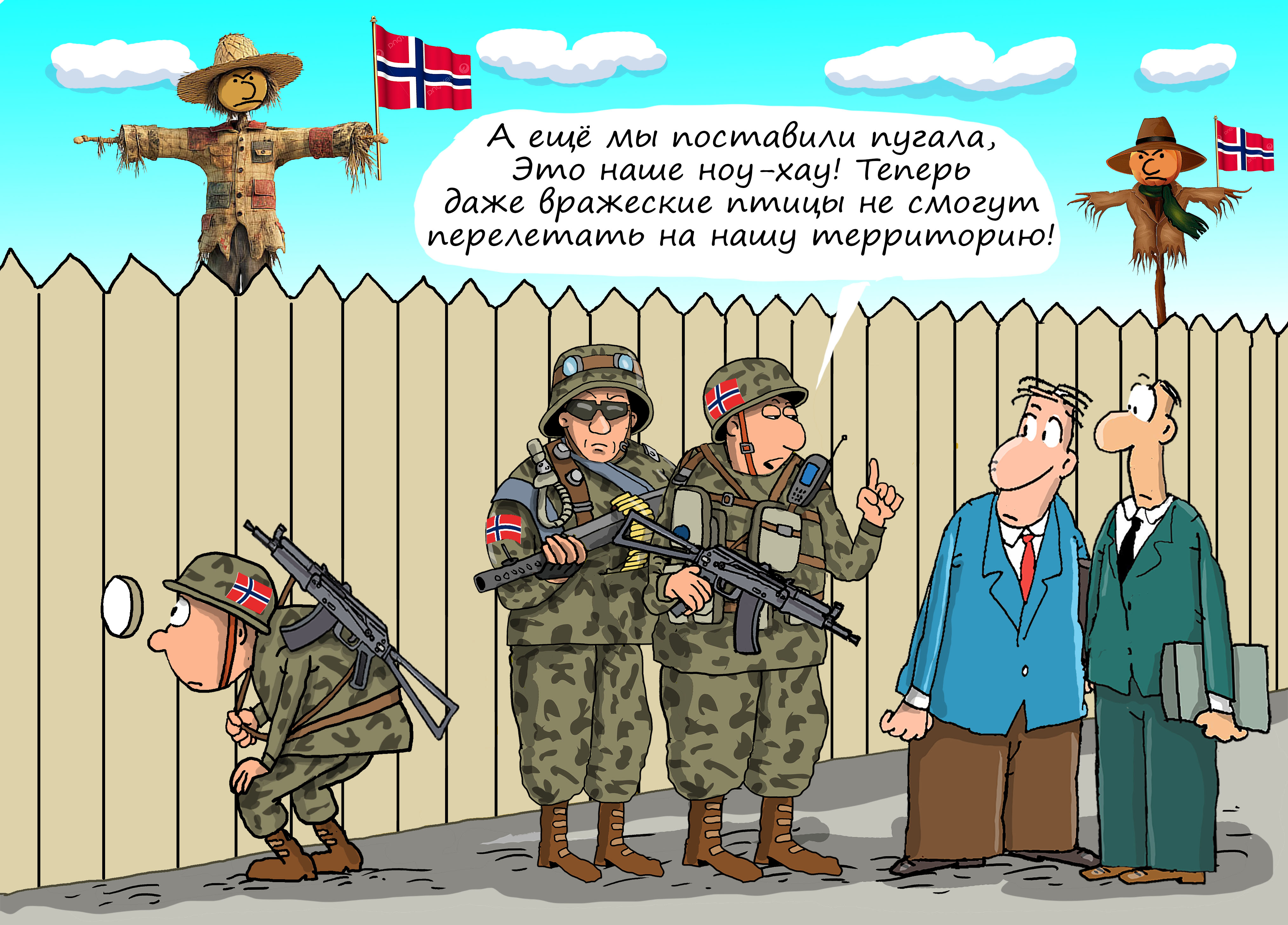
Foreign experience: Norway refused to build a fence on the border with Russia

Oslo has no plans to build a fence on the border with Russia, but is modernizing its infrastructure, the national police department told Izvestia. Earlier, the country has repeatedly called for the construction of fortifications along the border with the Russian Federation, following the example of Finland. Helsinki withdrew from the convention on the prohibition of anti-personnel mines in January, and now it can begin mining border areas. The Baltic countries and Poland have consistently increased restrictions against Russian citizens. Analysts consider this policy to be a long-term trend and do not rule out a complete closure of borders. The restoration of cooperation depends on the settlement of the conflict in Ukraine.
Norway will not build a fence on the border with the Russian Federation
Anti-Russian hysteria has sharply escalated in Norway, which is neighboring the Russian Federation. The military there sent out thousands of letters urging citizens to be prepared to confiscate homes and vehicles in the event of a war with Russia, The Daily Telegraph reported. Earlier, local media reported on the construction of a fence on certain sections of the border with the Russian Federation. Some politicians argued for the appearance of barriers along its entire length.
Norway has no plans to build a fence on the border with Russia, but is modernizing its infrastructure, the national police directorate, which is responsible for the security of the external borders, told Izvestia. This body is subordinate to the Ministry of Justice and Public Security.

Norwegian border guards patrol a section of the border with Russia
— The Norwegian police is currently modernizing the border, including technological and physical ones, with the support of the EU Border and Visa Management tool. This is a natural development of border management, aimed at increasing awareness of the situation and efficient use of resources. The current improvement involves upgrading the physical infrastructure designed to support modern border management, and does not include a general fence," they said.

The length of the Russian-Norwegian border is approximately 219 km (43 km by land, 152.8 km by river and 23.3 km by sea). The only functioning border crossing is in the village of Sturskug, on the Russian side the checkpoint is called Borisoglebsk. 51,000 people passed through this checkpoint last year, which is 11% less than in 2024. This is a record low since the collapse of the USSR, excluding the coronavirus pandemic.

Borisoglebsk checkpoint across the state border towards Norway
Oslo is constantly tightening entry conditions for Russians. In 2022, Norway, as well as Belgium, Denmark, Latvia, Lithuania, the Netherlands, Poland, Finland, the Czech Republic and Estonia stopped issuing tourist visas to Russians. Since October 2023, entry into the kingdom in passenger cars with Russian license plates has been prohibited. And in 2024, Norway closed access to anyone with "low-priority" goals. Recall that Oslo joins all packages of anti-Russian sanctions and is among the leaders in providing military assistance to Ukraine.
Norwegian security policy is based on finding a balance between deterring Russia, including through NATO, and maintaining good-neighborly relations with it, Nikita Lipunov, a junior researcher at the Moscow State Institute of International Relations at the MGIMO Ministry of Foreign Affairs of the Russian Federation, told Izvestia.

NATO military exercises Nordic Response 2024 in Norway
— Norway is not interested in border escalation. Oslo wants to maintain a stable military and political situation in the Far North," the expert stressed.
According to Lipunov, given the heightened perception of threats, additional precautions are being taken in case of a crisis, which often seem excessive and may look like preparations for a military conflict, but the Norwegian leadership does not have such an intention. The specificity of the Northern European model of comprehensive or total defense is that all social groups and levels of government are maximally involved in preparing for crisis situations in peacetime.

What is happening on the borders of the Russian Federation with NATO countries
The situation on the border is even more complicated with other member countries of the Western camp. For many years, the Russian Federation has maintained close cooperation with Finland, since the length of the common border is about 1.3 thousand km. After the start of its military operation, Helsinki set a course for a complete break in ties with the Russian Federation. In 2023, he closed all checkpoints on the border with the Russian Federation, accusing the Russian side of organizing migration flows. The construction of a massive security fence on the most vulnerable sections of the border continues, and it is expected to be completed in 2026.
Moreover, the strengthening of the border will not end only with a fence. Finland joined NATO in 2023, and earlier this year withdrew from the Ottawa Convention on Anti-personnel Mines. The Finnish military plans to use them on their own territory, the Russian Embassy in Helsinki told Izvestia.

Finnish border guards patrol the border with Russia
— The Russian side reserves the right to take retaliatory measures if necessary. At the same time, we believe that this step will have the most unpleasant consequences for Finland itself. Ultimately, the Finnish military plans to use antipersonnel mines on the territory of their own country, and it is Helsinki that will have to explain to its citizens why this is necessary," the Russian diplomatic mission noted.
Due to the decisions of the Finnish leadership, it is now possible to get from this country to the Russian Federation only through Estonia. Tallinn maintains the operation of all checkpoints on the border with Russia — Narva, Luhamaa and Koidula, but tightens the inspection regime. Since August 2024, Estonia has introduced a full inspection of all cargo and passengers, which creates significant delays. Queues began to appear in Narva, waiting takes several hours. Moreover, the Estonian authorities do not rule out the complete closure of the checkpoint in case of increased queues and worsening conditions.

Narva-2 pedestrian checkpoint on the Estonian-Russian border
Two automobile checkpoints are currently operating on the border of the Russian Federation and Latvia — Terekhovo – Burachki and Grebnevo – Ubylinka. The Vientuli and Pededze checkpoints will remain closed by decision of the Latvian authorities from the end of 2023. Officially, border crossing is allowed only by vehicles, you first need to register in the electronic queue.

Kibartai–Chernyshevskoye remains the main checkpoint for cars and trucks from the Kaliningrad Region to Lithuania. The Panemune–Sovetsk checkpoint is open for pedestrian traffic only. In addition, entry into Lithuania by cars with Russian license plates is completely prohibited. Vilnius is also preparing to terminate transit traffic between the Kaliningrad Region and the rest of the Russian Federation.

Trucks at the Chernyshevskoye multi-vehicle checkpoint on the Russian-Lithuanian border in the Kaliningrad region
It is important to remember that the three Baltic countries are building a strip of fortifications on the border with Russia. For example, in December 2025, Latvia completed the construction of a 280-kilometer fence. Estonia plans to build about 600 concrete bunkers. Vilnius expects to deploy anti-tank trenches, barriers and minefields along the borders with the Russian Federation, especially in the area of the Suwalki corridor, which connects Lithuania and Poland.
The Russian-Polish border can only be crossed through the Bagrationovsk–Bezledy and Mamonovo–Grzekhotki automobile checkpoints. Buses run across the border from Kaliningrad to Gdansk. At the same time, the joint work of Russia and Poland on the border of the Kaliningrad region has been stopped, said Sergey Andreev, the then Russian ambassador to Warsaw, last year. In addition, Poland intends to leave the Ottawa Convention in February and begin mining the country's eastern borders.

Anti-tank barriers on the Russian-Latvian border
Border issues are divided between the EU and the participating countries: customs control is regulated from Brussels, but national governments have more competence in relations with external partners. As practice shows, these rules are often tougher than EU norms, and they are more likely to be long-term in nature, Daria Moiseeva, PhD in political Science and chief analyst at ANO Kolaboratoria, told Izvestia.
"We can expect further tightening of the border regime, up to the temporary closure of the borders of one of the parties," the expert predicts.
Moiseeva believes that the prospects for restoring border cooperation directly depend on the foreign policy situation, primarily on the settlement of the Ukrainian conflict. A return to the normal functioning of the border is especially likely with an increase in trade turnover. In this case, additional resources will be required from the Russian side for the full operation of border checkpoints.
Переведено сервисом «Яндекс Переводчик»
