- Статьи
- Science and technology
- In the body itself: scientists have discovered "traces of life" in a meteorite from the last century

In the body itself: scientists have discovered "traces of life" in a meteorite from the last century

MSU scientists have told about the discovery, which can expand the understanding of the origin of life in the universe. In one of the "purest" meteorites, the carbonaceous chondrite Kainsase, which fell to Earth in 1937 on the territory of Tatarstan, researchers found structures similar to fossilized remains of biogenic origin more than 4.6 billion years old. If their nature is confirmed, it will become a new argument in favor of the hypothesis of an extraterrestrial origin of life. However, not all experts agree that the structures found may be related to extraterrestrial beings. For more information, see the Izvestia article.
What is the famous Kainsaz meteorite?
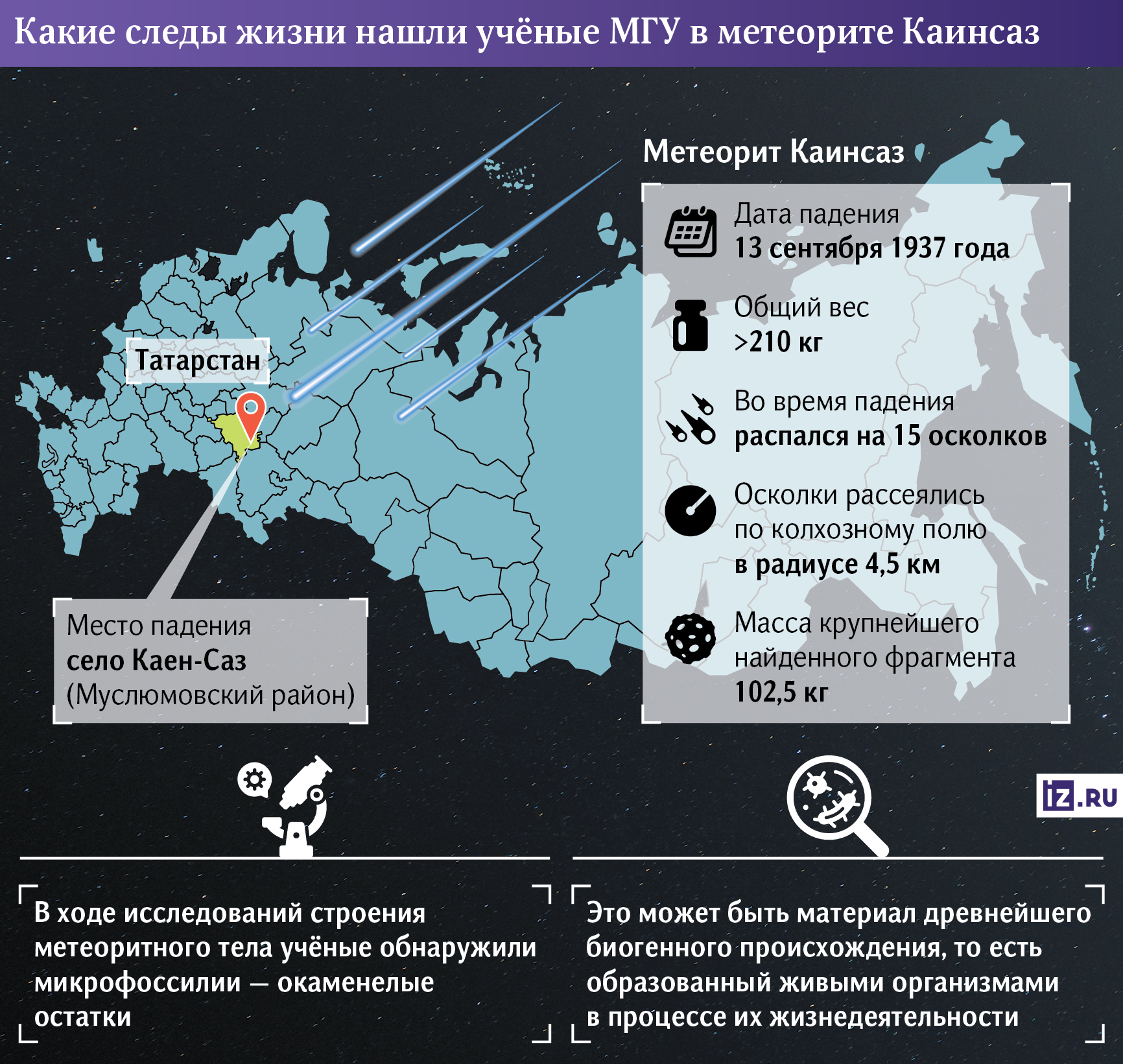
Scientists at Lomonosov Moscow State University have announced a discovery that could significantly expand the understanding of the origin of life in the universe. In the course of research on the microstructure of the Kainsaz meteorite body, they discovered material of the most ancient biogenic origin, that is, formed by living organisms in the process of their vital activity. According to scientists, the age of the microfossils found — fossilized remains invisible to the naked eye — is estimated at more than 4.6 billion years. This makes them one of the oldest pieces of evidence of life ever discovered.
The Kainsaz meteorite is a rare type of carbonaceous chondrite that fell to Earth on September 13, 1937 on the territory of the Republic of Tatarstan (near the village of Kaensaz). During the fall, it broke up into 15 fragments with a total weight of 210 kg. It is considered to be the least modified carbonaceous chondrite, which retains its original characteristics, which makes it possible to study its composition without taking into account the influence of subsequent geological processes.
The discovery of microfossils in the Kainsaz meteorite is of tremendous importance not only for astrobiology, but also for understanding the evolution of life on Earth, the university emphasized. The discovery suggests that life could have originated not only on our planet, but also exist in other parts of the Solar system, and possibly beyond. To this day, the existence of life beyond Earth remains one of the most intriguing mysteries of science, and the Kainsaz meteorite provides weighty evidence in favor of the theory of panspermia, the hypothesis of the introduction of life to Earth from space, said the Moscow State University.
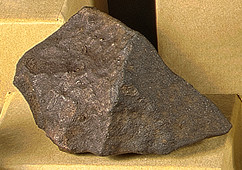
The discovery stimulates further research of carbonaceous chondrites and other cosmic bodies that may contain traces of ancient life, Mikhail Vinnik, a leading researcher at the Museum of Earth Sciences, told Izvestia. However, the discovery itself is a very rare event, but not unique. Previously, experts had already found something similar in other meteorites, the scientist said.
— The novelty of this study lies in the fact that such structures have been discovered in Kainsase for the first time. And there is a high probability that a deeper study of the meteorite will open up new opportunities for understanding fundamental questions about the origin and development of life in the universe, bringing us closer to answering the question of whether we are alone in the universe," he stressed.

How scientists found "traces of life" in a meteorite
Chondrites, which include Kainsase, are unique space objects containing significant amounts of organic matter and water, which makes them an invaluable source of information about the processes that took place in the early Solar System. Kainsase is considered to be the least modified carbonaceous chondrite, which makes it possible to study its composition with minimal influence from subsequent geological processes. Since its formation, the initial substance of the meteorite has undergone minimal metamorphism, which has preserved its pristine characteristics and made it possible to detect ancient biogenic structures, the Moscow State University reported.
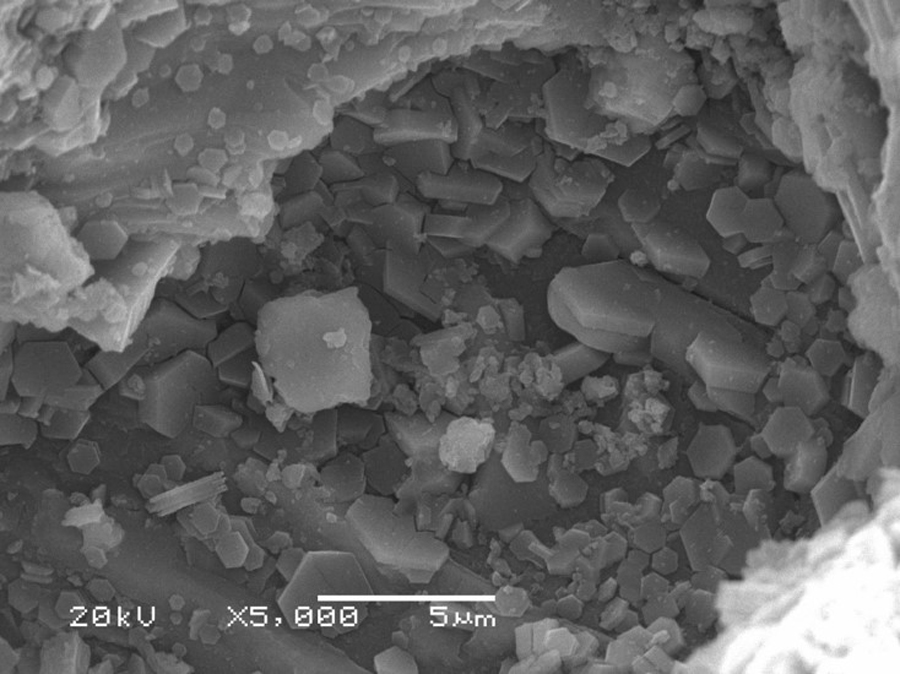
The study took place in the fall of 2025. The scientists studied the surfaces of individual microparticles using scanning electron microscopy (SEM), which allows them to obtain images of the surface of an object with high spatial resolution. In order to identify the elemental composition in the studied particles, the method of semi-quantitative electron probe microanalysis, that is, the analysis of the chemical composition of minerals, was also used. Energy dispersive X—ray spectroscopy (EMF, a variant of X-ray spectral analysis) was also used.
A detailed study of the microfossils found in the Kainsaz meteorite will require the use of the most modern research methods. The researchers plan to analyze the chemical composition of microfossils, study their morphology in detail, and conduct isotope analysis to confirm their biogenic origin and determine their age more precisely. This will allow us to gain a deeper understanding of the conditions in which life originated.
The question of the presence of alien life in the universe
When discussing life in the universe, modern science is increasingly moving away from the idea of its uniqueness for the Earth, Denis Kuzmin, director of the Phystech School of Biological and Medical Physics at MIPT, told Izvestia. Astrobiology assumes that the basic chemical and physical conditions — the presence of water, organic molecules, and energy sources —can be realized in many parts of the Solar System and beyond. In this context, studies of carbonaceous chondrites are of particular value because they are "time capsules" of the early Solar System.

— But at the same time, the discovery of microfossils in the Kainsaz meteorite is important as a hypothesis requiring rigorous verification. The scientific community well remembers examples when structures that look like biogenic ones subsequently received an abiogenic explanation (abiogenesis suggests that life originated from inanimate matter. — Izvestia). Therefore, isotopic, chemical and morphological analyses that can separate possible traces of life from complex but inanimate mineral formations will play a key role in the verification," the scientist said.
If the biogenic origin of microstructures is confirmed, it will not be a direct proof that "we are not alone" in the sense of the existence of intelligent life, said Denis Kuzmin. But this will be a strong argument in favor of the fact that life as a phenomenon could arise repeatedly and independently, and not be a unique earthly exception.
— From the point of view of the origin of life on Earth, such data strengthen the position of scenarios in which organic matter or even primitive biological systems could have been introduced from space. We are not talking about the abolition of terrestrial hypotheses of abiogenesis, but about a more complex, combined picture, where the cosmic and terrestrial evolution of matter are closely related," said Denis Kuzmin.

There is no need to talk about the discovery in the field of astrobiology, since the morphological structure of the fault surface of the Kainsaz meteorite sample has nothing to do with the issues of panspermia and the problem of the origin of life on Earth, Viktor Grokhovsky, head of the UrFU Extra terra consortium laboratory, commented on the find. Earlier, scientists from this laboratory found an inclusion in the Kainsaz meteorite containing silica-enriched components.
— Here we observe typical structures of mineral growth during terrestrial weathering. The sample was studied after 88 years of exposure to uncontrolled terrestrial conditions. As soon as a meteorite hits the earth's surface, bacteria are happy to pounce on it and participate in the transformation of its substance and the formation of new mineral structures. Similar formations can be observed on the surface of fractures of other meteorites with a solid terrestrial age," the expert said.
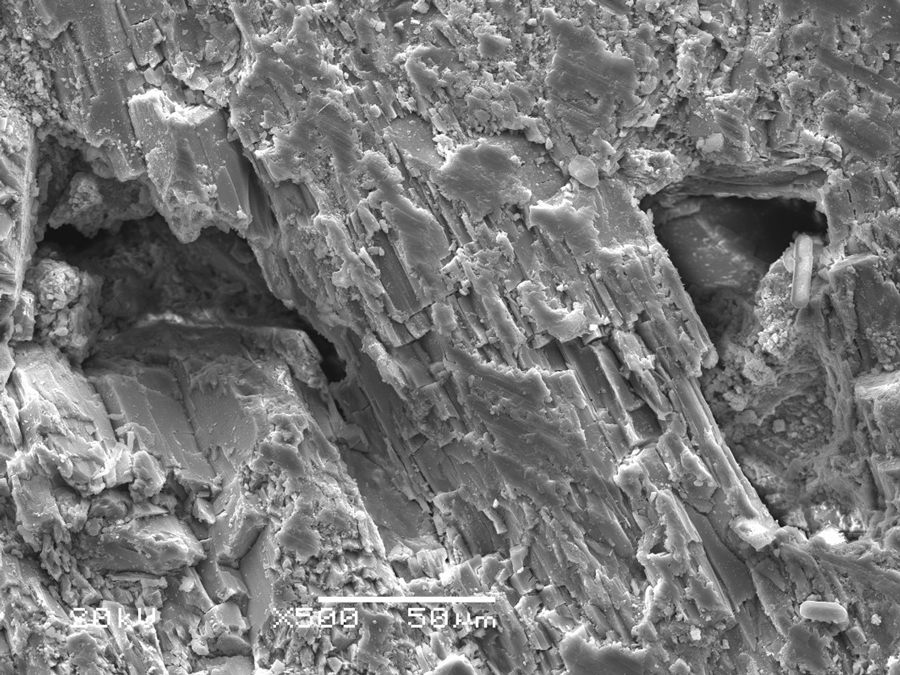
The biogenic nature of such structures in relation to meteorites is considered in the works of Academician Alexei Rozanov and NASA employee Richard Hoover, but their methodology and conclusions are considered highly controversial in the scientific world. In this case, the work of scientists also raises a lot of methodological questions, especially regarding the determination of the elemental composition, the scientist emphasized.
MSU specialists intend to continue studying the discovered structures.
Переведено сервисом «Яндекс Переводчик»
