Pedestrian section: mannequins with "unkillable" legs will accelerate the development of self-driving cars
- Статьи
- Science and technology
- Pedestrian section: mannequins with "unkillable" legs will accelerate the development of self-driving cars


Russia has developed a new test facility for testing car driver assistance systems. It is based on a device that controls the dummy and allows it to accurately simulate human movement when crossing the roadway. This allows AI systems and smart cameras to perceive an artificial pedestrian as a real one and practice correct maneuvers to prevent emergencies. An additional advantage of the complex is its shock—resistant design: the device can withstand collisions at speeds of 80 km/h and above, which allows it to be used repeatedly. At the same time, experts note that developers will have to test and certify the system to confirm its compliance with established standards.
How a mannequin imitates a live pedestrian
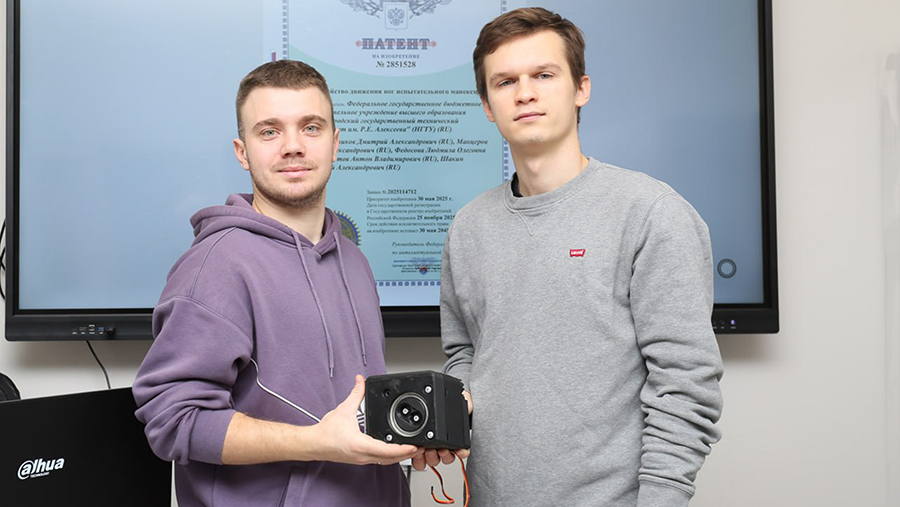
Scientists from the Nizhny Novgorod State Technical University named after R.E. Alekseev have developed and patented an innovative complex for testing driver assistance systems. It is based on a device that allows a mannequin simulating a pedestrian to simulate walking, running, sudden stop and other ways of human movement with high accuracy.
The complex makes it possible to simulate traffic situations as realistically as possible during the tests and check the operation of the systems in conditions close to the present. The development, in particular, is relevant for testing unmanned complexes with artificial intelligence.
It is planned that the new "smart" mannequins will be used in the certification of cars of both domestic and foreign production.
— Modern vehicles are equipped with sophisticated driver assistance systems, which, for example, allow emergency braking or warn of a possible collision. Dummies are used to check the correct operation of such electronics. At the same time, the devices must have human-like biomechanics. Our development helps to achieve this effect: the device's servos allow us to simulate human movements with high accuracy," Anton Zolotov, head of the production department at the Center for the Development of Industrial Robotics at NSTU, told Izvestia.
In addition, the authors of the project managed to achieve smoothness and precision of the movements of the mannequin. The device also allows you to simulate fright and other stress reactions of a person. All this makes it possible for AI systems and smart cameras to perceive a mannequin as a real person.
— The advantages of the invention include the ability to set various motion modes of the dummy using software methods. This distinguishes the development from its foreign counterparts, which use DC motors that mechanically deflect the legs to a set angle. As a result, it is not possible to adjust parameters such as the width and speed of the step. Our complex implements remote setup and control of the test device without the need to get into the mechanism with a screwdriver," explained Anton Zolotov.
According to him, the control device itself is located in the pelvic region of the artificial pedestrian. It is equipped with shock-absorbing surfaces, which makes the product invulnerable in a collision with a car even at speeds up to 80 km/h. In this case, the legs of the mannequin are connected to the body using magnets. Thus, in the event of an accident, they fly away, and then easily rejoin. This makes it possible to quickly restore the test facility in order to continue research, Anton Zolotov explained.

Why field tests of new cars are important
During the tests, the scientists compared the kinematics of the mannequin with the behavior of real people on the roadway. The results showed a high degree of repeatability of artificial pedestrian movements compared to humans. Currently, the developers have started the practical implementation of the device as part of the test equipment used on the polygons.
— Any technique is tested during development. These events have specific and industry-specific features. For example, in medicine, it is important to check for the toxicity of materials, and in motor transport, it is important to test materials and structures for strength and fracture. This includes crash tests involving dummies. Therefore, the idea of making a partially reusable dummy looks logical. This will reduce the cost of equipment and testing in general," Alexey Karfidov, Head of the Department of Technological Equipment Engineering at NUST MISIS, told Izvestia.
He added that Russian companies are currently developing and certifying a number of new domestic vehicles. Among them are the Atom electric car, the BAZ heavy all—terrain truck, and others. In the future, it is planned to produce new modifications of these machines, including those equipped with unmanned control systems.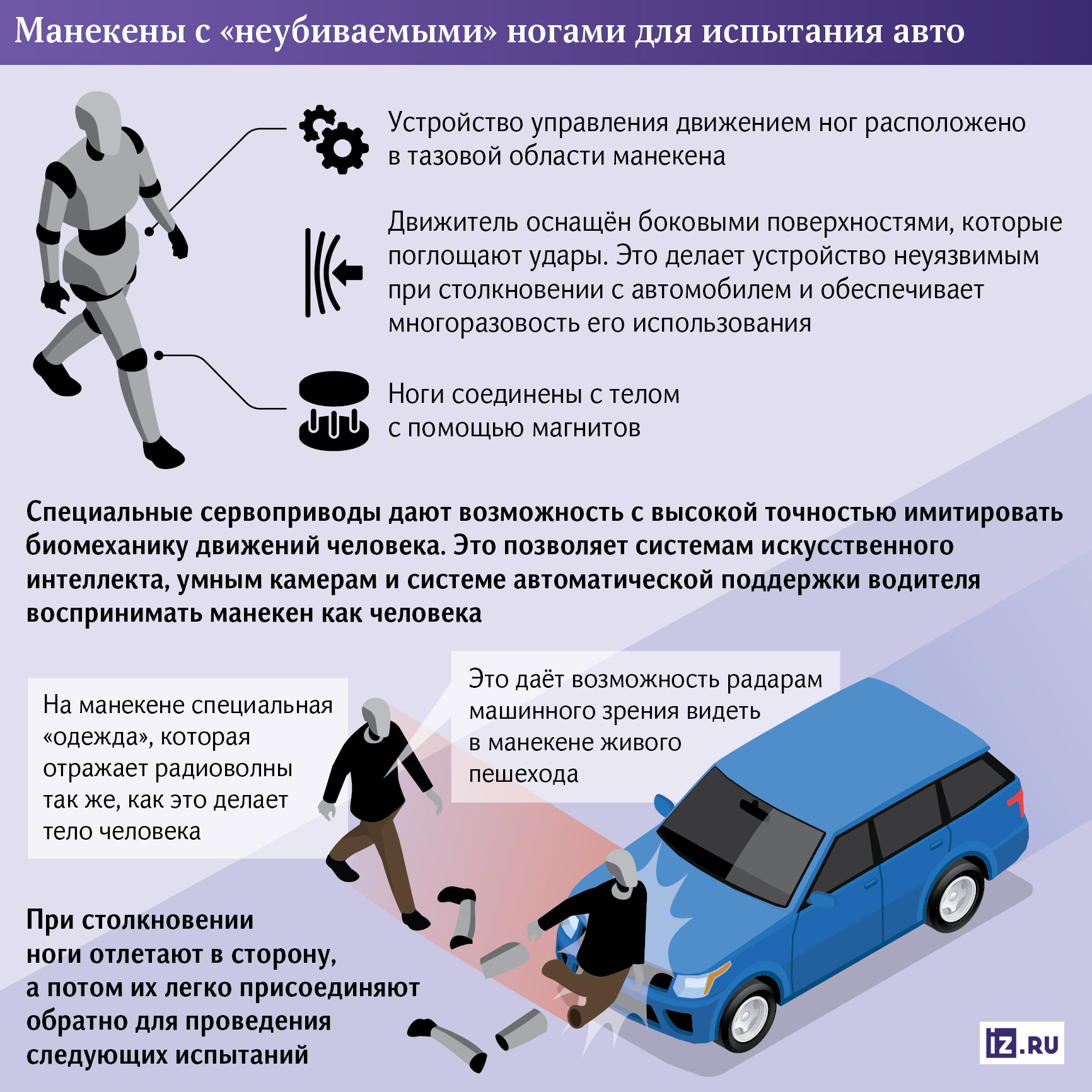
According to him, the demand for car testing will only grow, and the creation of an advanced domestic complex is an important part of the country's technological sovereignty. Having a reliable and reusable dummy will be a significant advantage for car manufacturers. At the same time, the developers will have to test and certify the device to confirm its compliance with established standards.
— The security of complexes based on artificial intelligence must be constantly checked. This is due to the fact that such systems are poorly interpreted. That is, people may not always understand why they made this or that decision. This opacity can lead to dangerous and unexpected situations on the road, and also makes it possible to manipulate such systems," says Dmitry Senyushkin, head of the Autonomous Vision research group at the AIRI Institute.
One example is attacks on automotive AI systems by deliberately placing drawings, road signs or realistic posters depicting people on the roadway, he explained. As a result, an unmanned vehicle may perceive a false warning or threat as a real obstacle and make a dangerous maneuver. Therefore, such systems need to be tested using various means to ensure that they respond correctly to real hazards.
At the same time, the test report itself should be as close as possible to real road situations. Dummies with unnatural behavior reduce the quality of system testing.
Переведено сервисом «Яндекс Переводчик»
