
Infernal canned food: what archaeologists are finding in the ruins of Pompeii

Gabriel Zuchtrigel, the young, energetic and enterprising director of the Pompeii Architectural Park, who took up his post in 2021 at the age of 39 (not without opposition from stagnant academic retrogrades), manages to touch on many topics in his compact book, both personal, professional, and general philosophical, related to his understanding of the socio-cultural mission of an archaeologist. Critic Lidia Maslova presents the book of the week, especially for Izvestia.
Gabriel Zuchtrigel
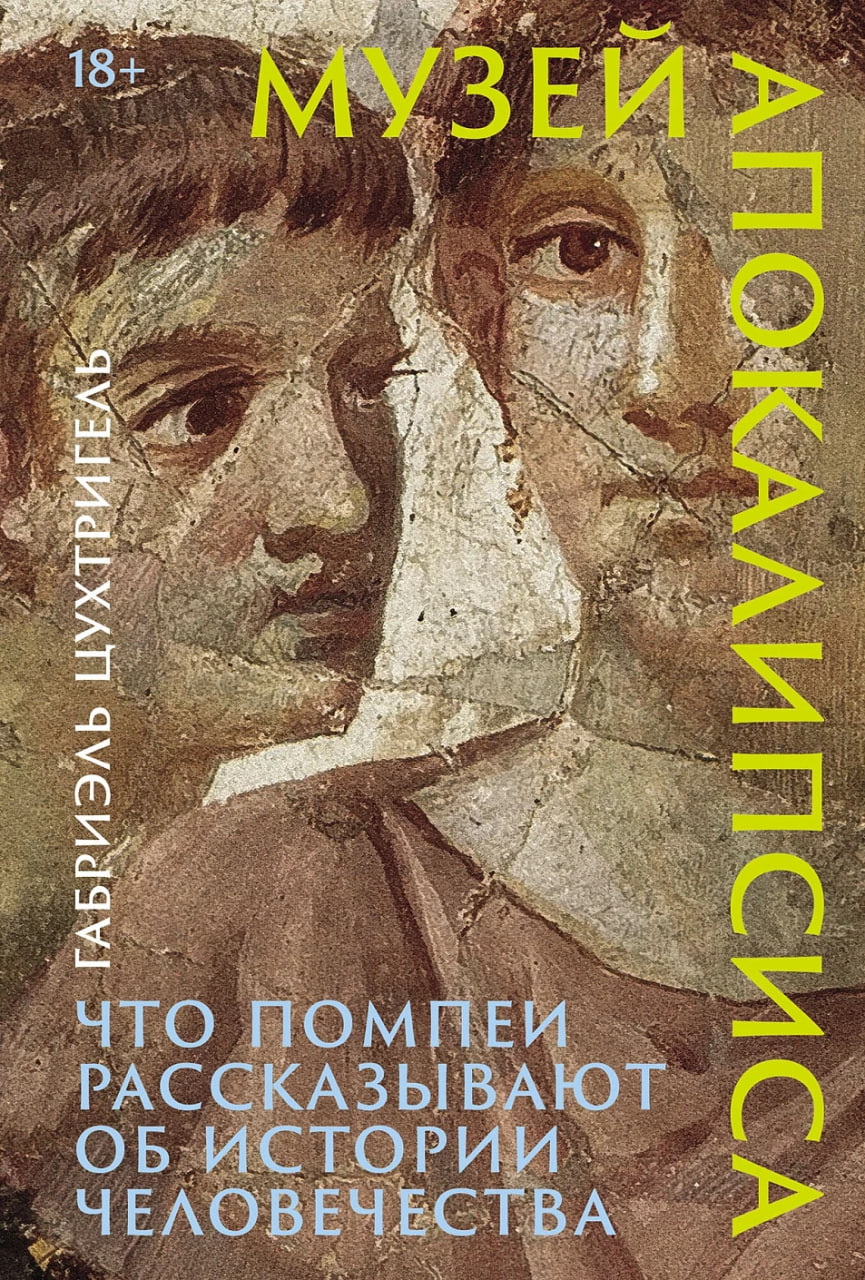
The Museum of the Apocalypse: What Pompeii tells us about human history"
Moscow : Alpina Non-fiction, 2026. translated from German, 218 p.
One of the main ideas of the Museum of the Apocalypse is that without a personal, deeply emotional attitude to one's work, neither real scientific discoveries nor the accompanying career growth are possible. To illustrate the productive inextricable connection between personal and professional, Zuchtriegel uses the automotive metaphor of the inner "motor" that drives every good specialist who has managed to find himself in his place in this life. One of the sub-chapters of the preface is called "What drives us?", and in it the author tries to explain why he wrote this book in the first place: "Whoever embarks on a journey needs an engine that guides him. Something that attracts us, just as Stendhal was attracted to Italy, the country to which he constantly returned."
Stendhal, who gave his name to the famous syndrome, which is expressed in the emotional perception of artifacts almost to fainting, appears on the very first pages of the book, and although Zuchtriegel did not experience the notorious syndrome himself, he admits that there are several places in Pompeii where he "does not feel protected." First of all, it is the Ortho dei Fujasci (Garden of the Fugitives) on the southern outskirts of the ancient city, where 13 victims of the eruption of Vesuvius in 79 AD, including several small children, were discovered. Shrouded in hardened ash and dust, their bodies decomposed, leaving cavities in the rock, which in 1870, archaeologist Giuseppe Fiorelli came up with the idea to fill in plaster, producing casts so accurately reproducing the facial features, hairstyles, clothes and physique of the dead, "as if they had died a few hours ago."
"On the day of the eruption of Vesuvius, the city was literally mothballed," writes Zuchtrigel, emphasizing the uniqueness of Pompeii as a treasure trove for archaeologists who received an example of a provincial ancient Roman city. The main feature and value of Pompeii, in the opinion of their director, "is not the temples (the more grandiose temples are in Paestum and Pozzuoli), not the amphitheater or theater (there are larger ones in Rome, Capua or Verona)," but the fact that the entire social infrastructure has been preserved here: shops, loupanaries, taverns, fountains squares, temples and cemeteries, and in residential buildings you can explore the smallest details of everyday life, including bread in the oven and pots on the stove. This makes it possible to overcome the original flaw of historiography and archaeology, which studies mainly the life of the elite, the ruling classes, but has much less data on the life of the poor: "Texts, inscriptions, buildings, tombs created by the will of a tiny minority of the rich and powerful make up the vast majority of the sources available to us.

What is currently accessible only to a narrow circle—the world of the super—rich and powerful-dominates our view of ancient Roman life." Thus, the elite's point of view closes the ancient reality in its entirety from scientists, especially since the poor, as Zuchtriedel notes, rarely write diaries, letters and treatises, and they reach researchers even less often: "... we get almost all information about the life of ancient slaves from the texts of slaveholders. or from the records of a small group of wealthy freedmen."

All this, according to the director of Pompeii, dictates the urgent need to preserve all the archaeological finds found here in place, resorting to moving frescoes and statues to museums only in exceptional cases, when otherwise they cannot be preserved. "The goal is, as can be seen from the example of the thermopolium (an ancient street cafe) excavated in 2020 and opened to the public for the first time in 2021, "to reproduce the condition of 79 AD as accurately as possible, including the cooking pots and amphorae that stood on or near the counter," explains Zuchtriedel, rejoicing that the days when Pompeii was more of a quarry where scattered works of art were randomly mined for royal collections, rather than an open—air museum requiring an integrated approach and understanding of a single historical context. It was precisely this approach that Goethe felt during his Italian voyage in 1787, when he was "less impressed by the works of art found in Pompeii than by the ancient city itself as a kind of gesamtkunstwerk."
Quoting Goethe, who mentally transfers the finds he saw in Pompeii "to a bygone time, when all these things that surrounded their owners were used in everyday life and brought joy," Zuchtriedel notes that the German encyclopedist also drew attention to the cramped houses that he visited during excavations: "Those small houses and rooms in Pompeii now they seemed both cramped and spacious to me; cramped because I imagined them filled with so many worthy objects, more spacious because it was these objects, decorated and enlivened by fine art, that pleased and filled with feelings in a way that no spacious room could have done."
But the author of the Museum of the Apocalypse looks at this narrowness in a slightly different, less exalted and joyful aspect. Goethe's sense of the crowding and smallness of Pompeii's "dollhouses" is useful to Zuchtriedel in the third chapter, "A City on the Verge of Disaster," where the archaeologist puts forward a rather convincing hypothesis about the overpopulation of Pompeii. Based on recent findings, some deductive reasoning and calculations, the scientist assumes that the city was inhabited by about 45 thousand people - "this is twice as many as the boldest estimates made in 150 years of scientific discussions, and four to five times more than was claimed in the scientific community until recently."

The concept of overpopulation allows us to paint a rather depressing picture of the existence of an ancient metropolis that depended on the import of basic foodstuffs, where many more people lived than could feed the surrounding lands, occupied mainly by vineyards (wine exports were the main source of income for Pompeii) and the villas of the rich (like Cicero or Nero's wife Poppaea Sabina).: "... in the last decades before the eruption of Mount Vesuvius in 79 A.D., Pompeii lived in anticipation of disaster — not only because of the impending natural disaster, but also because the city was in a precarious economic and social situation, constantly teetering on the brink of collapse."
If we take this hypothesis on faith, then the tragedy that occurred in Pompeii acquires a special disastrous charm, which is hinted at by the original title of the book — "Vom Zauber des Untergangs": the city, doomed to social collapse, eventually did not die, buried under a thick layer of ash and lapilli (petrified pieces of lava), but, on the contrary It has gained immortality in the form of a monument of ancient architecture and an inexhaustible source of archaeological discoveries.
Переведено сервисом «Яндекс Переводчик»
