- Статьи
- Economy
- The difference framework: the gap between the pensions of working and unemployed will decrease to 2-3 thousand.

The difference framework: the gap between the pensions of working and unemployed will decrease to 2-3 thousand.

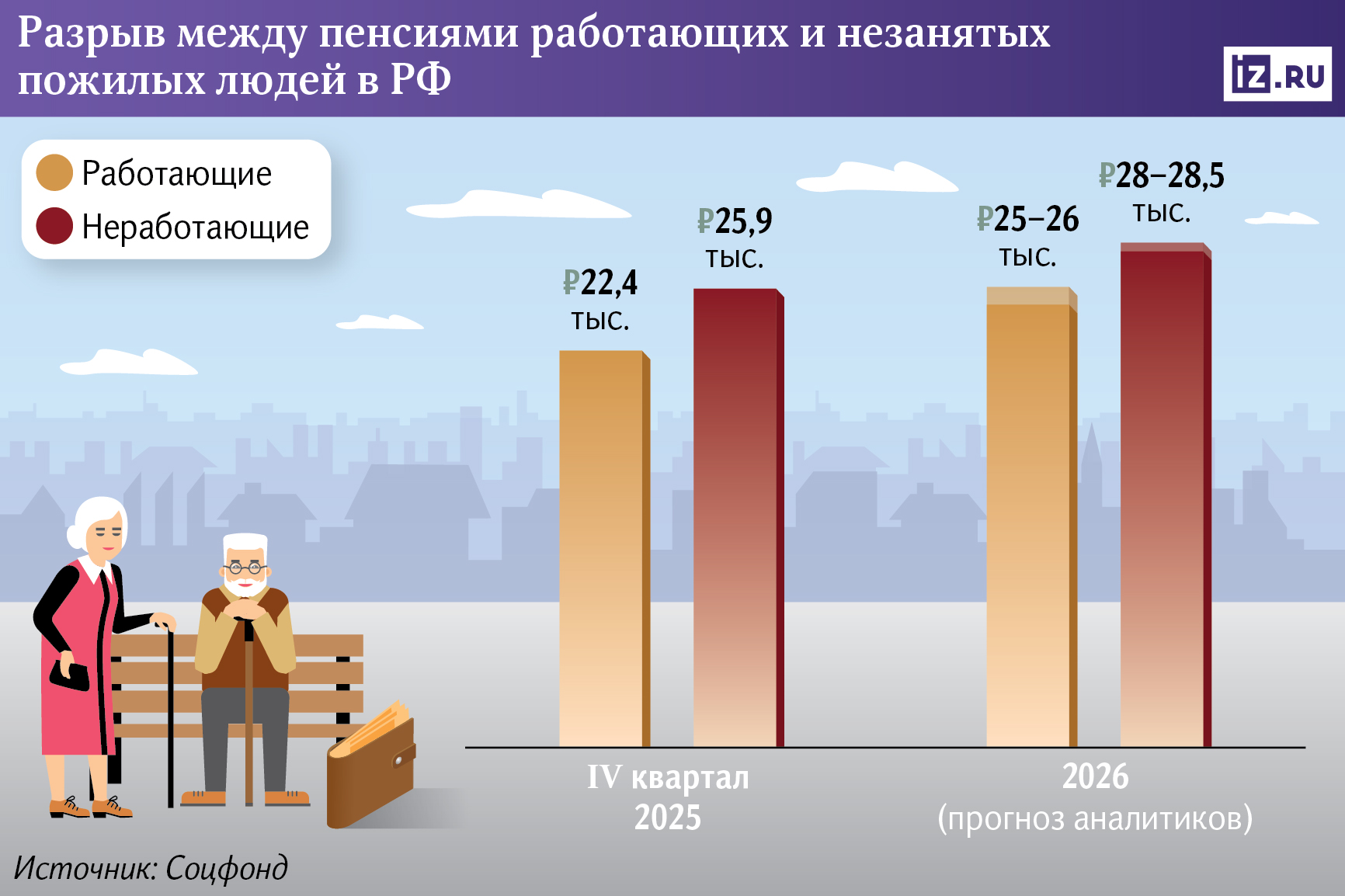
In 2026, the average old—age pension for working Russians will increase to 25-26 thousand rubles, for the unemployed - up to 28 thousand, analysts polled by Izvestia predict. That is, the difference between them will be reduced to 2-3 thousand, the minimum since at least 2021. The reasons are the resumption of indexation of payments for employed senior citizens, the growth of their incomes, as well as the retirement of 64—year-old men and 59-year-old women. But despite the growth outpacing inflation, these funds are still insufficient for a comfortable life. Therefore, experts advise to prepare for this period in advance. Which regions have the highest and lowest pensions and which tools allow them to increase their level — in the Izvestia article.
What will pensions be like in 2026
Since January 1, 2026, insurance pensions of Russians have been indexed by 7.6%, which is higher than the inflation rate. As a result, the average old-age payment in 2026 will reach 27 thousand rubles.
Usually, payments to senior citizens who continued to work were noticeably lower than those who were unemployed. However, after the resumption of indexation for the employed, which was suspended in 2016, the difference began to shrink rapidly.

According to the Social Fund, in the fourth quarter of 2025, the average amount of old—age payments for working pensioners was 22.4 thousand, for unemployed - 25.9 thousand. Thus, the gap between the amounts decreased to 3.5 thousand. This is the minimum value since 2021 - then the difference was 3.1 thousand, there are no earlier statistics. The editorial board sent a request to the SFR.
In 2026, the average amount of payments for working pensioners may be about 26 thousand, for non—working - 28-28,5 thousand. That is, the difference will decrease to 2-2.5 thousand, predicts Yulia Dolzhenkova, a professor at the Financial University under the Government of the Russian Federation.
After the January indexation, the average payout to employed people in early 2026 will reach about 24,000, estimated Natalia Milchakova, a leading analyst at Freedom Finance Global. At the same time, from August 1, an annual recalculation will take place for this category, taking into account the pension points accumulated in 2025. The Social Fund will take into account no more than three coefficients, even if they are actually earned more. As a result, the maximum increase will be 437 rubles, based on the cost of one pension point of almost 146 rubles. This will increase the amount to almost 25 thousand, the expert believes.
The average pension for unemployed in 2026, according to Natalia Milchakova, may approach 28 thousand rubles. Based on these calculations, the gap between the payments of workers and unemployed senior citizens will decrease to about 3 thousand.

Anastasia Gorelkina, deputy chairman of the Board of Directors of HC SDS JSC, came to similar conclusions: according to her, non—working pensioners, on average, can reach the level of about 28 thousand, and employed - about 25 thousand.
— With the expected reduction of the difference by 3-5% per year by 2030, payments to the employed and unemployed may become comparable. At the same time, the convergence of indicators will occur twice a year: in the beginning — due to indexation and in August — during the recalculation of pensions for the employed, taking into account the accumulated coefficients, — says Tatiana Podolskaya, an expert at the Presidential Academy.

Why is the difference between the pensions of the employed and the unemployed decreasing?
The gap between the pensions of the employed and the unemployed continues to shrink, as indexation for the former has been resumed since 2025. For them, it is calculated not from the amount actually accrued, but from the amount that they could receive if they rested, taking into account all missed raises. Also, upon dismissal, the payment is recalculated automatically using all missed increases, explained Olga Belenkaya, head of the Macroeconomic Analysis Department at Finam.
— This decision was made to respect the rights of both categories of pensioners and to reduce the proportion of those who receive salaries "in an envelope". The difference in payments previously pushed many to work informally in order to receive standard pensions," said financial adviser and founder of Rodin.Capital Alexey Rodin.

The decrease in the gap is also due to the fact that in 2026, 64-year-old men and 59-year-old women will retire on general grounds. These citizens received higher incomes at economically more favorable times and have sufficient insurance experience to receive better payments, recalled Yulia Dolzhenkova from the Financial University.
Which regions have the highest and lowest pensions?
Traditionally, the lowest old—age payments are recorded in the republics of the North Caucasus - Chechnya, Ingushetia, North Ossetia and Dagestan, as well as in some regions in the south, including Kalmykia, Yulia Dolzhenkova noted. The average level there is about 18% lower than the national level.
Residents of Moscow, the north-west and the north receive the highest pensions. So, in November 2025, in the Chukotka Autonomous Okrug, the average figure approached 40 thousand rubles: for workers - about 35 thousand, for non—workers — about 41 thousand, the expert pointed out.
The variation is explained by income levels and living conditions. Salaries are higher in large industrial centers, and in regions with harsh climates there are regional coefficients and additional payments, the professor explained. In addition, payments are brought up to the regional subsistence level, which cannot be lower than the national average. For example, in Chukotka it is 39.8 thousand.

The place of residence also has an additional impact: in rural areas, the amounts are usually lower due to lower incomes, she added.
How to save for old age
Formally, pensions are indexed annually, but growth often does not compensate for the rise in price of essential goods, and, as a rule, this money is not enough to live on, said Alexey Rodin from Rodin.Capital.
As Yulia Dolzhenkova from the Financial University reminded, there are several ways to increase future payments. The first is to accumulate seniority and coefficients during official employment. The second option is to purchase the missing points before going on a well—deserved vacation. In 2026, you can fill up to 7.5 years of experience and up to 8.7 percent of the required 30. The cost of one point is now 65.6 thousand rubles, so the maximum expenses for the year can reach 571 thousand. The self-employed can make contributions without restrictions.

Another option is to use an increasing coefficient if you apply for payments later than the set age. For example, with a five—year deferral, the fixed part of the pension will increase by 36%, and the sum of the coefficients will increase by 45%, the professor recalled.
Traditionally, residents of the Far North receive higher pensions. The northern experience of 15 years increases the fixed part by 1.5 times. At the same time, many remain registered in the region, moving to a milder climate, Alexey Rodin added.

Additional allowances are provided for holders of the highest state awards of Russia and the USSR, as well as for Olympic and Paralympic champions. In addition, you can direct the maternity capital to the parent's funded pension.
Those who think about the future in advance tend to prepare financially for retirement, the expert noted. As a rule, most choose bank deposits. Others invest in real estate, enter the stock market, or use the tools of private pension funds.
Additionally, you can participate in the long-term savings program, Arkady Nedbai, Chairman of the Council of the National Association of NPFs, reminded. It provides for state support for contributions, tax deductions and investment income. More daring citizens may consider stocks and individual investment accounts. To reduce risks, the expert advises allocating funds between different instruments — deposits, investments, and long-term programs, including personal income tax and shared life insurance.
Переведено сервисом «Яндекс Переводчик»
