The auto industry on a charge: how the market is rebooting through hybrids


In Russia, car production has been recreated in almost all the most popular segments, Anton Alikhanov, head of the Ministry of Industry and Trade, noted in early December. Russian assembly lines produce more than fifty passenger cars, sedans, crossovers, SUVs, pickups and vans. Domestic manufacturers have mastered such a new segment as electric vehicles and sequential hybrids. Izvestia found out how the transition from fossil fuels to new energy is carried out in the Russian automotive industry.
"People have dreams"
AvtoVAZ, Avtotor, and Moskvich already have separate electric models in their product lines, but Evolute became the first brand in Russia to be tailored to New Energy vehicles (NEV).
— In 2021, we came up with the idea that Russia lacks electric transport. There was no industry, and the charging infrastructure was scary. But there were dreams: of clean air in cities and cheap "charging" instead of refueling. That's why they named the Evolve brand as the basis for change, evolution along with the market," Andrey Reznikov, managing partner of the manufacturer, tells Izvestia.
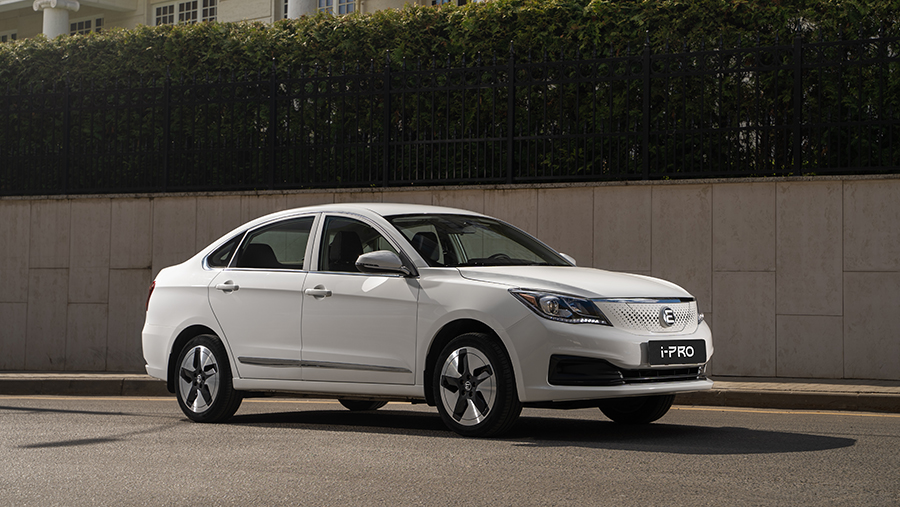
In March 2022, the company signed Russia's first SPIC 2.0 for the production of electric vehicles with multibillion-dollar investments. Already in the second half of the year, large-scale assembly of several models began at the plant in the Lipetsk region.
Passed the baton
The Evolve i-Pro sedan occupied an empty niche of an affordable electric car in 2022. Success came from taxi companies and corporate clients who appreciated the galvanized body, low maintenance costs and government benefits: subsidies of up to 925 thousand rubles, free parking and free passage on toll roads. This allowed the i-Pro to become the best-selling locally produced electric sedan in the Russian Federation (3,271 units), and the Evolve brand to take the first place in the Russian market in sales of vehicles powered by new energy sources from 2022 to 2025. However, in November 2025, the production of the i-Pro was unexpectedly stopped for many.
The company explains the decision for two reasons: the life cycle of the model has been exhausted, and the market has become more competitive in three years. They are now betting on more modern models. The new i-Joy crossover, while maintaining an attractive price tag (including subsidies), has become more technologically advanced and better equipped. Its full production cycle with welding and painting will start in early 2026.
Turning to hybrids
The key reason for the change of course was the unexpectedly high demand for hybrids. They offer more autonomy and are less dependent on the currently insufficient charging infrastructure. In the fall of 2025, hybrid sales were breaking records.
Therefore, changes were made to SPIC 2.0: the i-Pro was replaced with the Voyah Passion hybrid sedan, other Voyah hybrid models were added, and the electric lineup was rebooted with new i-Joy and i-Sky crossover platforms. At the end of 2025, the Lipetsk Region also launched a full production cycle of the Evolute i-Space hybrid crossover.
"Manufacturers within the framework of the SPIC can adjust the program taking into account market conditions and sanctions," the Ministry of Industry and Trade explained to Izvestia.
The production of NEV-segment cars in Russia has taken off. In 11 months of 2025, Evolute and Voyah have already produced more than 9 thousand cars, which is 3 times more than all manufacturers in Russia in the same period in 2024 (2,855 units).
The Russian-built Voyah Free crossover became the leader: in October 2025, it became the most popular NEV car in the country, with more than 1,500 cars registered.
Mechanics of state support
Support for the NEV segment is part of the government's strategy. The main instrument is a subsidy to the buyer of 35% of the price (a maximum of 925 thousand rubles) for electric vehicles and sequential hybrids for all categories of borrowers.
"The programs are aimed at stimulating demand through loans and leasing," the Ministry of Industry and Trade emphasizes. They also note that the manufacturer of Evolve (Motorinvest) did not receive direct state support for localization, but worked on the tasks of the SPIC at the expense of its own investments. Income tax benefits in the amount of 3.5 million rubles were received only in 2022.
Also, according to data provided to Izvestia, the manufacturer of Evolute Motorinvest received 8 million rubles under a federal project as compensation for part of the cost of maintaining jobs for the entire volume of i-Pro products.
Differentiation of benefits is needed
"There is an increased interest in hybrids, especially sequential ones, where the internal combustion engine is just a generator for the battery. In many countries, they are considered a type of electric vehicle with corresponding benefits. In order for the market to take off, we need benefits similar to those available to electric cars: free parking, free travel on toll roads," says Igor Morzharetto, partner at Autostat.
There are other objective but surmountable difficulties that industry experts are paying attention to.
Maxim Kadakov, editor-in-chief of Za Rulem, points out another problem: "The subsidy now does not take into account either the degree of localization or the final price of the car. With gasoline cars, there is a differentiation. For the development of the industry, it is necessary either to increase support or to introduce gradation of subsidies depending on the degree of localization."
Переведено сервисом «Яндекс Переводчик»
