
To raise the bonus: 13% of Russians are confident of receiving the 13th salary

Every eighth Russian is confident of receiving a 13th salary or a New Year's bonus, calculated for Izvestia hh.ru Extractive industry workers (21%) and IT specialists (16%) receive this payment most often. Bonuses are gradually ceasing to be a mass practice in the market. Companies are more likely to introduce one-time rewards for individual achievements, as well as offer additional weekends and training courses. Why some enterprises continue to support employees on the eve of the holiday and what the trend will be in the coming years is in the Izvestia article.
How many Russians will receive the New Year's prize
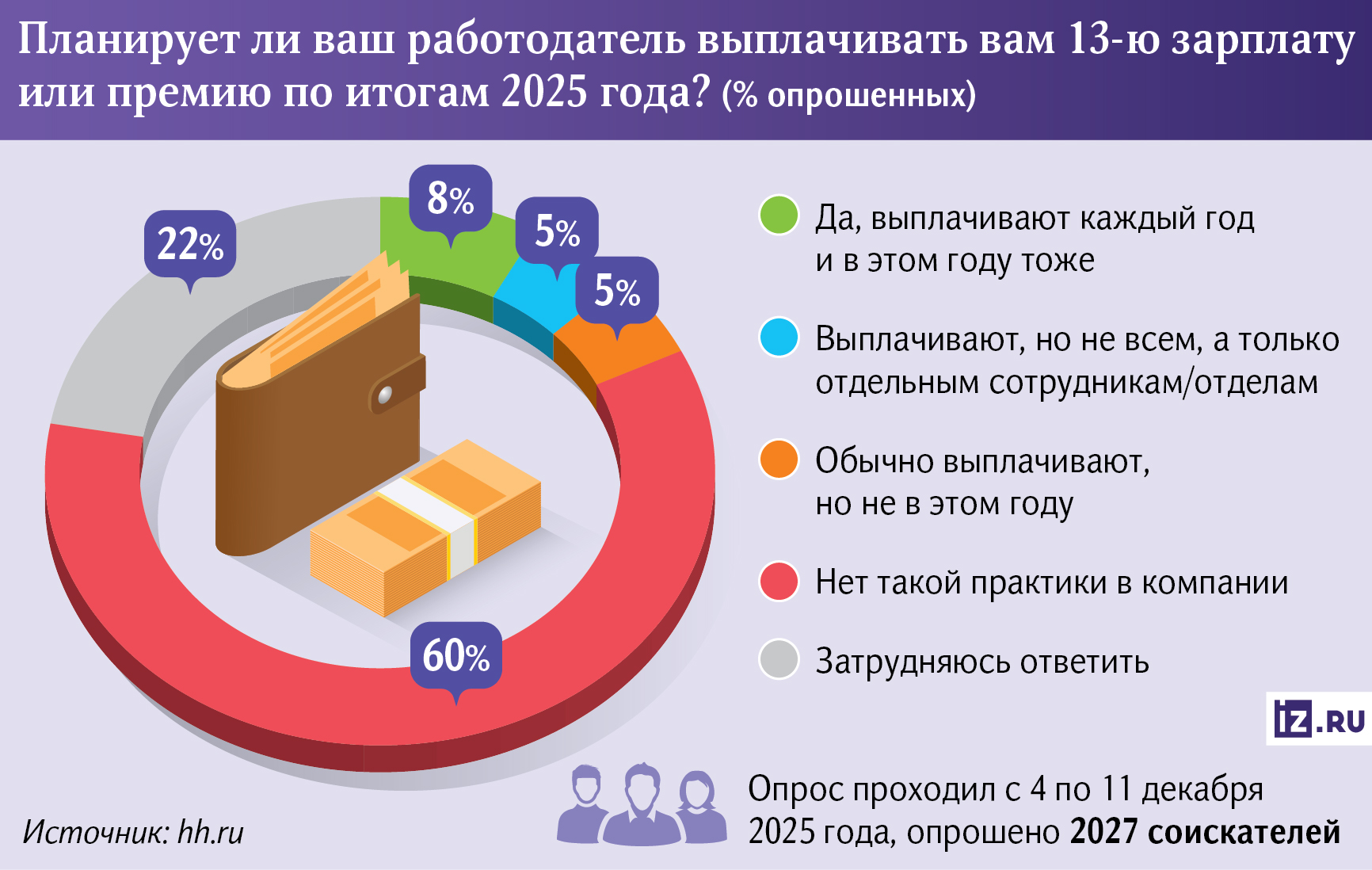
More than half of the Russians surveyed (60%) reported that they would not receive a New Year's bonus or a 13th salary, as their company does not have such a practice. At the same time, 5% of citizens stressed that their employers had stopped paying remuneration this year. This is evidenced by the results of the December survey of the service. hh.ru , which was attended by over 2,000 respondents (available from Izvestia).

Much fewer employees told about the appointment of financial incentives for them — only 13%. Most of them emphasize that they are paid additional funds annually, while the rest indicate that bonuses at their enterprises are selective and apply to individual specialists or departments. The remaining 22% of respondents found it difficult to answer whether they would receive a financial reward.
For example, this year, such remuneration is most likely to be expected for workers from the extraction of raw materials (21%) and IT specialists (16%), according to calculations. hh.ru . And this practice is least common in retail, tourism and hospitality (4% each), as well as in the automotive business, where none of the respondents reported such payments.

At the same time, employers are encouraging employees in December less and less every year. For example, in 2024, 17% of respondents were confident in assigning the 13th salary. And in 2023, more than a quarter of Russians expected to receive a reward, Izvestia wrote earlier.
The very term "13th salary" appeared in Soviet times, said Yulia Dolzhenkova, a professor at the Financial University under the Government of the Russian Federation. That was the unofficial name for the remuneration based on the results of the year. In most cases, it was equal to the size of a monthly salary and was paid upon completion of an annual production plan of appropriate quality, the expert added.

According to "Work.<url>", about a third of the respondents would like to receive an amount equal to half of their salary. And a little more than a fifth of the respondents expect a bonus of up to 100% of their monthly earnings.
At the same time, according to Avito Rabota, from January to November 2025, the number of vacancies with a mention of the 13th salary increased 1.5 times year on year.
To objectively assess the volume of annual premiums, we need data on December earnings, which arrive later, said Pavel Smelov, CEO of CSR. According to him, the survey reflects employees' expectations rather than actual payments, and allows us to judge only labor attitudes.
— Against the background of the fact that the discussion of salary increases has become the norm, bonuses regain their original meaning — encouragement for special results, and not an obligatory part of remuneration. This does not mean an increase or decrease in their size, but increasingly Russians perceive bonuses as an assessment of personal contribution, rather than as a guaranteed payment," the expert added.
Which companies have a 13th salary?
At the same time, more than half of employers announced plans to pay a bonus, according to the study "Work.ru". Most of them intend to reward the entire staff, the rest — only distinguished employees and those who have been working in the company for a long time.
At the same time, one third of enterprises are going to allocate up to half of the employee's monthly salary, the other third is going to pay the 13th salary, it follows from the data of the platform. In addition, for 26% of enterprises, the amount of the incentive will depend on the employee's achievements.

Izvestia asked the largest Russian corporations whether they plan to reward their staff. In particular, the press service of Rostec State Corporation reported that, in general, they do not practice paying the 13th salary by the holiday. Usually, rewards are linked to the achievement of the result for the previous year, so it is paid after summing up the results — in April next year, they added.
Rusal traditionally makes an additional New Year's Eve payment in the amount of one salary to its employees. The corporation clarified that despite the difficult conditions for the industry, the decision has already been made — the bonus should be expected at the end of December.

In addition, the annual remuneration at Severstal is part of a comprehensive system, which includes, in addition to salaries, a social package with compensation for mortgage interest, VMI, 20 thousand rubles, which can be spent on maintaining health, supporting motherhood, family and childhood. Such a bonus is not considered a gift for the New Year — it reflects the effectiveness of the work. At the same time, the 13th salary is not provided there.
In addition, the practice of awarding bonuses based on the results of annual work exists in the Lenta Group. The reward depends on the achievement of the goals and individual results of the employees.
How else do companies celebrate employee achievements
In fact, bonuses depend on the company's profit or operating cash flow, Natalia Milchakova, a leading analyst at Freedom Finance Global, pointed out. If incomes decrease over the course of a year due to the crisis or external challenges, or deterioration in the quality of management, this means that employee benefits will decrease, she added.
Nevertheless, organizations still continue to reward their employees in an attempt to retain staff, said Anna Khripchenko, Director of Academic and Career Development for students at the Presidential Academy. Payments are a tool for motivation, increasing loyalty and strengthening team spirit, as well as a symbolic expression of recognition of the contribution of employees. In addition, the availability of annual bonuses can serve as a competitive advantage in the labor market, especially in conditions of a shortage of qualified specialists, she added.

Igor Rastorguev, a leading analyst at AMarkets, is sure that the practice of 13 salaries will probably decrease in the coming years. Companies will begin to act selectively: premiums will remain in the profitable segments of mining, IT and finance.
At the same time, instead of massive annual bonuses, employers are increasingly using other forms of incentives — monthly or quarterly bonuses linked to specific achievements, intangible motivation such as extra days off or public recognition, as well as investments in employee training and development, Igor Rastorguev added. These tools are more flexible and allow companies to maintain cost control in an uncertain environment.
Переведено сервисом «Яндекс Переводчик»
