- Статьи
- Society
- Chat with a curator: special services of Ukraine have started recruiting schoolchildren in dating bots

Chat with a curator: special services of Ukraine have started recruiting schoolchildren in dating bots

Ukrainian special services have begun actively using popular Telegram dating bots to recruit Russian schoolchildren, sources told Izvestia. The editorial office found correspondence at its disposal, after which, in November, high-profile arson attacks were committed on a cinema in the Moscow Aviapark shopping center and a relay cabinet on the Belarusian direction of the MZhD. Under the guise of discussing the meeting place, the "girl" asked the teenager to name the addresses of shopping malls, and then the student received a video with "gratitude from the Armed Forces of Ukraine" allegedly for his help in preparing attacks. After further processing, the victims committed crimes, believing that they were carrying out a secret FSB mission. Moreover, the Ukrainian curator calmly used a Russian SIM card after the terrorist attacks, with which he blackmailed the victims. Izvestia managed to enter into correspondence with him.
"High trust"
On November 12, 16-year-old Vladimir Sh was detained at a self-service gas station with a canister of gasoline in Odintsovo, Moscow region. The student was going to start a fire in the local cinema "Yunost" during the evening session. A few hours earlier, he set fire to a relay cabinet on the 25th kilometer of the Belarusian direction of the MZhD, as well as a workwear store on Molodezhnaya Street in Moscow.
The next day, law enforcement officers detained another student — he started a fire in one of the halls of the cinema in the Aviapark shopping center. There was a chat on his phone with the same person who recruited Vladimir Sh.
Screenshots of the correspondence, which turned out to be at the disposal of Izvestia, confirm that the Ukrainian special services began using popular Telegram dating bots to recruit and deceive schoolchildren.

The day before his arrest, Vladimir met a "girl" in just such a chatbot. She asked to send the addresses of the nearest shopping centers, ostensibly to choose a meeting place. But as soon as the teenager sent geolocations of objects, instead of a date, he received a video in which a man in the uniform of the Armed Forces of Ukraine thanked him for his help in preparing attacks on the territory of Russia.
This was just one of the stages of blackmail. A few hours later, the student received a call from the FSB and was informed that a criminal case had been opened against him on suspicion of treason. He could avoid punishment by completing the tasks of the "Service for the Protection of the Constitutional Order and the Fight against Terrorism of the FSB of Russia" (NWKSBT).
For greater persuasiveness, the young man was even asked to write and send a photo of the receipt with the following content (the author's spelling is preserved): "I <...> I undertake to comply with the orders of the NWSBT to counter terrorism. I have read the non-disclosure article. 12.11.2025».
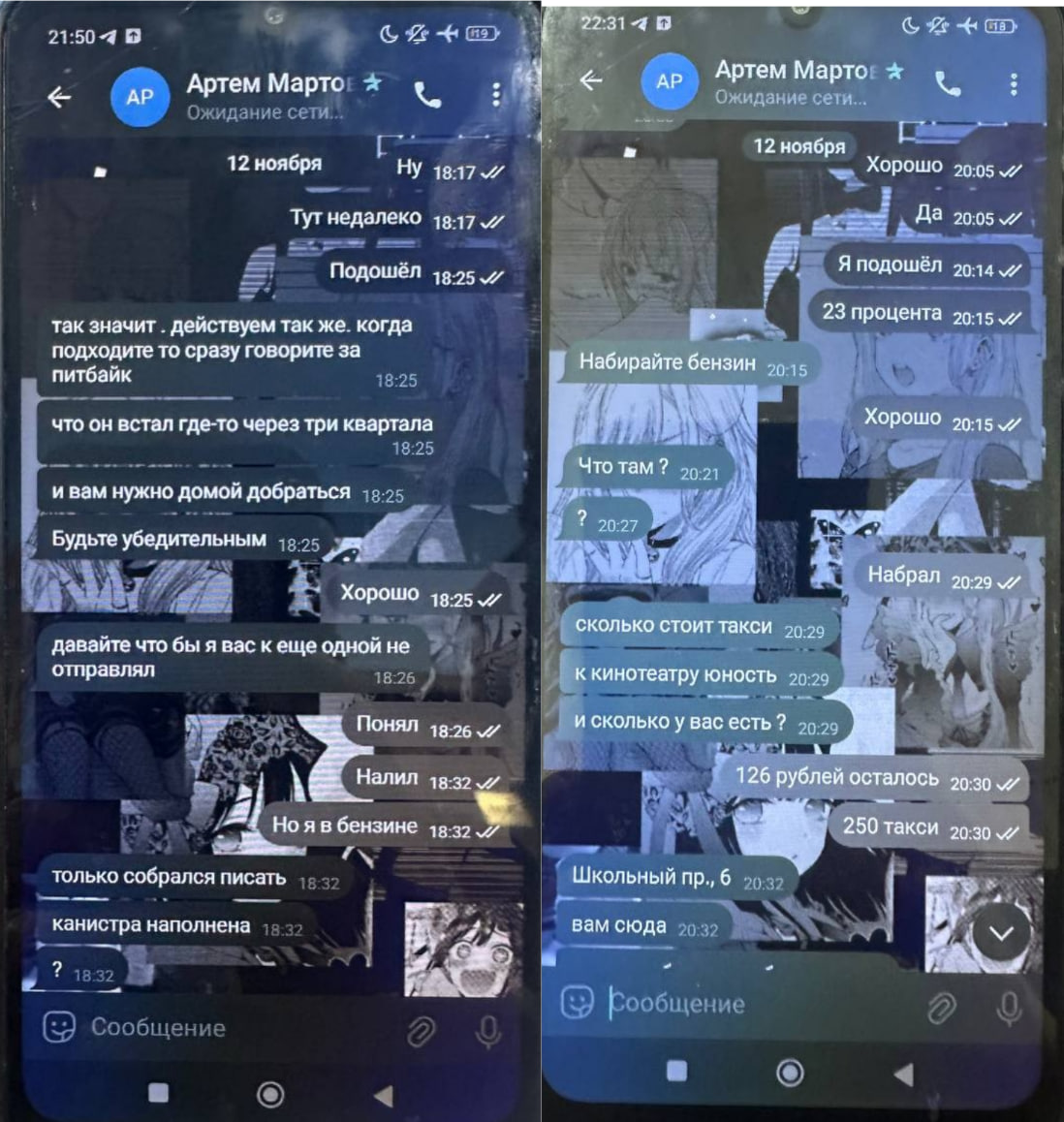
The tasks were to set fire to civilian objects. Their addresses in video calls and via Telegram chat were indicated by the curator, who introduced himself as Artem Yurievich Martov, an employee of the NWSBT. He also transferred money for taxis and fuel to the student's card.
During the course of the assignments, not everything went smoothly, Martov constantly had to improvise. So, in Odintsovo, at one of the gas stations, the student was categorically refused to sell gasoline. The supervisor sent the teenager to another gas station with instructions: "As soon as you approach, immediately tell the pit bike that it stopped about three blocks away and you need to get home. Be convincing."
During his conversation with Martov, Vladimir had some doubts — the guy did not hide that he was scared and that he did not understand why so many arson attacks were needed. "But because our people are like that, they sell Ukrainians for a penny, and our job is to get such scum out. The FSB trusts you, that's why they chose you," the Ukrainian curator motivated the minor.
Under his leadership, Vladimir first set fire to the Voentorg store, and then to a relay cabinet on the Belorussky line of the Moscow Railway.

The photo that Vladimir Sh. I sent it to an "FSB officer" to confirm the arson.
Before setting fire to the Yunost cinema, Martov sent Vladimir to get gasoline again, this time the option of refusing service to the boy was unlikely — it was a self-service gas station. But there, along with the canister, the student was detained.

15 seconds to ignite
According to a similar scheme, Artem Martov encouraged another student to commit a crime. Correspondence with this man was found in the phone of a 16-year-old teenager who set fire to a cinema hall in Moscow's Aviapark shopping center on November 13.

Vladimir Sh. when detained with a canister of gasoline at a self-service gas station
During the conversation with the representative of the Ukrainian special services, the student was in an extremely depressed state. Nevertheless, the curators (the student was redirected to the account of a certain Alexander Belov) tried to calm the teenager down: "Do you think if we didn't have our own people there, would they let you go to the cinema with a can of gasoline?"
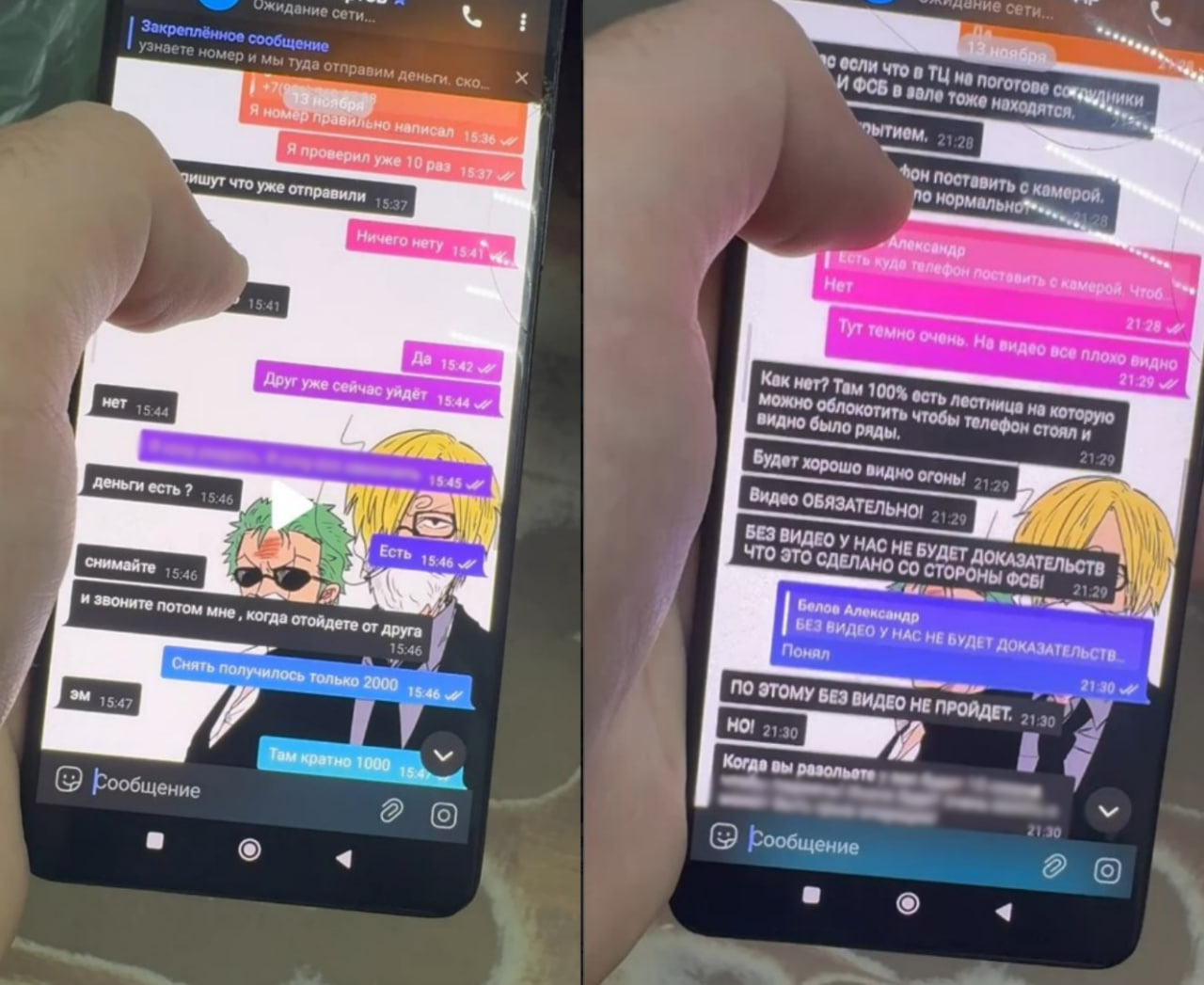
Immediately before the arson, when the young man was already in the auditorium, he underwent a second briefing. "You will need to turn on the camera so that you can see how it all happens," the curator wrote and further described in detail the sequence of actions.
Judging by the correspondence, the organizers of the terrorist attack were counting on the maximum possible number of victims — the teenager was required to quickly set fire to gasoline so that people in the hall would not have time to smell and evacuate. "When you spill, you'll have 15 seconds to set it on fire! Otherwise, it will stink a lot and the operation may be disrupted," the curator warned. Fortunately, there were no casualties — the fire was quickly extinguished, none of the spectators were injured.

"The Ukrainian Peacekeeper"
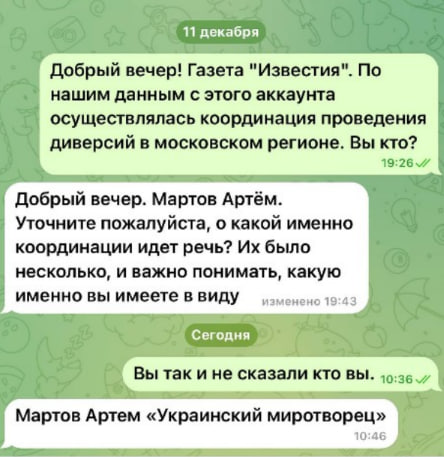
According to Izvestia, Artyom Martov's account, through which the teenagers received instructions from their supervisors, was registered to an anonymous phone number with the code 958. The "gray" SIM card was activated in the Rostov region and is serviced by the MTT operator. Interestingly, the account was not deleted after the arson attacks, and the ID number of the contact we found matches the one used to organize the sabotage. In correspondence with a correspondent of Izvestia, the alleged curator said that he represented a certain organization, the Ukrainian Peacekeeper, and that there were several such "coordination" on its account.
"To organize sabotage, Ukrainian curators can involve their call centers, which specialize in telephone fraud," a law enforcement source told Izvestia. — They have already developed algorithms for processing victims, and they have the necessary technical base.
The scheme itself, when people are forced to commit certain actions under threat of a criminal case for treason, is not new, but the use of popular dating chats for recruitment is its development, experts believe.
On November 13, Vladimir Sh. was charged with committing a crime under paragraph "a" of Part 2 of Article 205 of the Criminal Code of the Russian Federation ("Terrorist act"). The student faces up to 20 years in prison. The initiation of a criminal case against the arsonist of the cinema in the Aviapark shopping center has not been officially reported.
Izvestia sent inquiries to the Interior Ministry and the FSB.
According to the Judicial Department of the Supreme Court, in the first half of 2025, 42 teenagers aged 14 to 17 were convicted of committing sabotage and terrorist attacks. This is almost twice as much as in the same period last year, when there were 25 verdicts, and almost as many as in the whole of 2024 (50 cases). At the same time, teenage saboteurs do not always commit crimes, becoming victims of deception. So, on December 9, in Karelia, a 16-year-old local resident was charged with committing sabotage, a teenager set fire to the equipment of cellular stations for a monetary reward.

Cybersecurity expert Igor Bederov believes that one of the main reasons for the growing number of minors being used in sabotage and terrorist attacks is the deep penetration of recruiters into the Russian digital infrastructure.
— Recruiters are actively working together with phone scammers on social media. They use dedicated servers and network infrastructure located in Russia for anonymization, and the degree of penetration into the country is frightening. Our law enforcement agencies are actively fighting this, but the situation remains difficult. We need the systematic work of law enforcement agencies to "take out" that part of the infrastructure that is located in Russia — at hosting providers, in data centers," the expert noted.
According to Igor Bederov, the state also needs to accelerate efforts to combat the turnover of "gray" SIM cards. Because scammers are coming up with new ways to get them.
Переведено сервисом «Яндекс Переводчик»
