- Статьи
- Science and technology
- The art of intelligence: AI will help determine the value of art objects

The art of intelligence: AI will help determine the value of art objects

Russian developers have created the first domestic AI system for assessing the market value of contemporary art objects. Unlike ChatGPT and other universal models that can provide only general guidelines, the new technology performs in-depth statistical analysis of more than 30 parameters and generates a specific cost estimate. According to the authors, this should help potential investors get a more objective view of the market and avoid subjective price gouging. So, according to AI calculations, one of Nikas Safronov's paintings may cost 20 times less than the sellers request, while an art object by contemporary artist Taras Zheltyshev, on the contrary, may be underestimated. For more information, see the Izvestia article.
AI for evaluating contemporary art
MIPT specialists, together with colleagues from Moscow State University, have created the first specialized domestic system for assessing the market value of works of contemporary art. The algorithm analyzes art objects according to 35 parameters, determines the key factors influencing the price, and almost instantly gives a final estimate. To calculate, it is enough to upload an image of the work to the system and specify its main characteristics: author, year and country of creation, dimensions and other data. According to the developers, their task was to create a tool for those who consider art as an investment object.
— In Russia, the contemporary art market is largely gray or even black. There are practically no objective conditions that determine the price, such as, for example, the cost of goods. Art objects are bought by an extremely narrow circle of collectors, and the value of works is often determined by the opinion of individual market leaders. If, conditionally, the Sotheby's auction house likes something, it will be expensive, if not, it may not find a buyer at all. As a result, it remains unclear why some objects are more expensive than others. The main task of our model is to identify the real liquidity of artworks and make them a more understandable and transparent object for investment," Tatiana Shaga, a researcher at the Department of Technological Entrepreneurship at MIPT+Skolkovo, told Izvestia.

The new system evaluates the work in two stages. First, computer vision algorithms determine its style, artistic direction, and genre. The machine learning model then performs an in-depth analysis of market data, including size, material, technique, information about the author, his exhibition activity, the availability of works in museum and private collections, the level of media coverage, sales history and price dynamics. As a result, based on a large array of data, the system generates a transparent and reasonable estimate of the value of the product.
As an experiment, Izvestia tried to calculate the cost of several relevant works using publicly available AI services. So, ChatGPT was able to provide only general background information about how the size and technique in which the work is performed can affect the price. As well as excerpts from an interview where the author himself mentioned the amounts. For example, the language model reported that Nikas Safronov's works were auctioned in the range of $38 to $104 thousand, which is very difficult to interpret to evaluate his specific paintings.

— ChatGPT is a linguistic predictive model. It generates text by predicting the next word based on a huge array of data. However, despite access to almost the entire Internet, such a model is not able to correctly calculate the market value. The model we used predicts numbers based on statistical analysis: for each artist, it takes into account 35 criteria and determines those that most strongly influence the price. At the same time, all the uploaded information is verified," explained Tatiana Shaga.
How much are the objects of contemporary art
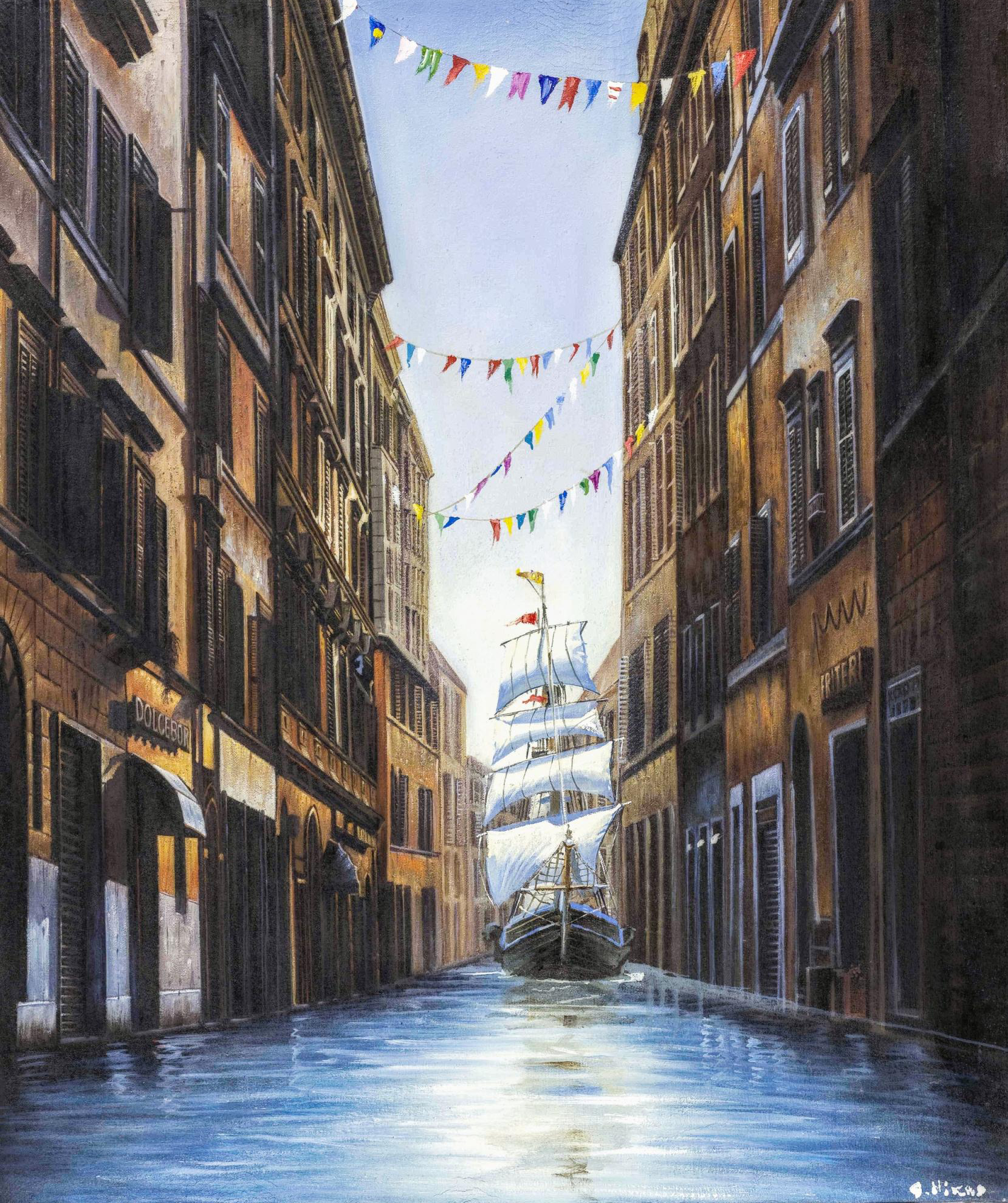
Izvestia tested the system on the works of several famous artists. For example, the oil painting "The Phenomenon of the ship on the night before the Venetian Carnival" (2011, 51 × 42.5 cm) by Nikas Safronov, according to the AI, should cost about 160 thousand rubles. Whereas on the artist's website, they are now asking for 3 million rubles for the original, and 500 thousand rubles for a copy. As the developers explained, in this case, the results of the calculations of the machine were based mainly on the real history of auctions for the sale of works by this author.
But the art object of backgammon, the clutch Another Kingdom: Game of Light, created by artist Taras Zheltyshev, was appreciated by AI more expensive than the author himself. The piece sells for $20,000, and the machine estimates it could cost $21,671.
— For me, the idea of evaluating contemporary art using AI sounds unusual, because such a process inevitably remains partly subjective and fluid. There is no universal cost formula in the art environment, but there is a set of key factors that the algorithm apparently focuses on, which is probably why it rated my work even slightly above the stated price, which is nice. I am sure that today artists and gallery owners do not rely on the results of such technologies, but primarily take into account the history of ownership, context, rarity, demand and other important characteristics," Taras Zheltyshev told Izvestia.
According to the artist, AI can be a good tool, but in the hands of an experienced person, because in the end it all comes down to solving it. Art is from and for people, and it is they who will shape market demand and marketing strategy, which also influences the process and decides the fate of works, especially when it comes to entering large auctions.

Backgammon clutch "Another Kingdom: Game of Light"
According to artist Anastasia Kopyttseva, the use of AI technology to determine the market price of contemporary art can be beneficial, but for an adequate assessment it is important to take into account many factors that are difficult to include in the program.

— For example, an artist may formally have a rich history of foreign exhibitions, but all these are commercial events, for which it is enough to pay for participation. For example, you can exhibit at the Louvre. An experienced specialist is needed to figure out what status a particular gallery has. A huge number of galleries are opening in New York, but most of them have not existed for more than a year," she noted.
According to her, it is difficult to consider Russian art as a reliable investment asset today. The works of Russian artists of the 20th century are practically not bought in the West, and modern authors have even less chance of being in demand in the world. The Russian art market is extremely small, so the probability of selling something at a profit is also low. It is better to consider these works as an investment in one's own emotional life, Anastasia Kopyttseva emphasized.

Lyubov Agafonova, the owner and director of the Vellum Gallery, agrees that it is extremely difficult to make money on Russian contemporary art. It makes no sense to invest in it, because it should be enjoyable. And the financial success of an artist is most strongly influenced by the personality of his promoter, she concluded.
Переведено сервисом «Яндекс Переводчик»
