Delay service: Russians began to complain more often to Rostrud because of salaries


Russians submitted 26,000 appeals to Rostrud on salary issues by the end of 2025 - the number of such letters sent only through the electronic portal increased 1.6 times compared to last year, Izvestia calculated according to the service. If earlier people complained more often about dismissals, now almost 40% of reports relate specifically to salaries. The increase in requests to the inspectorate is due to the fact that salary debts tripled over the year and exceeded 2 billion by October. In addition, in conditions of staff shortages, employees have become less likely to put up with injustice and more actively defend their rights in the supervisory authorities. What to do to an employee in case of salary delay is in the Izvestia article.
Why do Russians complain about employers?
At the beginning of December 2025, the number of electronic requests to Rostrud exceeded 70 thousand - almost one and a half times more than a year earlier (then it was slightly less than 50 thousand). The flow of complaints related to wages has also increased significantly, to 26,000: there have been 1.6 times more complaints.
Previously, the bulk of complaints were about layoffs, but now employees are noticeably more likely to complain about salaries. The share of such letters rose to 37% from 31% a year ago. At the same time, the percentage of complaints about dismissals decreased from 33 to 31%, although their absolute number also increased by a third, to 22 thousand, Izvestia calculated according to statistics from the Rostrud Online Inspection portal.
According to the service, the most common topics of appeals for all time were salary delays, non-payment of settlements upon dismissal and illegal termination of an employment contract. The editors sent a request to the service.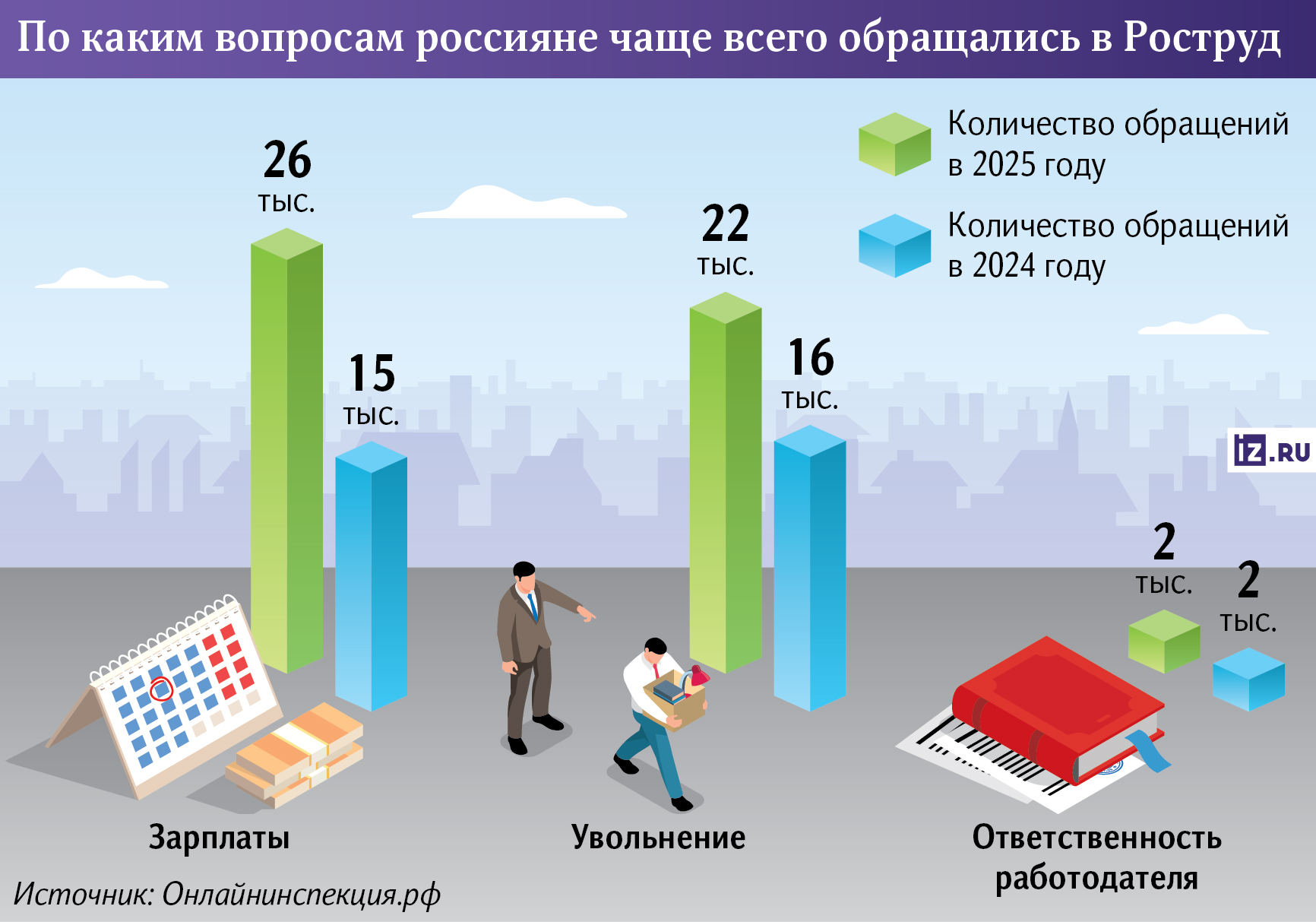
Natalia Milchakova, a leading analyst at Freedom Finance Global, is convinced that the increase in the number of appeals to Rostrud is associated with an increase in corporate salary debts.
The growth of overdue salary arrears has become one of the trends this year, said Olga Belenkaya, Head of the Macroeconomic Analysis Department at Finam. According to Rosstat, at the end of October, total salary debts reached 2.2 billion rubles. They increased by almost 11% in a month, and tripled compared to the same period in 2024. In absolute terms (excluding inflation) This is the maximum level since August 2020, the expert emphasized.
The main part of salary debts falls on the construction sector — 36% of the total, said Igor Rastorguev, a leading analyst at AMarkets. Mining (almost 25%) and manufacturing (about 21%) also occupy significant shares.
— The reason is simple: many companies in these industries operate with long production cycles and regularly face delays in payments from counterparties. At the same time, interest rates are rising, which forces some funds to be redirected to servicing loans. At the same time, almost 78% of all debt was formed in 2025," the expert explained.
Against the background of high inflation, reduced volumes of preferential mortgages and deteriorating external conditions — lower world prices for oil and coal, pressure from sanctions and a strong ruble — the economic growth rate slowed to 1%, Olga Belenkaya recalled. Corporate profits are also declining: in January –September they were 7.7% less than in the same period last year.
Earlier, Izvestia reported that the share of companies with overdue loans reached a record quarter. Over the year, it increased by 6 percentage points, and since 2023 it has doubled, according to the Central Bank.

What to do in case of salary delay
Another reason for the growing number of complaints to Rostrud is extremely low unemployment, said Igor Rastorguev from AMarkets. With a historic low of 2.1% and a shortage of staff, which is now felt by seven out of ten enterprises, employees feel more confident, and therefore more actively defend their rights. According to the expert, this is a healthy trend: people have stopped being afraid of conflicts with employers, realizing that they can find another place if necessary.
If the salary is delayed, the employee has the right to initiate a pre—trial settlement of the problem - to negotiate with the authorities or file a complaint with Rostrud, Natalia Milchakova from Freedom Finance Global reminded. If these measures do not help, the employee can contact the prosecutor's office, collect the debt through the court, and even initiate bankruptcy proceedings for the employer.
At the same time, it is important that the employee is officially registered and receives a "white" salary, the expert emphasized. In the case of "gray" transfers, it will be extremely difficult to prove the fact of non-payment.
If the employer delays the salary for more than 15 days, the employee has the right to suspend work by notifying the management in writing in advance, Igor Rastorguev added.
For each day of delay, the employer is obliged to charge compensation — at least 1/150 of the Central Bank's key rate of the unpaid amount. For the head of the company, a delay in payments is fraught with administrative fines from 30 thousand to 50 thousand rubles, and in case of repeated violation — up to 100 thousand. In particularly severe cases, when the delay exceeds three months, criminal liability is also possible, the expert noted.

Employers are interested in timely payments
At the moment, the scale of salary arrears is not yet large enough to significantly affect the economy, says Olga Belenkaya from Finam. According to Rosstat, at the end of October 2025, the share of employees who were not paid on time was less than 1%. In absolute terms, there were about 12,000 such employees, which is a relatively small figure for the country. However, their number has more than doubled in a year, the expert emphasized.
And it is important to take into account that the Rosstat sample does not include small businesses, where the situation with salary debts may be the most difficult, the expert noted.
— In general, statistics indicate a slowdown in consumption growth this year — against the background of a slower increase in income, a reduction in consumer loans and cautious expectations of buyers. Weakening demand forces enterprises to review production plans and optimize costs, including the payroll," Olga Belenkaya added.
In general, in conditions of staff shortages, employers themselves are interested in timely payment of salaries — competition for staff forces companies to value each employee, said Igor Rastorguev from AMarkets. Most businesses understand that losing a specialist due to delayed payments is too expensive, so they try to resolve financial issues promptly.
Переведено сервисом «Яндекс Переводчик»
