Entrepreneurs take responsibility: how the social capital of business helps social harmony
- Статьи
- Local news
- Entrepreneurs take responsibility: how the social capital of business helps social harmony


The V Responsible Business Forum "Congress: RBC—Public Capital", held on November 26, brought together representatives of business, government and the public sector to discuss a new but extremely important topic — the standard of public business capital being introduced across Russia. The participants of the key session "National Goals — Sustainable Well-being goals" discussed the interaction of government and business in achieving socio-economic well-being, paying special attention to the role of the Standard of Business Social Capital developed by the Agency for Strategic Initiatives and the Ministry of Economic Development of the Russian Federation on behalf of the President of the Russian Federation. Izvestia reports on how the standard of public capital will contribute to the conduct of public dialogue, the development of business and society as a whole.
General measure
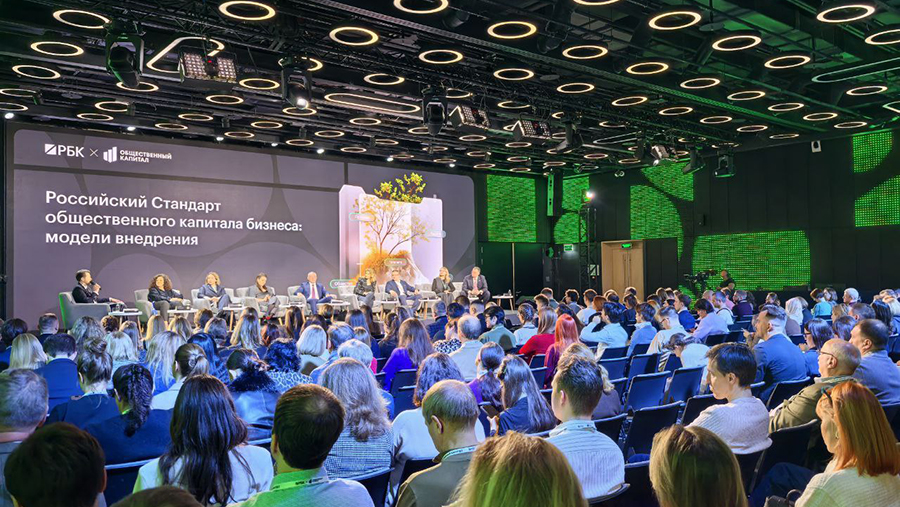
Social responsibility is a concept familiar to Russian business. However, colorful events, charity and environmental events, and multi-page non-profit reports do not always fully reflect the importance of the company's social policy for employees, the region, and the country as a whole, and their compliance with national development goals. The standard of public capital of business, according to the participants of the congress, will be able to become the most universal tool that will help coordinate the efforts of the government, the commercial sector and charitable organizations, create a space for public dialogue. This was discussed by the participants of the session "The Russian standard of Public Business Capital: implementation models".
Moscow, where industrial clusters are developing at a breakthrough pace, has shown interest in using such a tool from the very beginning. "For the breakthrough development of the economy and the strengthening of technological sovereignty, a strategic alliance of the state, business and society is needed. The implemented public capital standard will become a tool for an objective assessment of the contribution of private companies to achieving national priorities. Moscow, as the country's main innovation center, is a key driver of this work. Already today, more than 400 companies have joined the project, and every third of them is from the capital," Anatoly Garbuzov, Minister of the Moscow government and head of the Investment and Industrial Policy Department, told Izvestia.
As it turned out during the congress, regional business is currently showing great interest in the new format. So far, 65 partnership agreements have already been signed, ten of which were concluded directly during the forum. 62 regions of Russia are involved in working with the standard of public capital, and 17 regions have already drawn up roadmaps for the implementation of the standard at their level. According to Asiyat Bagatyrova, Director General of ANO "Public Capital", such an interest is quite logical. "We planned to attract about 300 companies by now, but today there are already more than 400 of them. We clearly see that Russian business is interested in this topic, is aware of its social responsibility and is ready to act in the appropriate direction. Our task is to help him," Bagatyrova said.
With benefit to the cause
According to Yana Kudashkina, Chairman of the Committee on Ecology and Sustainable Development of Opora Russia LLC, for many small and medium—sized companies, the standard of public business capital is an opportunity not only to make themselves known, but also to learn how to make their efforts more effective. "Many companies are already on the agenda of sustainable development, public capital, and environmental programs. Previously, they had almost no opportunity to get an assessment of their programs — the standard of public business capital gives them this opportunity," Kudashkina said.
However, even socially responsible businesses need to support their efforts, especially in an economically difficult situation. As Elena Myakotnikova, Chairman of the Council for Sustainable Business Development, CSR and Volunteerism of the CCI of the Russian Federation, noted, it is the standard of public capital of business that provides such an opportunity. ANO "Public Capital" creates prerequisites for the construction of support infrastructure, promoting new approaches in small steps," the expert believes.
However, these steps are not too slow: according to representatives of Public Capital, the Academy of Public Capital, an online resource where project participants will have access to educational materials and will be able to post their own developments, will be launched in December. Thus, the organizers expect to eventually assemble a library of best practices. This data set will be a serious help for responsible businesses in their work aimed at achieving the national goals of the Russian Federation.
National priorities
The standard of public business capital is an effective way to increase investment attractiveness, the forum participants agreed. The company's willingness to make long-term investments in the development of the company testifies to its desire to remain in the Russian market seriously and for a long time. But for this, it is necessary to focus not on foreign metrics, but on the modern needs of your country. Today we are witnessing the transition from the Western model of sustainable development to the Russian model of social responsibility, said Georgy Belozerov, Deputy Director General of the Agency for Strategic Initiatives, during the session "National Goals — goals of sustainable well-being." And within this model, business and society work together.
"This is a strategic initiative that creates a serious foundation for the development of our science, technology and entrepreneurship, which affects the improvement of citizens' health, improving public well-being and achieving national goals. However, it is important to move from formal reporting to systems of empirical accounting of the state of the environment, to measuring the real impact of business entities on the health of people, nature and society, because the report on the activities carried out does not always show real results. They can only be assessed based on a combination of many factors based on objective data," Belozerov explained.
According to the participants of the congress, successful assessments according to the standard of public business capital should not remain just a "badge of honor" — based on the results, companies should have access to appropriate federal and regional support measures. These measures are already under development. This was stated, in particular, by Vladimir Petrakov, Deputy head of the Moscow Department of Investment and Industrial Policy, reminding the audience that the initiative of the business public capital standard grew out of a proposal made back in 2020 that provided support measures for socially responsible companies. And today this idea is still relevant. However, in order for the mechanism to work for the benefit of society, becoming an effective instrument of state policy, it is necessary to comply with a number of conditions, Petrakov believes.
"The first condition is that we must evaluate the social activity of a business in terms of results. Moreover, you should think about this in advance: you should not deal with the consequences of wrong actions, but initially abandon steps that may have similar consequences. To give an example from the environmental agenda, a socially responsible company is not one that cleans water or forests from pollution caused by its activities, but one that thinks in advance about the negative consequences of certain production processes and does not allow these consequences. Secondly, we need to think about creating technologies for public well—being, effective methods that ensure it, and if such technologies exist, we need to use them where they are needed, laying in advance. This means that there is a third necessary point — scaling. In order for the mechanism to work effectively, we would like to extend it not only within the country, but also in friendly countries, in particular, the BRICS and SCO states," Petrakov said.
In a friendly environment
The Congress participants discussed the significant potential of the business social capital standard as a tool not only for domestic but also for international policy during the session "Markets of the Future: BRICS and SCO in the Economy of Trust". The experts reviewed the application of the standard as part of the simplification of international cooperation and mutual recognition of non-financial reporting with the friendly BRICS and SCO countries.
According to experts, a number of Russia's international partners from the Middle East, Africa, and Asia have already expressed interest in this model. As Georgy Belozerov noted, due to its versatility, this mechanism will be convenient for use on an international scale.
"One of the objectives of the Business Social Capital Standard is to build a new loyalty system between government and business based on an empirical assessment of the real impact of companies on increasing public well—being and achieving national development goals. Therefore, the Standard can be adapted by partner countries: each of them will be able to apply this paradigm, focusing on sovereign interests," Belozerov concluded.
In general, the participants in the discussion agreed on the absolute need for further development of the Standard and related metrics and conditions. This joint work for the benefit of the country will be the key to progress towards achieving national goals, they agreed.
Переведено сервисом «Яндекс Переводчик»
