"Baba Yaga" on the contrary: how our snipers fight with heavy drones of the Armed Forces of Ukraine
- Статьи
- Army
- "Baba Yaga" on the contrary: how our snipers fight with heavy drones of the Armed Forces of Ukraine


Two combat exits — five eliminated Baba Yaga drones. A sniper in modern conditions is now also a drone hunter: its effectiveness is largely determined by its ability to hit aerial targets both day and night. Rabdan, the call sign of the Cat, is a sniper and instructor in one of the special detachments operating in the Sumy area. Once every two weeks, he marches, coming up close — 1.5—2 km - to the enemy, and seeks to hit the most deadly enemy UAVs. Over the past six months, his unit has shot down more than 40 heavy copters with rifles. About what conditions are required to create a convenient observation position, why going on a mission takes at least 10 days, and what it's like to come face to face with the enemy on a narrow path, in the Izvestia article.
The principle of expediency
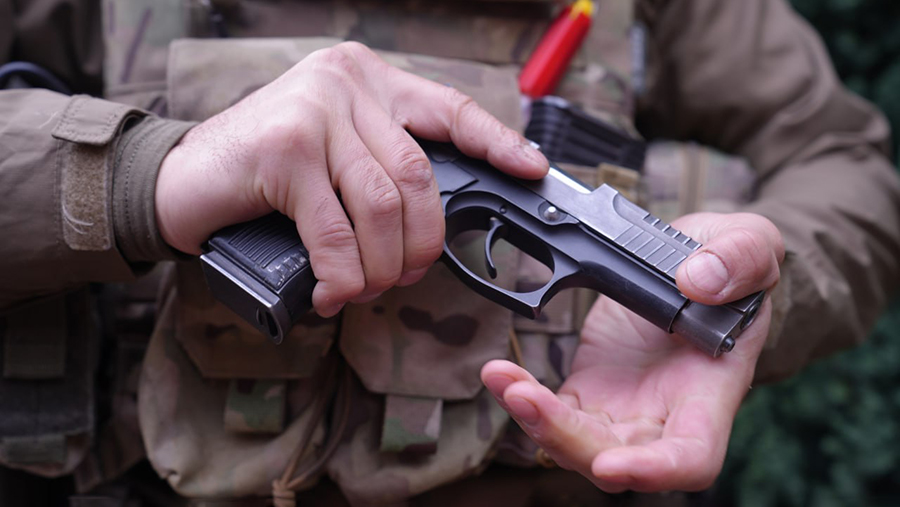
Drizzling November rain. The approaching cold. There's a long way out ahead. Rabdan has warm clothes, a sleeping bag, a karemat rug, an SVD rifle, four magazines — each for 10 rounds, a Yarygin pistol — in case of close combat, camouflage equipment, a gas stove, power banks, groceries, water — at least 5 liters for the first time. The Cat goes on a mission with a submachine gunner, call sign Darkness. The second number is extra hands, assistance in case of injury, and fire support.
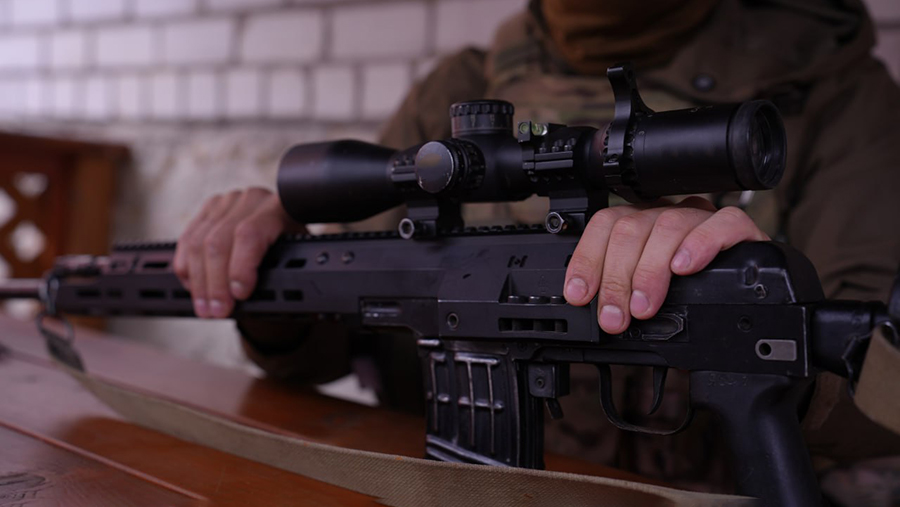
They go out for 11 days. The deadline is determined by expediency: the more you control the sky, the better. Besides, it's extremely dangerous to go back and forth once again. The distance in one direction is 16-17 km.
Rabdan is a Buryat. Of those who volunteered at the beginning of 2015 to help the DPR with the closure of the Debaltseve boiler. At the same time, he received his call sign — in a battle for one of the settlements, it was necessary to take a three-story house where the enemy was holed up. Rabdan, taking with him a bag of grenades, climbed up the balconies to the upper floor. The house was taken. And the guy has an iron-clad speaking call sign.

Aerial hunting
He graduated from Sniper school in 2019. Prior to that, he served in the communications, air defense, infantry, and tank units. He explains that the current specialty has become, to some extent, a logical development of the entire previous path: a sniper must possess the skills of tactical training and medicine, be able to shoot from different types of weapons, drive many modes of transport, and know the laws of survival in extreme conditions.
The combat exits of recent months for the Cat are hunting exclusively for drones.
"Our profile has changed, and time dictates new rules," he explains. — The priority is Baba Yaga, as the deadliest drone. She arrives accompanied by a scout fighter, so she strikes with precision and precision. It can carry, for example, four 82-millimeter mines, or two 120-millimeter, or dangerous high-explosive bombs FAB-8.5.
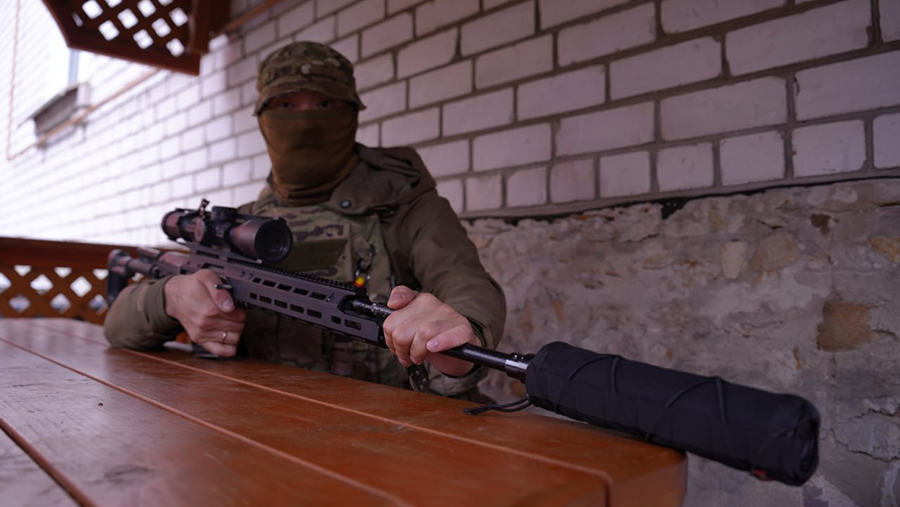
As an illustration of the work, the Cat shows videos from recent exits. Night, a Ukrainian drone patrolling our positions, bombarding our positions with petal mines: on the screen you can see how PFMS, similar to sparks, are scattered in abundance over the ground. The distance to the drone is 350-400 m. The shooter catches the "bird" in the sight. Several shots follow: after the fifth or sixth, the UAV lights up. The cat sends several more bullets after the defeated target. "On emotion, euphoria," he explains.
The drones are buzzing continuously
It takes almost a day to walk one way, and you often have to lie down and wait for silence. The most dangerous sections, of course, are the "postcards" — there are a total of about 3 km of such squares on the current route. The drones of the Armed Forces of Ukraine are buzzing continuously: the last time a cat and a friend came into the field of view of a kamikaze. They hid in the woods, running from tree to tree while he circled and looked out. The partner started shooting back with a machine gun and probably scared off the "bird" — it turned back.
You should carefully look at your feet: in one place on the side of the trail there was a mine disguised as a bush — a new kind of "surprises" from the Ukrainian Armed Forces. The body is made of a bottle neck, with TNT inside, and a stud at the bottom to stick into the ground. The cat, noticing the unnatural object, examined it with optics, and then shot it with a rifle.
As you walk, you often have to meet your own people — under trees, in burrows, in dugouts — everyone is on duty, the forest lives its own invisible life. Once, during a similar outing in Donbass, Rabdan collided head-on with two Ukrainian soldiers. He says it played into his hands that he was walking alone and was in a camouflage suit, he noticed them first. And he was the first to react, pulling out his gun.…

"On the move, on the march"
The place to observe, says the Cat, is chosen based on the data on the map, as well as information from intelligence officers and UAV operators. The main components are that the point should be located on a hill, in a forest or landing, it is very good if there are abandoned dugouts or basements of buildings to hide, as well as direct access to the field for observation. Next, you equip yourself with a couch: you pull out a trench, line it with branches, insulate it, and mask it as much as possible. The mode of operation is to listen and keep your eyes open during the day. At night, covered with an anti-drone blanket, you lie and wait.
— The last time we just entered the position, and then the Baba Yaga was flying. And, it turns out, on the move, from the march, I shot her," Rabdan says. — After that, the same drones appeared again, but only a couple of times, and because of the fog it was not possible to see them. The role was played by the fact that our guys are now well-ironing the AFU positions with aerial bombs, and the Ukrainians are forced to roll back, move away from the border, and they have become less likely to attack with drones.
The human attitude
The guys' meals are what they brought with them: stew, biscuits, nuts, chocolate, smoked sausage, instant noodles, cooking takes place in the morning and for the whole day. There are also gifts of nature — apples, pears, which are rich in local gardens. We were lucky with the water this time: we found a surviving well, ran there, 600 m in one direction (at other times, it happens, a river or pond saves). Days and nights pass in tension, on edge. The surrounding cacophony adds degrees — the artillery is working continuously, and it flies there, and from there. Sometimes you can't sleep a wink at night.
In September, during a mission, a Cat with a previous partner, Aslan, hit four Baba Yagi. On the way back, they came under fire — a mine landed, probably a stray one. Aslan was shot in the knee. The cat was also hit, but lightly (this was his fifth injury). He put a splint on his friend, made a bandage, and slowly moved on. On the way, we met another "three hundredth" — a young boy from an adjacent unit, he was sitting on the ground with a broken foot — he stepped on a "petal". They helped — they cleaned the wound, bandaged it, tightened it, injected a cocktail of drugs. And the three of them moved on. And we got there. The subcontractor guy is still thanking for the rescue in messages. Aslan underwent surgery and is recovering.
The Cat himself returned to the ranks. He's going out again today.
— Do you consider yourself an effective sniper? — I'm asking him one last time.
— I try to do my job well. But I don't keep score, I don't notch my weapons, as they say. I even consider such an attitude towards the dead to be blasphemy. There are the same people on the other side," he replies.
Переведено сервисом «Яндекс Переводчик»
