
Research route: Russia wants to develop 3-5 models of light aircraft

Russia wants to develop from three to five models of light aircraft for domestic routes, Izvestia has learned. The United Aircraft Corporation (UAC) has announced its readiness to support small design bureaus in the development, certification and organization of their mass production at their enterprises. The planes should accommodate 5-9 passengers each and will operate on regional routes up to 600 km. By the first quarter of 2026, the volume of the small aircraft market should be calculated and the demand for such aircraft should be determined. Cooperation with small design bureaus will help avoid mistakes made when designing the Baikal aircraft, experts believe.
Why does UAC need third-party design bureaus
The United Aircraft Corporation (UAC) may lead the process of creating a small aircraft market in Russia. The head of the UAC, Viktor Badekha, during a meeting of the Expert Council on the Aviation Industry at the State Duma, instructed to assess the market size and the required range of aircraft. Small design bureaus and firms with experience in designing and building analogues of the American Cessna small aircraft will be involved in the work. Izvestia has reviewed the minutes of the Export Council meeting.

To speed up the development, shorten the time and reduce the cost of aircraft certification, alternative certification centers may be created — appropriate proposals will be sent to the Federal Air Transport Agency, the document says.
A standardization program for 2026-2032 will be worked out for the production of new aircraft. It will also be required for the construction of unpaved landing sites, flight organization, pilot training, and technical staff.

In addition, a working group has been set up under the State Duma to develop a federal law on the development of small aircraft in Russia. Proposals to the Expert Council must be submitted by the end of January 2026.
"In essence, UAC has expressed its readiness to provide organizational, scientific, technical and production support to small design bureaus in terms of the development, certification and organization of mass production of light commercial cargo and passenger aircraft at its enterprises," Sergey Detenyshev, a participant in the meeting, a member of the working group and head of the Association of Small Airlines (MalAP), told Izvestia..

For a long time, Russia has not produced small-capacity aircraft for commercial passenger transportation. This niche was occupied by American Cessnas, the expert noted.
These are, in particular, light Cessna 172/182 (with four seats), which in Russia were used for aviation work, sports purposes, personal needs, pilot training and for entertainment. Cessna 208 (six seats) and Cessna 208, designed for nine passengers and two pilots, were purchased in small quantities for commercial transportation. This is the basic model on the basis of which passenger and cargo modifications, as well as amphibians, were built.
— Cessna models are common in Russia. They have displaced domestic technology and have become the main ones not only in small Aviation Training centers (ATS), but also in state flight schools," Sergei Bondar, head of the aviation training center at the Gagarin Aviation Training Center, told Izvestia. — Our training YAK-18T does not satisfy the operators. Their engines consume too much fuel and oil. This aircraft has been discontinued in educational institutions since 2012.
There are problems with American Cessnas in maintenance and repair due to sanctions, said Sergey Detenyshev.
"It is necessary to replace them with modern Russian aircraft with similar characteristics, and small design bureaus (design bureaus) can help UAC in this," he believes.

According to Andrey Patrakov, the founder of the RunAvia flight safety service, there are still private design bureaus in Russia that can develop light aircraft. However, they used to work mainly for export.
Experts believe that Silver Wings, the MAI Design Bureau, the First Design Bureau from Taganrog, which created the SP-30 aircraft, as well as the developer and manufacturer of AeroVolga flying boats, have good competencies.
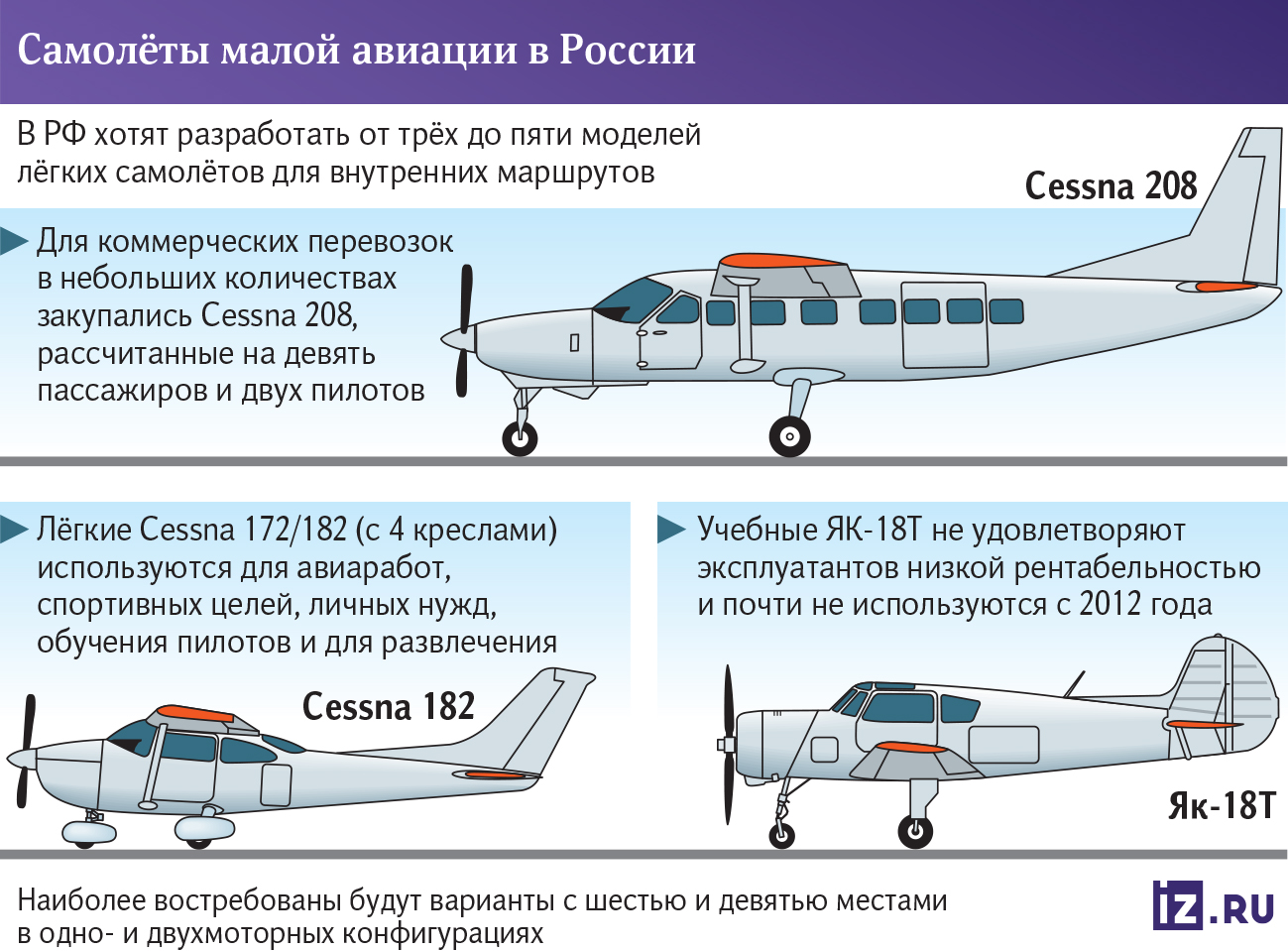
— Cooperation with them will reduce the time needed to develop new aircraft, — says Sergey Detenyshev. — The most popular options will be with six and nine seats in single- and twin-engine configurations. In general, we need a range of three to five models.
If the close cooperation of the design teams with the UAC had been implemented earlier, many mistakes in the design of the Baikal aircraft, which was created by the Design Bureau of the Moscow Aviation Institute and the Ural Civil Aviation Plant (UZGA) to replace the An-2, could have been avoided, Sergei Detenyshev believes.

Light multipurpose aircraft LMS-901 Baikal
The first test flight of Baikal took place on January 30, 2022, and the launch into mass production was planned from 2024. However, the delivery dates were later adjusted more than once.
In May 2025, the presidential envoy to the Far Eastern Federal District, Yuri Trutnev, announced that the project had reached an impasse, and production of the aircraft was not expected. The Ministry of Industry and Trade also stated that the aircraft is being finalized, taking into account previously received comments. Its certification is now scheduled for the end of 2026.

Timeline for the development of light aircraft
According to the chairman of the MalAP Association, the development may require over 500 million rubles of investment per aircraft and take 1.5–2 years. However, certification, the term and procedure of which is not regulated by the Federal Air Transport Agency, may take years.
Therefore, legislative clarifications are needed to speed up the process and conduct certification in parallel with development, including in a digital environment, says Sergey Detenyshev. Then it is possible to start mass production of aircraft within 2.5–3 years from the start of work.

The key problem of small aircraft is the lack of a domestic piston aircraft engine, Oleg Panteleev, executive director of the Aviport agency, told Izvestia. Another difficulty is related to certification. The participation of a large aircraft corporation in the process can help solve them, the expert believes.
—The UAC has consolidated the engineering and production competencies of the domestic aviation industry, and it can act as an expert platform for supporting and developing the small aviation segment," the corporation's press service told Izvestia. — We believe that the accumulated design and industrial competencies can be useful for aircraft development teams.
In addition, the corporation's specialists can share their experience in implementing modern digital design and manufacturing tools, as well as act as experts and consultants in shaping the regulatory framework. Joint work will make it possible to form a systematic set of actions aimed at developing the small aviation sector, the UAC noted.
Izvestia sent requests to the Ministry of Transport, the Federal Air Transport Agency and the Ministry of Industry and Trade.
Where will light aircraft be in demand
The development of small aircraft is hampered by existing barriers in legislation, said Deputy Chairman of the State Duma Committee on the Development of Civil Society, Issues of public and religious associations, MP Oleg Leonov. Now you can't just buy a plane and transport people and cargo. This is allowed to be done only as part of a large airline, which requires too much organizational and financial costs. It is impossible for small and medium-sized businesses to master them, although the need for such air transportation is enormous.

In the USSR, hundreds of light An-2s transported people and cargo on short routes. But now the big airlines are not interested in these routes. They are focused on more profitable interregional and international destinations, said Andrey Patrakov.
Since 1990, air transportation in the Far East has fallen 10 times, Oleg Yemets, Deputy General Director of Aurora Airlines, said at the Transport Week forum. The air traffic coefficient on inter-regional routes in Siberia is now 0.3, which is twice as low as in Russia (0.6). This means that a person flies long-distance every three years, he added.

According to Oleg Emets, the situation is even more complicated on local routes, where the mobility coefficient is 0.1. On average, a resident of a remote village in Siberia flies on local routes only once every 10 years.
Aviation is the only alternative transport for 160 settlements in the Far East. There are extremely few land and river roads there, Oleg Yemets noted.

According to Sergey Detenyshev, small businesses that are exempt from the regulations of large airlines can operate on local routes. They can operate small aircraft from small unpaved or asphalt airfields, which are currently unprofitable due to regulations. And in order to legitimize them, new standards are needed for the industry, the expert noted.
"If restrictive regulations are relaxed or lifted, the market will revive by 2030 and may require several thousand small aircraft, and in the future — tens of thousands of aircraft," Oleg Leonov said.
There is a huge need in the regions for the transportation of passengers, tourists, and light goods from marketplaces. A small aircraft is designed for just such purposes. Its fuel consumption is similar to that of motor vehicles, which is why the cost of delivery is much lower than by helicopter, the deputy believes.
"With the aging of the regional An-24 fleet, small aircraft are essentially the only alternative on local routes,— says Andrey Patrakov. — Only they can be operated from unpaved airfields, from snow strips or even from water (flying boats).

According to Sergey Detenyshev, two- or nine-seat aircraft are capable of flying routes with a shoulder of 300-800 km. You can do more, but then they will require the installation of a bathroom.
"With appropriate subsidies and a reasonable leasing policy, regional airlines are able to put up to 50 new aircraft per year with a capacity of nine to 19 passengers on the line and restore old routes in the Far East," Sergey Alafinov, general designer of NPO AeroVolga, told Izvestia.
At the same time, serious infrastructure costs are not required — there are enough unpaved lanes with the status of aviation sites, he added.
Переведено сервисом «Яндекс Переводчик»
