- Статьи
- Society
- Behind the brooms: there are not enough janitors, electricians and engineers in the housing and communal services sector

Behind the brooms: there are not enough janitors, electricians and engineers in the housing and communal services sector

The most acute personnel problem in the housing and communal services sector has developed with janitors, engineers, locksmiths and managers, the regional authorities told Izvestia. The editorial board asked all regions of Russia about where and what staff is missing. As follows from their answers, the situation has not changed much since last year. At the same time, salaries in this area have increased by 25% over the past year to 81 thousand rubles, but they still remain insufficient to overcome the personnel shortage. The lack of prestige of the industry also prevents going into housing and communal services, experts say. More information about the reasons for the shortage and how to attract staff is available in the Izvestia article.
Who is missing in the housing and communal services sector
Engineers, janitors and electricians are now primarily looking for housing and communal services. The regional authorities informed Izvestia about this — the editorial board sent requests to all subjects of the federation, about a third responded — 29.

For example, in the Amur region, the need for qualified specialists in the municipal sector is 1,164 people. The largest number of open jobs there falls on the specialty "machinist (fireman) boiler room". In the Ryazan region, 104 housing and communal services enterprises have applied to the employment center since the beginning of 2025, stating the need for more than 1,9 thousand workers.
According to the organizations of the municipal complex of the Orel region, 435 vacant jobs were opened in 2025, in 2024 there were only one less. In the Altai Republic, there are not enough drivers, boiler room machinists, locksmiths for emergency repair work, maintenance of heating networks, plumbers, electricians for electrical equipment repair, electricians, electric and gas welders.

"In general, there is a tendency to increase the shortage of personnel," stated the Ministry of Construction, Housing and Communal Services of the Republic.
In Yamal, from 2023 to 2025, the most sought-after professions among employers in the housing and communal services sector were also an engineer, a janitor, a cleaner of industrial and office premises, and a utility worker.
"According to the regional vacancy bank, the need for employers in the field of housing and communal services is 147 specialists. During 2025, employers have declared 768 jobs," the regional department added.

The Ministry of Housing and Communal Services of the Sakhalin Region reported that the demand for employees for housing and communal services enterprises in the region in 2025 is 227 people. The shortage is most felt in skilled workers, technical and maintenance personnel, as well as in unskilled ones — janitors, cleaners, auxiliary workers, handymen.
"Among the reasons for the shortage of personnel: the lack of prestige of work in the industry, mainly older employees are employed in the field, young people and skilled workers are interested in higher wages," they said.
According to the Novosibirsk Region Housing and Communal Services Modernization and Development Fund, there is a shortage of roofers, locksmiths, plumbers, electricians, and handymen in the region. The Department of Construction, Housing and Communal Services and the Fuel and Energy Complex of the Kostroma region noted that now the enterprises of the municipal complex have serious problems with staffing qualified workers — 622 people are missing. The same problem was reported in the Perm Region and the City Hall.
"The fundamental problem remains the insufficient financing of the industry and the relatively low level of wages. State regulation of utility tariffs significantly limits the possibility of increasing wages for employees," the Department of Housing and Communal Services, Fuel and Energy Complex and Energy Supply of the Orel region added.

In Tatarstan, the organizations' need for personnel amounted to 371 people. In particular, these are senior positions and engineering and technical staff. The Ministry of Housing and Communal Services of the Rostov region reported that the department is constantly working to popularize the field: industry forums, professional skills competitions and other events for the influx of specialists are supported.
Izvestia also sent a request to the Ministry of Labor.
What are the salaries in housing and communal services
In St. Petersburg, the staffing of district housing agencies with janitors and tractor drivers, who are responsible for organizing cleaning of residential areas, is 80% and 98%, respectively.

"The current staffing makes it possible to carry out the work efficiently. Thanks to the measures taken, we are seeing a positive trend in attracting staff compared to 2023 and 2024. In two years, the number of janitors has increased by 32%, and machine operators by 21%," the city's housing committee told Izvestia.
One of the effective measures to attract staff there was a 30% increase in wages from the beginning of 2025.
The fully staffed staff turned out to be in Moscow, the Housing and Communal Services department of the capital said.

The difficult personnel situation was also confirmed by the recruitment services. In the press service hh.ru It was reported that the most in-demand specialists in the housing and communal services sector this fall were locksmiths and plumbers, cleaners, handymen, electricians, drivers, engineers of the production and technical department, machinists, welders, maintenance engineers, shift supervisors and site foremen, service engineers and janitors.
"In the housing and communal services sector, janitors, locksmiths and plumbers, electricians, welders and machinists are in short supply," they said.
The greatest demand for specialists in this field in the fall of 2025 was recorded in Moscow — 23% of the total number of vacancies, the Moscow region, St. Petersburg, Sverdlovsk, Rostov regions and Krasnodar Territory.
At the same time, salaries in the housing and communal services sector have increased by a quarter over the past year, Avito Rabota said. The largest increase in the average salary offer is observed among technicians — by 25%, up to 80 thousand rubles.
"Handymen came in second place, with average salary offers for which increased by 23% and amounted to 70.8 thousand rubles," the platform's analysts added. — Salary offers for electricians also increased by 23%, reaching 81.3 thousand. The plumber closes the top five — the average salary offers for this profession increased by 15% and amounted to 65.4 thousand rubles."
Andrey Kucherenkov, Director of the Working and Linear Professions category at Avito Jobs, added that the demand for specialists involved in the housing and communal services sector increased the most in the Moscow (+74%), Volgograd (+65%) and Rostov regions (+61%).

In the housing and communal services sector, intangible advantages play a crucial role — a team, stability and a convenient schedule, said Boris Kurbatov, founder and CEO of Dream Job. The most noticeable plus that experts note is the atmosphere, a "friendly team" is mentioned in 53% of reviews, which makes the team a key retention factor.
—However, 22% of the reviews contain requests for increased pay and bonuses, especially in the context of high workload," he said. — Professional development is a weak link in the industry. 11% of the reviews explicitly mention a lack of career opportunities or training. This is especially noticeable among employees with up to a year of experience.
The regions also reported on preparations for the winter season — heating equipment, a supply of repair crews and fuel for boiler houses are fully provided.

Why is there a shortage of staff
In early November 2025, Alexey Yeresko, Deputy Minister of Construction and Housing of the Russian Federation, announced problems in staffing the industry. He appealed to young people to consider housing and communal services as a promising area for professional realization.
"Only by resolving the personnel issue will we be able to achieve a new quality of work in the housing and communal services," he stressed. — The industry is in dire need of young, energetic and qualified specialists, from workers to engineers.
The shortage of personnel in the public service sector is due to the unpopularity of working professions and low wages, as well as due to the drain of personnel to more prestigious jobs, the regional authorities said.

"Working in housing and communal services in the mass consciousness is associated with dirty, low—skilled and low-prestige activities," said the Ministry of Construction and Housing and Communal Services of the Altai Republic. — This is a powerful demotivating factor for young people. The salary of ordinary employees is often at the minimum wage level or slightly higher. Highly qualified engineers and managers can also find better-paying jobs in other industries."
They added that wages often do not match the amount of work, responsibility, and harmful or dangerous working conditions.
"Housing and communal services employees, especially dispatchers, foremen, and chairmen of the Management Committee, are at the forefront of conflict with residents who are dissatisfied with the quality of services, rising tariffs, and emergency situations. This is a high stress level. As a rule, there is no career growth in the field. There is also a shortage of young personnel," the ministry stressed.
Personnel shortages in the housing and communal services sector are currently being fixed in many regions, but it is important to understand that the problem is much broader, said Alexander Yakubovsky, a member of the State Duma Committee on Construction and Housing and Communal Services.

"This is not just a matter of housing and communal services," he said. — In fact, the country is faced with the loss of prestige of working professions in general. For many years, the focus has been on attracting cheap labor from the CIS countries. Employers and the government have not invested in the systematic training of their own personnel, in the development of working specialties and the creation of a clear trajectory of professional growth.
As a result, the professions of janitor, locksmith, maintenance engineer and other specialists have been undeservedly forgotten.
How to solve the problem of staff shortage
The personnel problem in housing and communal services has indeed acquired serious proportions, confirmed Igor Rastorguev, a leading analyst at AMarkets. According to the monitoring of the Ministry of Construction conducted earlier this year, the shortage of workers in the industry is about 21% of the full-time staff. The issue of working professions — janitors, locksmiths and plumbers - is particularly acute.
"The main reason is clear: for many years, salaries in housing and communal services remained uncompetitive," he said. — After university, a young specialist can get a job as a courier and receive twice as much, and without shift work and work in the cold. To this is added the problem of the prestige of the profession and the average age of employees is about 50 years old — young people simply do not see career prospects in this field.

The shortage is also related to the tightening of migration policy, Pavel Sklyanchuk, an expert of the Popular Front in the housing and communal services sector, added. At the level of the Ministry of Construction, work is underway to develop certain professional standards aimed at improving the skills of employees.
— However, there are no programs aimed at the influx of new people, personnel from external professions into the housing and communal services system, and this is a big problem, — he said. — This program can be implemented as a pilot within the framework of secondary special education, through subsidized training, but with the condition of mandatory post-graduation work.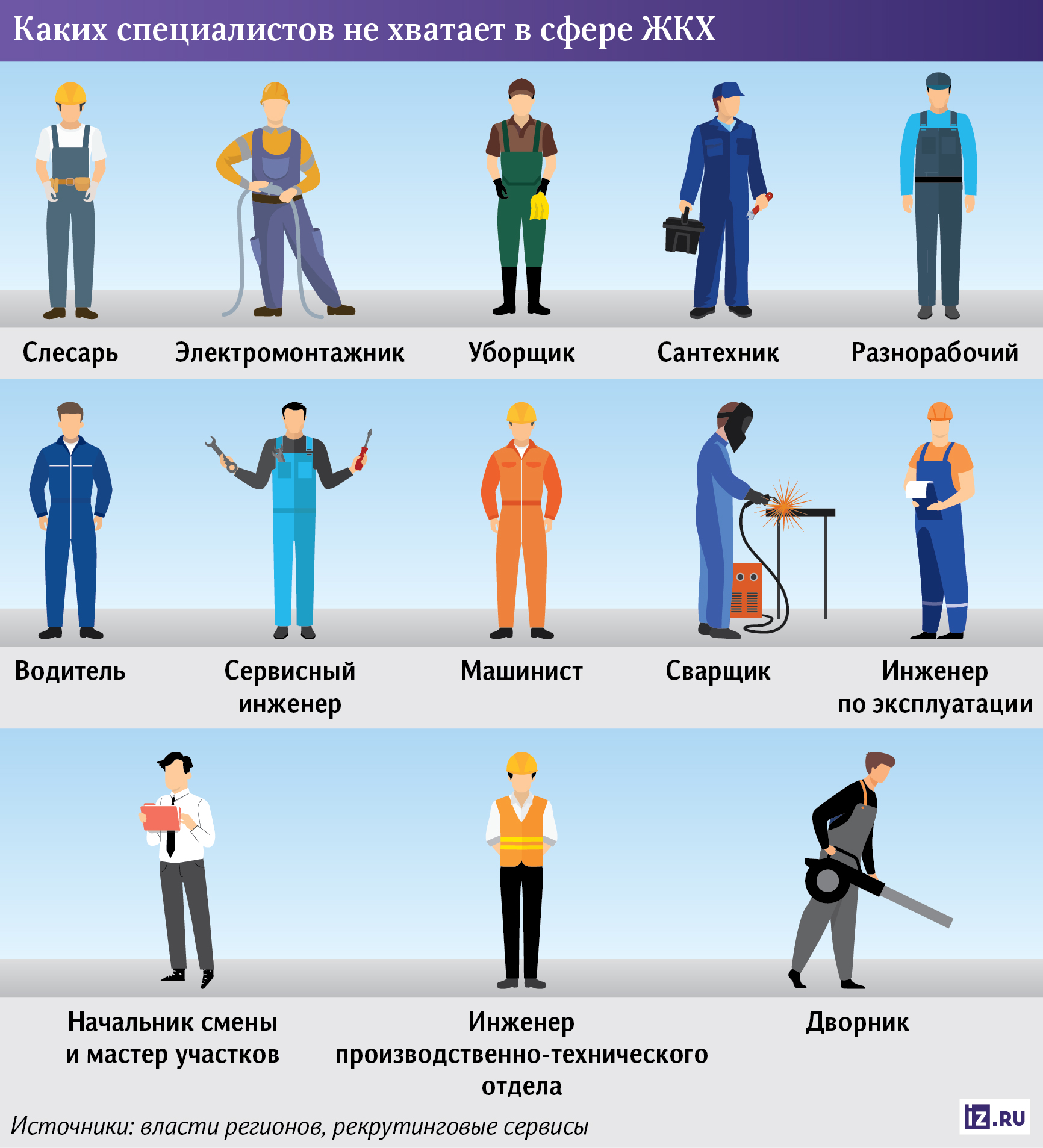
Alexander Yakubovsky noted that now the regions are already increasing wages, creating training programs, and enterprises have begun to invest in their own personnel.
"The state is increasing attention to working professions, forming a demand for high—quality education and a modern approach to personnel training," the deputy stressed. — This is a move in the right direction, but how quickly it will produce results will only become clear over time.
Currently, retraining programs have been launched within the framework of the national project "Personnel" to solve the personnel issue, housing and communal services training complexes are operating, experts say. According to them, it is necessary, in particular, to strengthen career guidance work with schoolchildren and show them real career paths in the industry. In addition, remuneration should be made as transparent as possible, since there are many adjacent and overlapping areas of responsibility in the housing and communal services sector, Pavel Sklyanchuk added.
Переведено сервисом «Яндекс Переводчик»
