It's hard: the gap between the pensions of the employed and the unemployed has reached a minimum since 2021.
- Статьи
- Economy
- It's hard: the gap between the pensions of the employed and the unemployed has reached a minimum since 2021.


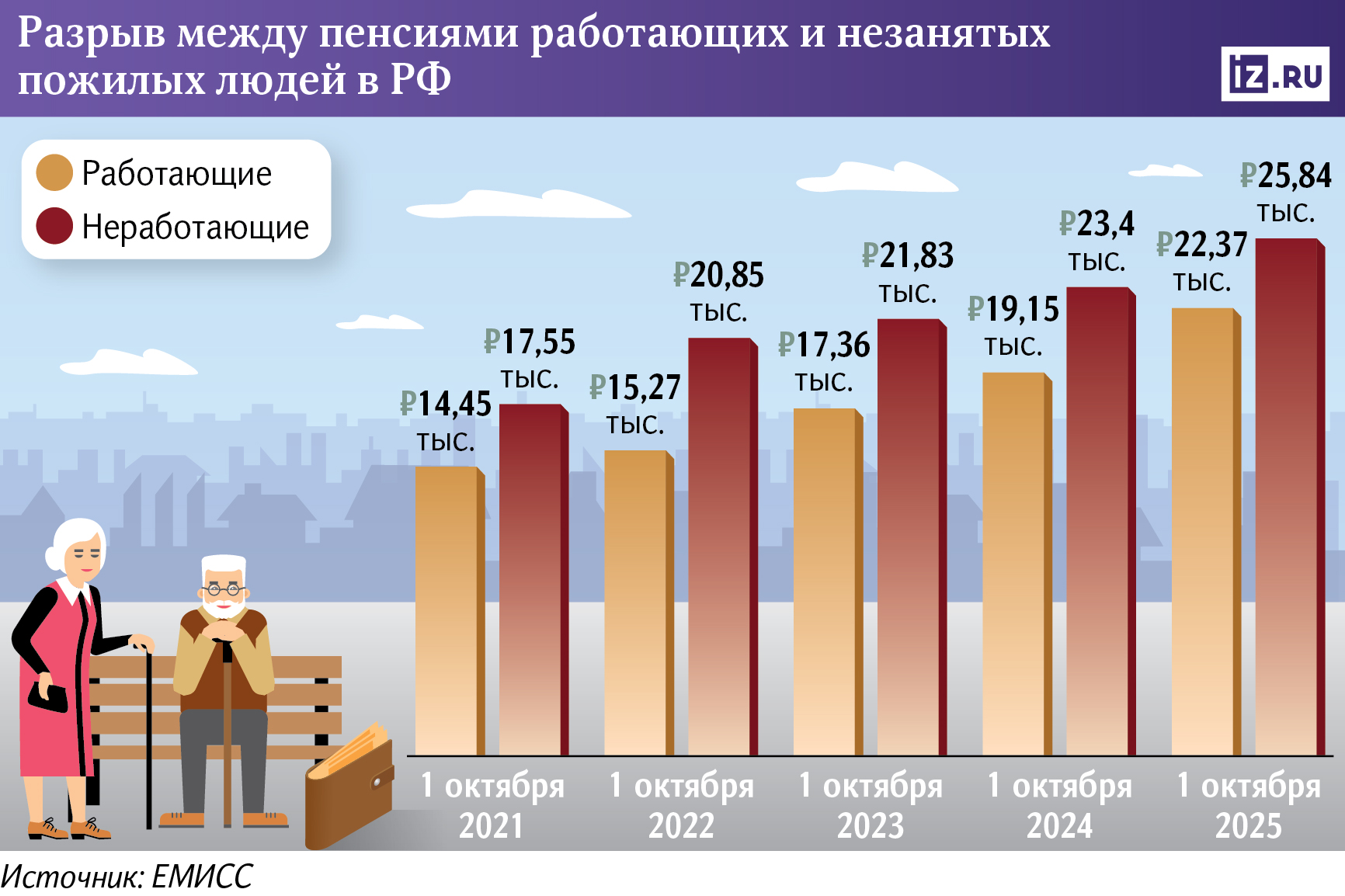
The difference between the pensions of the employed and the unemployed decreased to 3.5 thousand rubles in October. This is a minimum since 2021, it follows from the data of the Social Fund (Izvestia studied them). Over the year, the indicator decreased by almost 20% due to the indexation of payments to employed citizens. At the same time, the growth of accruals was uneven: for those who were employed, the payment increased by 17%, for those who were not working, by only 10%. The resumption of indexation has encouraged some elderly Russians to come out of the shadows or become self-employed, which has supported their incomes, increased budget revenues and attracted experienced personnel to the market. Whether the gap will continue to narrow is in the Izvestia article.
Why are working people's pensions growing faster
As of October 2025, the average size of the old-age insurance pension was 25.9 thousand rubles for non—working citizens and 22.4 thousand for employed people, according to the Social Fund. The statistics take into account the amounts actually accrued: all receipts are summed up and divided by the number of recipients. However, payments to a specific person may vary, as they depend on length of service, number of pension points, and region of residence.
Thus, the gap between payments to the employed and the unemployed amounted to 3.5 thousand rubles. This is the lowest value since 2021, followed by a jump: additional indexing for the unemployed in 2022 increased the difference to 5.5 thousand rubles. This figure has dropped to less than 4 thousand this year alone. Over the past 12 months, the gap has narrowed by almost 20%. The editorial board sent requests to the SFR and the Ministry of Labor.
The reduction in the difference between the payments of the employed and the unemployed was a natural result of the resumption of indexation for the former, explained Valery Tumin, a member of the expert council of the State Duma Committee on Economic Policy. In 2025, pensions were increased by the inflation rate of 9.5%. The main effect is related to the fact that the recalculation is carried out from the base size, that is, taking into account all past adjustments: in fact, the increase is calculated as if there had been no cancellation of indexation for the employed in 2016. This difference has now been added to the payments of working citizens.
Previously, for many years, the pensions of non-working citizens were adjusted annually to take into account price increases, while payments to workers were "frozen" (except that there were fixed small increases). As a result, the gap between the two groups gradually widened, said Tatiana Podolskaya, an expert at the Presidential Academy.

Another reason is the change in the age structure of pensioners. In Russia, the age of retirement is gradually increasing, and with it the amount of accumulated points and length of service, said Yulia Dolzhenkova, a professor at the Financial University under the Government of the Russian Federation. She explained that the higher the salary and the longer a person works, the more significant their support becomes after they stop working.
In addition, there are many categories of citizens in the country who are eligible for early retirement.: These are teachers, doctors, employees of hazardous industries, as well as residents of regions with unfavorable conditions. Some of them, as a rule, have higher payments, especially now if they continue to work, the expert said.
Finally, the practice of fictitious dismissals persists, when a person temporarily terminates an employment relationship in order to receive full indexation, and then returns to his former place, the professor noted.
How has the resumption of pension indexation for workers affected the economy
The resumption of indexation has become a strong incentive to legalize the employment of pensioners, says Tatiana Podolskaya from the Presidential Academy. According to her, this contributes to the withdrawal of older people from the shadow sector and motivates them to formalize, which provides them with social guarantees, including sick leave.
The expert stressed that in conditions of acute staff shortages, especially in healthcare and education, the legalization of the work of experienced specialists is becoming key to alleviate staff shortages. In addition, the growth of official employment improves budget revenues by increasing insurance premiums and personal income tax.
— According to the Ministry of Labor, the share of Russians working "in the shadows" is 13.4%, and the authorities intend to reduce the illegal sector by 30% by 2026. When a working citizen's pension increases officially, the incentive to enter informal employment decreases. At the same time, employers are getting more motivated employees: it is estimated that the resumption of indexation has affected about 8 million people, including many specialists with critical experience for industry and the military—industrial complex," said Valery Tumin from the Expert Council at the State Duma.

It is difficult to estimate the proportion of retired citizens employed in the shadow sector. However, the increase in the number of self-employed to almost 14 million people indirectly shows that many older people who previously had no official status have registered as self-employed and started paying tax on professional income, said Natalia Milchakova, a leading analyst at Freedom Finance Global. According to her, this opportunity helps to increase the income of senior citizens and supports their purchasing power.
On the other hand, employers are still not actively seeking to hire retirees, said Yulia Dolzhenkova from the Financial University. According to her, if you look at vacancies aimed at older applicants, in most cases these are low-paying and unattractive positions. This is also why some older people prefer to apply for self-employment.
Income replacement rate
The gap will continue to narrow, as indexation for workers will continue, and the impact of a higher retirement age threshold will also accumulate, said Natalia Milchakova from Freedom Finance Global. She believes that the difference in payments will decrease gradually — by about 3-5% per year, which may lead to an equalization of pension amounts by 2030. In addition, more and more people are likely to continue working at an older age, as current payments are simply not enough for many.
A decent payment should exceed the living wage of a pensioner by two and a half to three times, said Yulia Dolzhenkova from the Financial University. Taking into account the fact that in 2025 it amounts to about 15 thousand rubles, we are talking about a range of about 38-46 thousand, the professor estimated.
According to her, the current level of pension provision in Russia remains unsatisfactory. The so—called replacement rate, the ratio of the average pension to the average salary, is about 25%, which is noticeably lower than international benchmarks. The International Labour Organization recommends a rate of at least 40%. This means that the payment in the Russian Federation covers only a small proportion of a citizen's previous income. This situation is related both to the rapid growth of salaries and to the peculiarities of the indexing mechanism, which does not work to prevent payments from lagging behind income dynamics, the professor emphasized.
To solve this problem, it is necessary to develop accumulative and voluntary pension mechanisms, says Tatiana Podolskaya from the Presidential Academy.
Переведено сервисом «Яндекс Переводчик»
