
Fine construction: An AI foreman will speed up repair work by 25%

ITMO specialists have developed a platform that, using various AI tools, automates the calculation of estimates and repair control from the design project to the "last nail". The program can perform all calculations in two minutes, using SNiPs and GOST standards for accuracy, analyzes the supplier market, finds optimal prices for materials and generates documentation. As a result, construction and repair organizations can save up to 25% of project management time and reduce budget overruns by 20%. As experts told Izvestia, so far the level of AI implementation in the industry is low — about 12% of companies regularly use it. However, such projects will be in high demand in the future.
The AI platform will make an estimate
ITMO University's AI Talent Hub undergraduates have proposed a solution to the urgent problem of delaying deadlines in the construction industry. They created the ConstrUct platform, which uses AI to automate the calculation of estimates and repair control "to the last nail."
As the university told Izvestia, the main difference between the solution is that it is based on an AI agent system and works for solutions of various formats: from layout to a detailed design project. Specialists do not need to mark up and refine the solution for each individual contractor. The evaluation process takes into account the average amount of material on the market and repair recommendations based on current regulations.
— The platform allows you to move from outdated tables and human errors to predictable digital construction management. This is especially important for small and medium—sized businesses, where every day of downtime means serious losses," said Artem Astapenko, the founder of the project, a second—year master's student.

Artem Astapenko, a second-year master's student at the AI Talent Hub of ITMO University
The platform uses SNiPs and GOST standards for accurate calculations, analyzes the supplier market, finds optimal prices for materials, and generates documentation. According to the developers, it solves most of the routine processes of the estimator and repair companies, from analysis, planning of repair stages and necessary materials, to the selection of free specialists for the type of work.
The project uses a whole ensemble of algorithms, from OCR+CV (image text recognition+ computer vision) to multi-agent systems using LLM and VLM (large language models and models capable of understanding and processing video).
— But, of course, it will not replace the work of cost estimators, but will only help to carry it out faster, — said Artem Ostapenko.
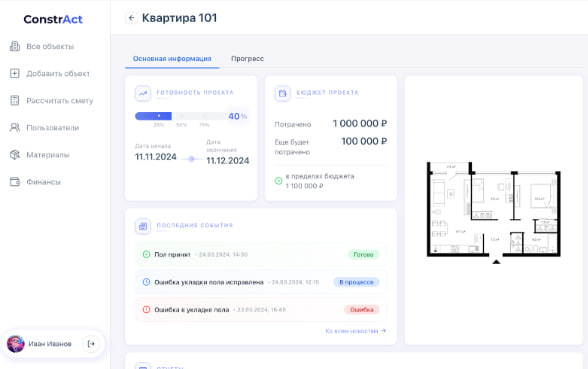
The system processes uploaded documents (drawings, plans, design projects), generates accurate estimates in two minutes, builds logistics stages and helps to control each step of finishing. As a result, construction and repair organizations can save up to 25% of project management time and reduce budget overruns by 20%. As a result, project deadlines will be disrupted twice as often, ITMO added.
The demand for AI in the construction market
Potential users include construction and repair companies, developers, real estate services, and private customers.
The project was carried out by undergraduates with an understanding of the real needs of the construction industry and the market. It attracts the attention of potential customers, said Dmitry Botov, head and co-founder of the ITMO Graduate School in Artificial Intelligence, winner of this year's Yandex ML Prize in the "Heads of educational programs" nomination. As part of the industry hackathons, the team has developed specialized submodules for the needs of large companies.
— The role of an AI engineer is being transformed today: from a designer and developer of technical systems, he becomes a specialist capable of transferring individual processes to neural networks and "AI" business, by analogy with electrification in the past, - he said.

Dmitry Botov, Head and co-founder of the Master's Degree in Artificial Intelligence AI Talent Hub at ITMO University
Russian developers are already transferring some of the tasks during the construction of facilities to AI assistants. Neural network services are most in demand now for automating routine operations in design, said the head of the AI department. Cloud.ru Dmitry Yudin.
— Now about 70% of the time of the construction process is spent on design. Among the reasons are the shortage of qualified engineers, data distortion during transmission between different organizations, and the high cost of delays and errors. Therefore, the construction industry has developed a request to use LLM, including to speed up the analysis of project documentation, search for information in estimates, and assist in the development of estimates," the expert said.

Other popular scenarios for the use of AI in construction include visualization of design and interior design. The model generates layout options and suggests improvements based on various factors: cost, environmental friendliness, and use of materials. AI also reduces project visualization time by 40%. In addition, artificial intelligence is actively used to provide plans and forecasts. The AI agent analyzes data on the availability of specialists, materials, and the weather, and suggests/implements adjustments without manual intervention. The reduction in delay time is up to 20%, the specialist said. Less popular AI application scenarios include video processing from drones to monitor the progress of construction on the site, and automatic detection of security risks. Neural networks are also used in logistics to optimize tractor or truck routes.
—However, so far the level of implementation is low — only about 12% of companies regularly use AI in construction processes," Dmitry Yudin said.

The presented platform reflects the general vector of the industry's development — the transition from fragmented digitalization to end-to-end process automation. However, it is necessary to evaluate such solutions strictly through the prism of regulatory requirements, reliability of algorithms and real applicability on production sites, says Grigory Bazhin, First Deputy General Director of the Stroitelstvo Scientific and Technical Center, lecturer at the Department of Metal and Wooden Structures at Moscow State University of Civil Engineering, NTI expert.
— The stated effect — saving up to 25% of time and reducing budget overruns by 20% — is possible only if the algorithms take into account real production conditions: variability of materials, logistical delays, deviations of actual volumes from design, the work of contractors with different skill levels. In practice, this requires trained models on large data sets and constant quality monitoring," the expert emphasized.
The development team is currently negotiating the launch of pilots and the integration of the platform with major construction services marketplaces.
Переведено сервисом «Яндекс Переводчик»
