- Статьи
- Science and technology
- Useful income: radioactive waste will be turned into energy for satellites

Useful income: radioactive waste will be turned into energy for satellites

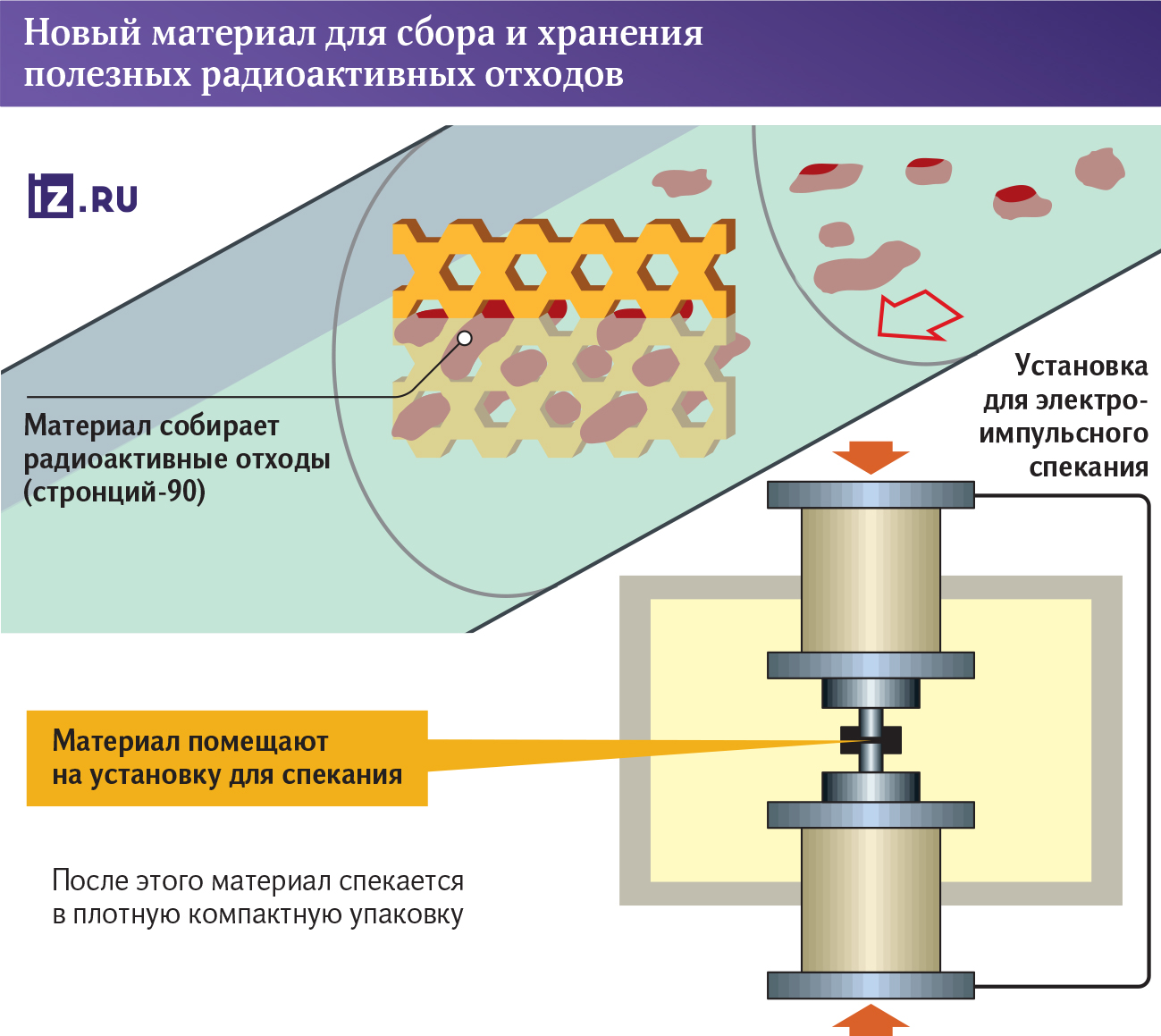
Scientists have developed a material and technology for the safe collection and subsequent long-term storage of radioactive waste. It is based on a synthetic sorbent, which extracts radioactive strontium from water. Then everything is sintered together into super-dense ceramics. In this form, waste can be stored for a long time. If necessary, radioactive elements can be extracted to make useful products from them. For example, rtgs are radioisotope sources of electricity that are used on space satellites and underwater lighthouses.
What is the danger of radioactive strontium?
Scientists from the Far Eastern Federal University, in cooperation with specialists from the National Academy of Sciences of Belarus, have developed a material and technology for the harmless collection of radioactive waste and its subsequent safe long-term storage. The Ministry of Education and Science of the Russian Federation told Izvestia about this.

The development is based on synthetic zeolite. It is a material with a molecular sieve effect. It has a microporous structure that allows it to effectively absorb only the right substances. For example, the NaY type zeolite proposed by the developers is a structure with the largest "ends" between the faces of the molecular lattice. Such a material effectively absorbs ions of radioactive strontium-90.
— This isotope is one of the main products of uranium fission in nuclear reactors. It accumulates in significant quantities in spent fuel and in liquid radioactive waste generated during the operation and maintenance of nuclear power plants. The main danger lies in the fact that this element emits beta particles with a half-life of about 29 years," Oleg Shichalin, a researcher at the Laboratory of Nuclear Technologies at the FEFU Institute of High—Tech Technologies and Advanced Materials, told Izvestia.

He added that strontium is a chemical analog of calcium (both are in the second group of the periodic table). Because of this, biological systems often "confuse" them and instead of calcium include a radioactive element in the composition of bone tissue. Thus, strontium-90 is located near the bone marrow, where hematopoiesis occurs. This can contribute to the development of bone cancer, leukemia (blood cancer), and other cancers.

Bright blue cloud of strontium atoms
— Usually, in order to collect dangerous substances, liquid radioactive waste is passed through columns with highly selective sorbents. In our research, we have shown that NaY is an ideal collector for strontium ions. It has a high capacity and perfectly "catches" radioactive elements even in the presence of interfering ions. For example, in seawater. As a result, the zeolite is saturated with strontium and forms a solid phase ready for further transformation," Oleg Shichalin said.
How to ensure reliable storage of radioactive materials
Then, the scientist continued, compaction takes place, for which the technology of electropulse plasma sintering is used. This is a high-speed hot pressing method that occurs by passing millisecond current pulses through the material. As a result, the initial mass with radioactive strontium is sintered into super-dense ceramics.
According to the expert, the studies confirmed the compliance of the samples with the requirements for highly active cured waste. The material has a crystalline structure similar to natural feldspar.
It is one of the most common minerals. It makes up half the mass of the earth's crust and is part of most rocks that are formed when magma cools. In natural conditions, strontium feldspar (in the crystal lattice of which calcium is replaced by strontium) remains stable for millions of years.

— As a result, ceramics reliably retain radionuclides. In this form, radioactive elements can be stored for a long time. The technique makes it possible to immobilize strontium-90 into an inert and durable ceramic form," Oleg Shichalin said.
In his opinion, if necessary, the material makes it possible to extract strontium isotopes from it in order to make useful products from them. For example, rtgs are radioisotope sources of electricity that supply remote facilities such as space satellites, lighthouses, and weather stations.

The developed technology can be effective for long-term storage of other radioactive waste, the specialist added.
— It is important to note that the technology not only offers a safe and reliable solution to the problem of radioactive waste fixation, but also contributes to the development of environmentally sustainable and efficient nuclear energy of the future. The key advantage of the approach is that the same material consistently performs the function of a sorbent and then a final matrix for burial," commented Ivan Tananaev, scientific supervisor of the direction, Professor of the Department of Nuclear Technologies at the ITPM FEFU, Academician of the Russian Academy of Sciences.

This fundamentally simplifies the technological cycle and significantly reduces operating costs, he explained.
— The use of waste such as strontium-90 is, of course, possible and in demand. It is used in medicine and some specific technologies. For example, to create exemplary radiation sources. And also for radioisotope thermoelectric power generators. The difficulty lies in choosing a decent package. First of all, it must be durable in order to avoid the release of a radioactive element into the environment," said Tatiana Kulagina, Doctor of Technical Sciences, Professor, Head of the Department of Technosphere and Environmental Safety at Siberian Federal University.
The proposed technology correctly solves the problem of strontium-90, which is found in radioactive waste. However, the technology is not ready yet, because there are other radioactive elements in this waste. First of all, caesium. And over time, its decay products appear, said Georgy Tikhomirov, Deputy Director of the Institute of Nuclear Physics and Technology at the National Research Nuclear University MEPhI.
In this regard, he stressed, the development can be assessed as an important step towards creating a technology for the disposal of radioactive waste, which nevertheless has yet to be created.
Переведено сервисом «Яндекс Переводчик»
