
Fast access: HSR Moscow-Petersburg to be connected to satellite Internet

The Moscow — St. Petersburg high-speed railway will be connected to the satellite Internet. It is impossible to cover the HSR with a regular cellular connection due to the high speed of movement. Bureau 1440, the Russian equivalent of Elon Musk's Starlink, may become a provider, Izvestia has learned. The company has already signed a cooperation agreement with Russian Railways. The Ministry of Finance confirmed that the development of Internet equipment is already underway, it can be used on both high-speed trains and conventional ones. Whether there are alternatives to such technologies is in the Izvestia article.
Who will connect the HSR to the Internet
The developer of the Rassvet satellite communication system, Bureau 1440, which market participants call Ilon Musk's analog Starlink, may become an Internet provider of the high—speed railway line between Moscow and St. Petersburg. A source in the radio electronics market told Izvestia about this.
Such a project is indeed being discussed, an interlocutor of the editorial office, close to the company's shareholder, confirmed. According to him, it is already developing Internet terminals that can be installed not only on high-speed HSR trains, but also on other rolling stock.

He recalled that earlier, Russian Railways and Bureau 1440 signed an agreement providing for the development of digital services based on a low-orbit satellite constellation, as well as the creation of in-demand industry IT solutions. In early October 2025, the head of Russian Railways, Oleg Belozerov, mentioned that it was planned to use Russian low-orbit satellites to provide communications for HSR trains. And the Dawn belongs to this type of spacecraft, one of the Izvestia interlocutors noted.
The editorial board sent a request to Russian Railways and the HSR Information Center.

Work on the creation of a Russian low-orbit satellite communications constellation with global coverage is proceeding according to plan, six experimental spacecraft have already been launched into orbit, the Ministry of Digital Affairs told Izvestia. The first mass launch of production satellites is planned at the end of the year, and two more launches are planned in the first half of 2026, with the bulk of the constellation to be formed by 2027.
"Thanks to this, fast and stable Internet will be available throughout the country, including in remote settlements and on transport, including rail," the ministry noted.

Izvestia's interlocutors found it difficult to estimate the cost of equipping high-speed and other trains with satellite Internet. This is a completely new solution, there are no special railway antennas on the world market, explained Leonid Konik, partner at ComNews Research. But an electronic scanning antenna for a cruise ship operating on the OneWeb network (another foreign Internet access system from low-orbit satellites) costs about $30,000, he said.
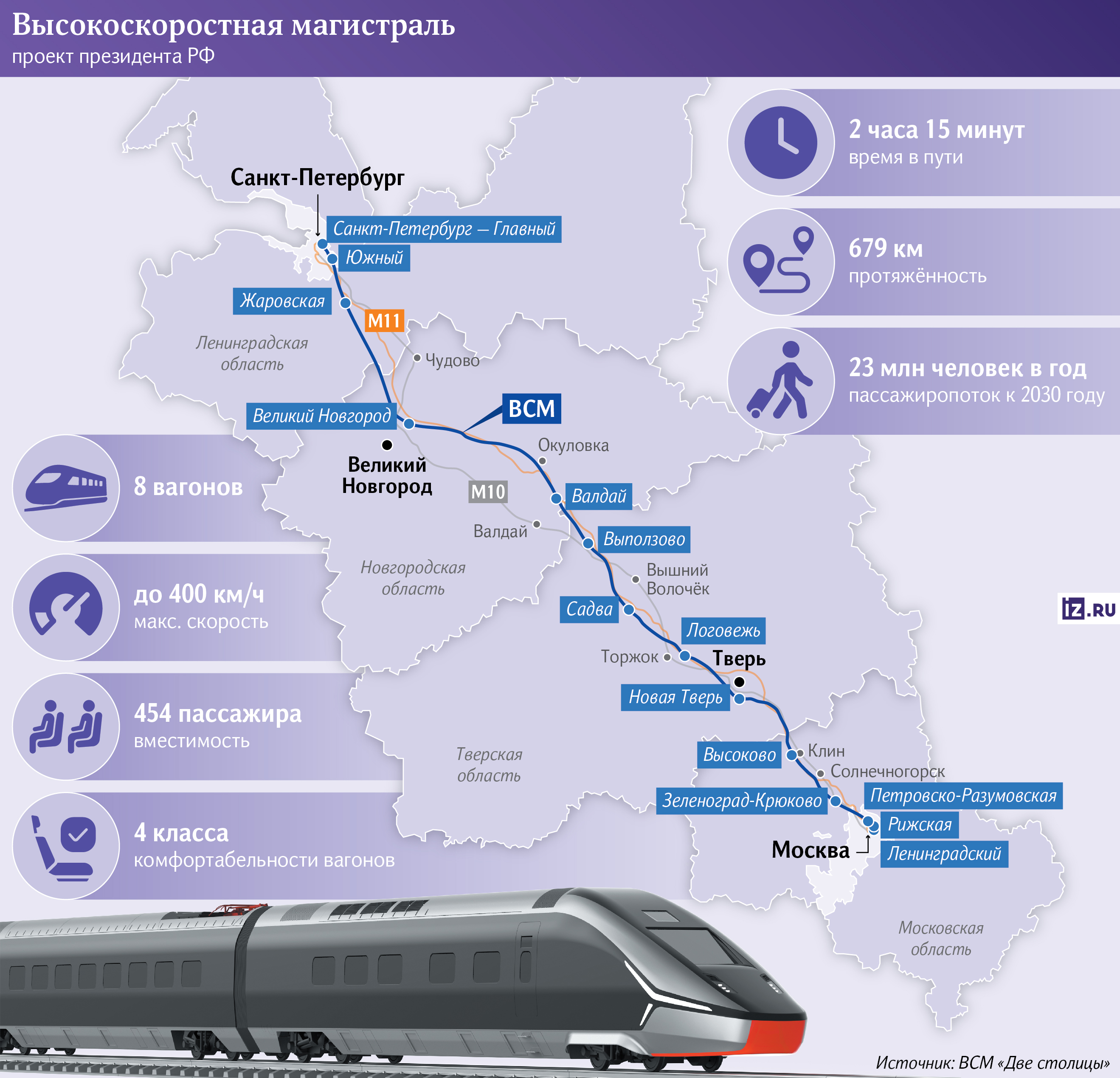
It is planned to fully commission the 679 km high-speed railway between Moscow and St. Petersburg in 2028. The speed of trains along it is expected to be up to 400 km/h, and the travel time between the two cities is 2 hours and 15 minutes.
Bureau 1440 is part of X-Holding (the shareholders of this structure have not been disclosed). The federal project "Infrastructure for Access to the Internet Information and Telecommunications Network" stipulates that 383 Rassvet communications satellites will be launched into orbit by 2030. The cost of the project is estimated at 329 billion rubles, while slightly more than 17 billion rubles can be allocated from the federal budget for the creation of a satellite constellation. The state is also ready to spend 52 billion rubles to launch these vehicles into space, and the organization can receive another 33.6 billion rubles in the form of preferential loans, according to the federal draft.

The planned composition of the grouping in low—Earth orbit is 292 spacecraft, and a total of 383 satellites are to be launched, taking into account the replacement of 91 vehicles with expired active life, the Ministry of Digital Said.
The aerospace company is currently developing a universal subscriber terminal for all types of wagons, which will provide satellite communications for different types of trains, Bureau 1440 confirmed to Izvestia. The terminal takes into account the features of the existing digital infrastructure of the railway, they stressed.
"Next—generation satellite communications will allow rail passengers to maintain their usual communication quality and use online resources throughout the route, while carriers will develop intelligent transport systems," the company added.

Are there alternatives to satellites on railways
The technical characteristics of the Rassvet satellites have not been publicly disclosed, Leonid Konik noted.
— But OneWeb, the closest group in terms of the number of spacecraft, has a bandwidth of 7.2 Gbit/s per satellite. If the entire capacity is allocated for train maintenance, then each unit will be able to provide Internet to about 14 trains of ten cars in one location," the expert estimated.
In Kazakhstan, where two trains running between Astana and Alma Ata have been equipped with OneWeb Internet access since the beginning of 2025, this speed per train does not exceed 150 Mbps, he added.

According to one of Izvestia's sources, connecting HSR trains to the Internet has its own peculiarities: due to the very high speed, cellular communication may be unavailable or extremely inefficient.
—Satellite communications with global coverage based on a low—orbit constellation is a technological solution that has virtually no alternative for transport infrastructure in terms of a set of parameters," Bureau 1440 says. "This includes a wide data transmission channel, low signal latency, and the absence of geographical barriers, connecting objects in motion at high speed.

Theoretically, there are alternatives to satellite communications, Leonid Konik noted.
— Back in 2018, 3GPP, the developer of global cellular communication standards, released the LTE standard specification (LTE Release 15), which standardized the main characteristics of subscriber device mobility at train speeds up to 500 km/h. If it were just about meeting the needs of passengers, that would be more than enough," he said.
But railway companies are also interested in the possibility of remote video surveillance, this service creates a huge amount of traffic: the cellular network may not be able to withstand such data flows, the expert pointed out.
Dedicated Trackside Network networks can solve the problem. They involve laying a fiber-optic cable along the railway track and installing Wi-Fi base stations along the entire length of the track.
But over long distances, the Trackside Network will be very expensive, warns Leonid Konik. The only alternative is low-orbit satellite systems that can provide high-speed Internet access everywhere, he is sure. Foreign systems of this type — be it Starlink, OneWeb or SpaceSail — are not legalized in the Russian Federation, so we can only rely on Bureau 1440, the expert concluded.
Переведено сервисом «Яндекс Переводчик»
