Universal scale: nature-like technologies will help to explore space


The principles of wildlife not only open up new opportunities in energy, genetics, agriculture and medicine, but will also allow us to reach a new level in space exploration. This was discussed at the plenary session of the III International Forum of Nature-like Technologies, organized in Moscow by the Kurchatov Institute Research and Development Center. Mikhail Kovalchuk, President of the Kurchatov Institute, stressed that only approaches borrowed from living systems will allow humanity to cope with the global problem of the depletion of the planet by the ever—growing technosphere.
International Forum of Nature-like Technologies
The III International Forum of Nature-like Technologies was officially opened in Moscow at the House of Scientists named after Academician A.P. Alexandrov. In his plenary lecture, Mikhail Kovalchuk, President of the Kurchatov Institute, emphasized that a new technological order based on the principles of living, natural systems is the only possible solution to the conflict between technological progress and the biosphere. And Russia is consistently developing this area.
"A new idea always changes the landscape, disrupts the current situation, so it needs to be promoted — this happened with the nature-like approach. The President of the country has now approved a strategy for the development of nature-like technologies, and a number of federal scientific and technical programs are being implemented," Mikhail Kovalchuk said.
The president of the Kurchatov Institute also recalled that the national project "Bioeconomics" has already been prepared, which will be the first step towards a new nature-like way of life.
Valery Falkov, the head of the Ministry of Education and Science, who participated in the meeting, said that the ministry, together with the Kurchatov Institute, had prepared and submitted to the government a draft decree on the development of nature-like technologies. As part of the implementation of this order, the Kurchatov Institute, together with other scientific organizations, will conduct research primarily in the fields of genetics and agriculture, energy, medicine, the creation of new materials, as well as the development of a new megascience infrastructure.
"This is a significant step forward," the minister stressed.
"Nature-like technologies rely on a broad interdisciplinary scientific and technological base. They do not cause damage to the world around them, but seek to restore the balance between the biosphere and the technosphere that has been disrupted by man," said Gennady Krasnikov, President of the Russian Academy of Sciences, another participant in the meeting.
He assessed the format of the forum as effective, providing an opportunity to share best practices, innovative technologies, and new approaches to solving global challenges.
Dmitry Bakanov, General Director of the Roscosmos State Corporation, spoke about how the nature-like approach is implemented in solutions for the rocket and space industry. For example, the principles of naturalness are already used in self-healing materials that eliminate micro-damage to surfaces.
"Swarm intelligence is already being used to control satellite groups and unmanned aerial vehicles: multiple devices act as a single system, automatically distributing functions and workload. Natural principles are also used in aerodynamics and thermal systems. For example, lotus leaf-type coatings protect solar panels and optical elements from contamination. The microstructure of the surface, similar to shark skin, reduces air resistance and improves flow. This has the direct technical effect of reducing fuel consumption and increasing resources," he said.
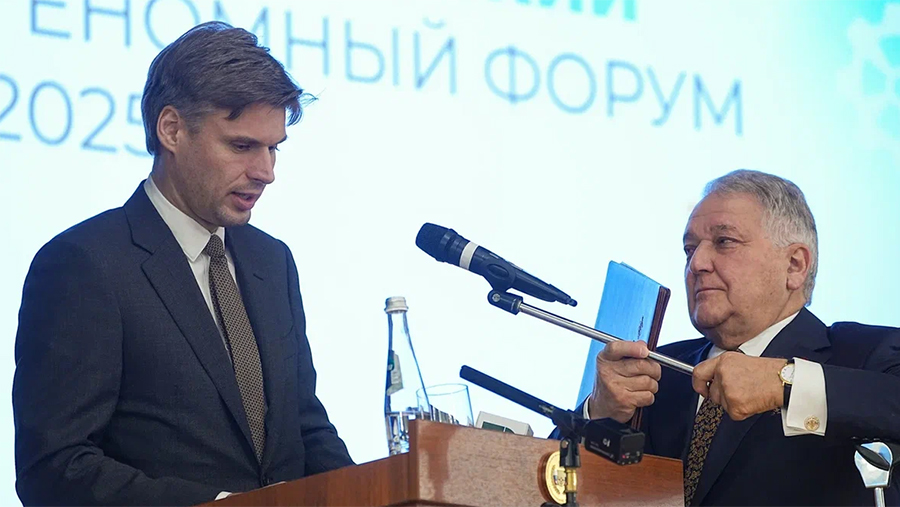
Nature-like technologies in the context of space exploration were also the main topic of Mikhail Kovalchuk's report. He spoke about a number of research and development areas that the center conducts to solve space problems. These include nuclear space power engineering (the Kurchatov Institute has been engaged in this field since the 1950s), space materials science, microelectronics, and even the study of the effects of space flight conditions on living organisms using primate models based on the Kurchatov Complex of Medical Primatology.
Closed cycles are implemented in life support systems, which are also based on natural processes.: photosynthesis, regeneration and recycling. They are already being used on the ISS, and in the future they will become the base for new orbital stations, lunar exploration and long-range manned missions.
In addition, Mikhail Kovalchuk spoke about the prospects of creating space engines based on thermonuclear fusion, a reaction that occurs inside stars.
"Thermonuclear engines in space may appear earlier than on Earth. In fact, there is everything necessary for this, including ultra—low temperatures for cooling superconducting magnets and a vacuum," he explained.
And the basis for these power units can be rocket plasma engines, the primacy in the development and implementation of which belongs to the Russian scientist Alexei Morozov, an employee of the Kurchatov Institute.
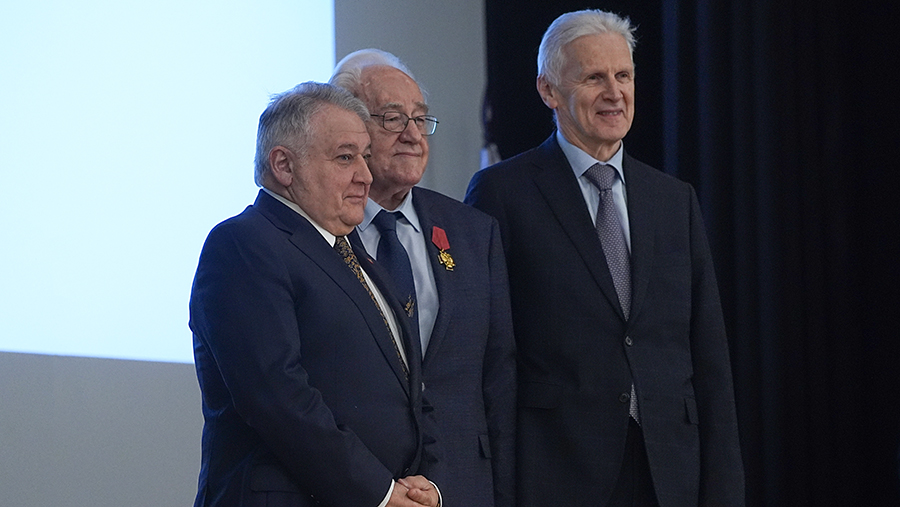
During the opening ceremony of the forum, the scientists of the Kurchatov Institute were awarded state awards. The Order of Merit for the Fatherland, IV degree, was awarded to the outstanding theoretical physicist Nikolai Tyurin, who headed the Institute of High Energy Physics in Protvino. Oleg Naraykin, Vice-President of the Institute, was awarded the title of "Honored Scientist of the Russian Federation." Yulia Dyakova, Director of the Kurchatov Institute, was awarded the medal "For Merits in the Development of atomic Energy." The Order of Friendship was awarded to Ekaterina Yatsishina, Deputy Director of the Kurchatov Institute for Scientific Work.
Kurchatov Genomic Forum
The scientific program continued with the Kurchatov Genomic Forum. The sessions discussed the importance of genetic technologies for industrial biology, modern agriculture, prevention and treatment of socially significant diseases.
According to Alexander Yanenko, Deputy head of scientific Work at the Kurchatov Complex of NBICS-Nature-like Technologies, recently our country has been paying special attention to the development of bioeconomics as the first stage of the nature-like technosphere. The goal is to create a scientific and technological basis and create an infrastructure for the establishment and development of bioeconomics in Russia as a new economic system based on the use of biotechnologies and natural bioresources for the production of goods, services and energy. A national project for the development of this area is currently being prepared in the Russian Federation. It highlights two stages. Until 2036— the goal is to ensure technological sovereignty: the creation in our country of production of critical biotechnology products (amino acids, enzymes, vitamins, etc.).
"This is a very high-tech field. Therefore, it is important that scientific research develops along with production. The Scientific and Technological Center for Bioeconomics and Biotechnologies, established by government decree on August 7, 2024, will play a major role in this. It includes 10 of the country's leading organizations in this field. In addition to the Kurchatov Institute, which is the main structure, these are the Institute of Bioorganic Chemistry, the Institute of Cytology and Genetics, the All—Russian Research Institute of Agricultural Biotechnology and others," said Alexander Yanenko.
Also, within the framework of the forum, a contest of ideas was held on the development of the National Database of Genetic Information created at the Kurchatov Institute. This is a digital project necessary for the development of biological science and industries related to living systems, Maxim Patrushev, deputy director of the Kurchatov Institute for Biology and Genetics, told Izvestia.
— This system already has a lot of functionality today. But it was important for us to discuss with representatives of the scientific community in which direction to develop it, which is most relevant now," he explained. — Our scientists need clear and accessible bioservers. All genetic information should be linked to specific topics. For example, we talked about plasmids, which are special parts of the DNA of microorganisms. They are widely used in scientific research, including for the creation of producing strains for industry. This aroused great interest. Various development options have been proposed.
This resource will be constantly evolving: after commissioning, the developers plan to collect feedback on its work and further improve the system, achieving its maximum effectiveness as a practical scientific tool.
Переведено сервисом «Яндекс Переводчик»
