Learning and light: unknown works by Matyushin presented in St. Petersburg


Canvases with images of lakes and sunsets, watercolor panoramas of the Gulf of Finland and real roots from Karelian forests. All this can be seen in the Museum of the St. Petersburg Avant-garde (a branch of the State Museum of the History of St. Petersburg) at the exhibition "Learning from Nature. Landscapes by Mikhail Matyushin". The first monographic retrospective of the great artist in many years is the first attempt to show the entire evolution of his work using the example of one genre and one collection. Details can be found in the Izvestia article.
Remembering the avant-garde
During the formative years and heyday of the Russian avant—garde - the 1910s and 1920s — Mikhail Matyushin's name sounded no less loud and weighty than the names of Kazimir Malevich and Vasily Kandinsky. But since the second half of the 1930s, they were practically forgotten in their homeland, their finds were called misconceptions, and their works were hidden in storerooms. The return of this art to the general public began first abroad and, of course, with the work of those figures who, during their lifetime, managed to make themselves known in Europe. Matyushin, who had never aspired abroad, found himself in the shadows.
But even in new Russia, his legacy did not arouse widespread interest at first. The point is both in the "table of ranks" that has developed in the West, and, in fact, in the very specifics of Matyushinsky art — not as radical and catchy as the author of the "Black Square", not as large-scale in number and size of works as Natalia Goncharova and Mikhail Larionov. Yes, his stuff was on display, of course, but mostly as part of group projects.
The situation has only begun to change in recent years. Matyushin's artistic works began to appear more and more often in exhibition halls, and his musical works (since he is also a bright composer) began to be performed on major stages. It is enough to mention the premiere of the scientific reconstruction of his opera "Victory over the Sun", held at the Moscow Philharmonic. Now this recording is played non—stop at the blockbuster exhibition "Our Avant-Garde" at the Russian Museum. And last spring, when the Zotov Center successfully hosted a large "paired" exhibition of Matyushin and his wife Elena Guro, "Love in the avant-garde," it became clear that even for the general public, these figures are by no means strangers.

A bridge to the future
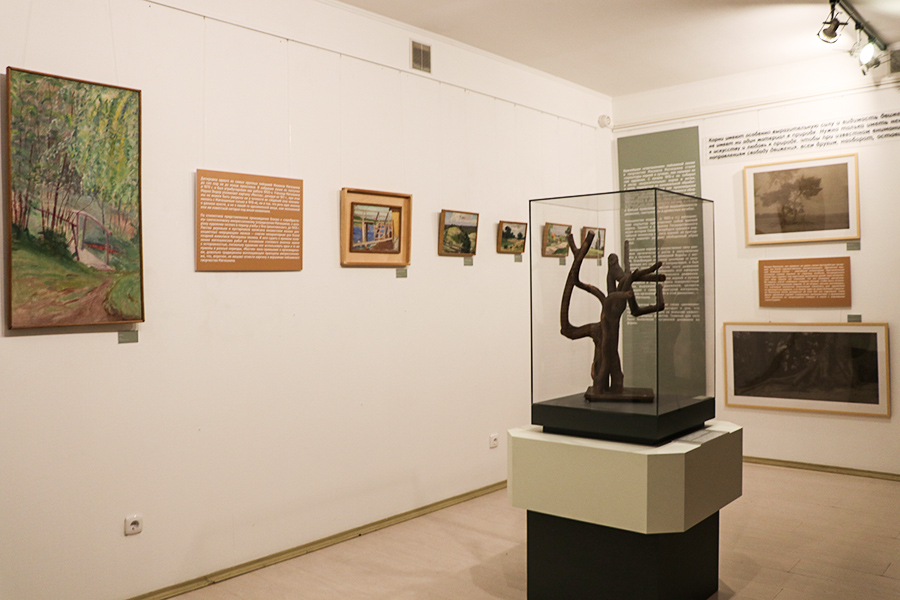
Now St. Petersburg is taking over the baton from Moscow. However, the exhibition at the Museum of the St. Petersburg Avant—garde — it is located in the very house where Matyushin lived - has nothing in common with the capital. Even the set of works does not overlap. In "Zotov" they told a love story, the emphasis was on the personalities of the characters. The GMI SPb has a different task: to show with all clarity, using the example of one genre, how Matyushin's style developed: from student sketches to later experiments.
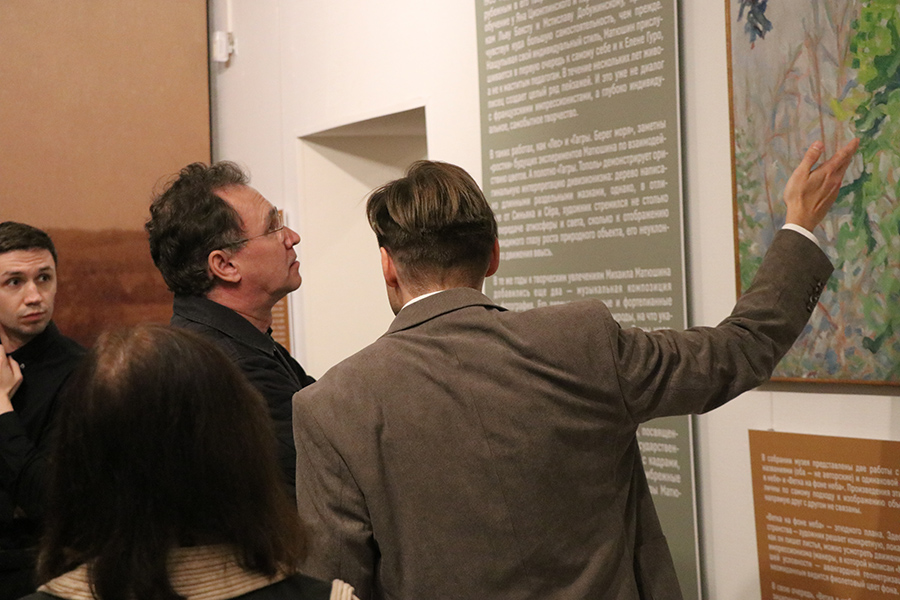
Some canvases had previously been in the same house as part of the permanent exhibition. But after descending from the artist's memorial studio to the first floor, they acquired a completely different "sound". First of all, this concerns the "Bridge" — one of the largest, but at the same time mysterious landscapes of Matyushin. It is still unclear in what period it was created: information varies, there is no exact dating. Although the style, clearly inspired by French impressionism, convinces that this is still the beginning of the 20th century.
The lush foliage of young trees, shimmering in the sunlight, forms an arch over a forest path stretching into the distance. And the detail with which the green crowns are painted turns out to be completely uncharacteristic of the painter's later style. At the exhibition, the landscape is intentionally separated from the rest of the paintings, it turns out to be a kind of overture to the whole narrative. And, of course, it immediately attracts the eye.
As well as the sculpture of tree roots that stands in the showcase. Previously, it stood in the mentioned workshop just on the floor — and was not perceived at all as a work of art. Now this art object is becoming one of the central exhibits: the driftwood found by Matyushin in the Karelian forests is attached to a stand in such a way that a generalized image of dance is seen in their curves.
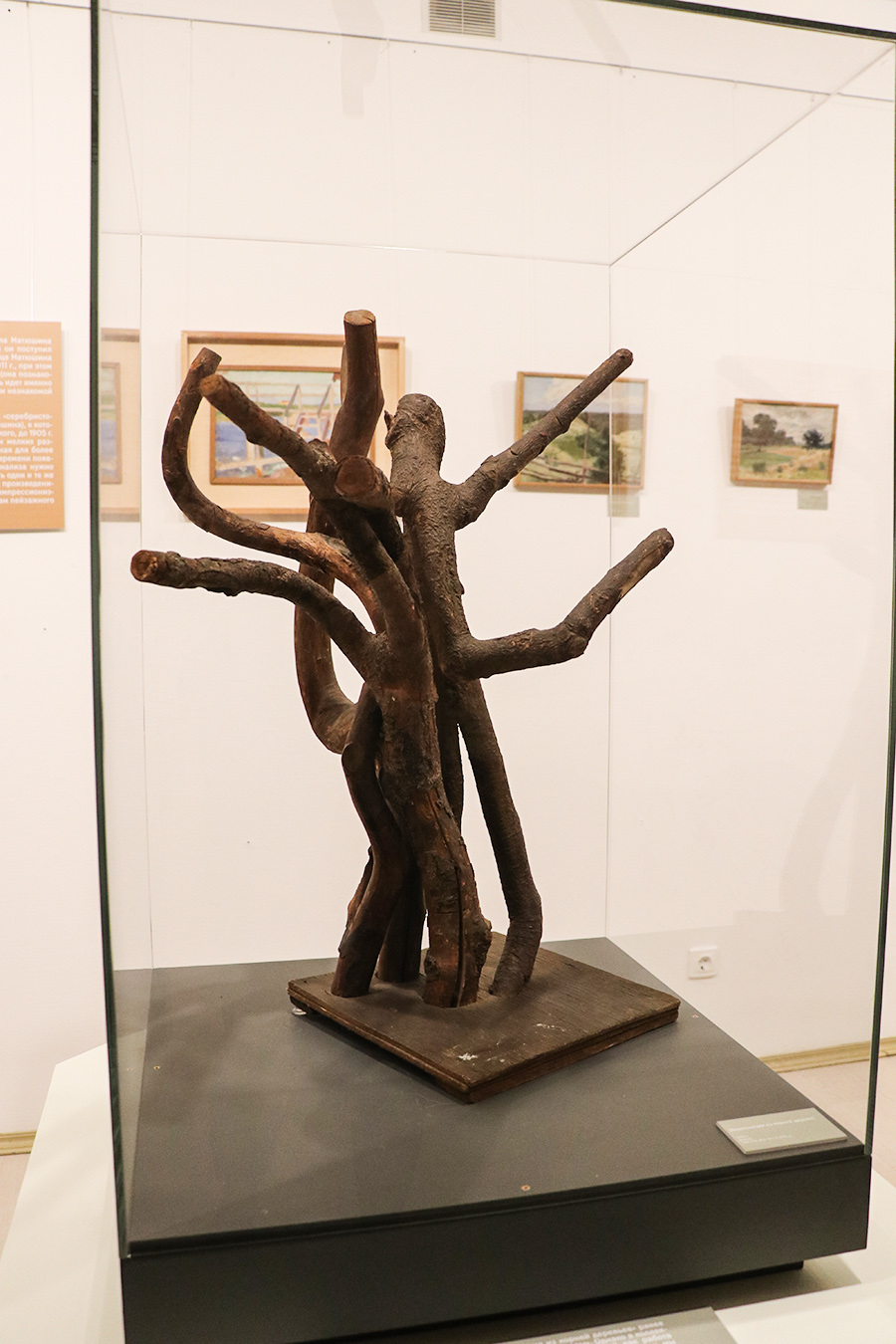
In deliberately coarse, "mundane", unprocessed material (even the bark is preserved here) Matyushin reveals incredible inner plasticity without interfering with the original form itself. Unlike ordinary sculptors, he did not carve or plan anything. He only cut off the branches he found, trying to reveal the dynamics and artistry inherent in them by nature itself.
But not the same ideas, for example, in his photographs? The 1912 photograph "Giant Roots", which depicted the "tentacles" of mighty trunks crawling along a sandy embankment, was printed for the exhibition in a large format (about a meter wide) and placed at the bottom, at the level of the viewer's feet — as befits the roots. And the shots with the crowns of trees, respectively, rise from the ceiling. And we involuntarily repeat the direction of the artist's own gaze.
The landscape from all sides
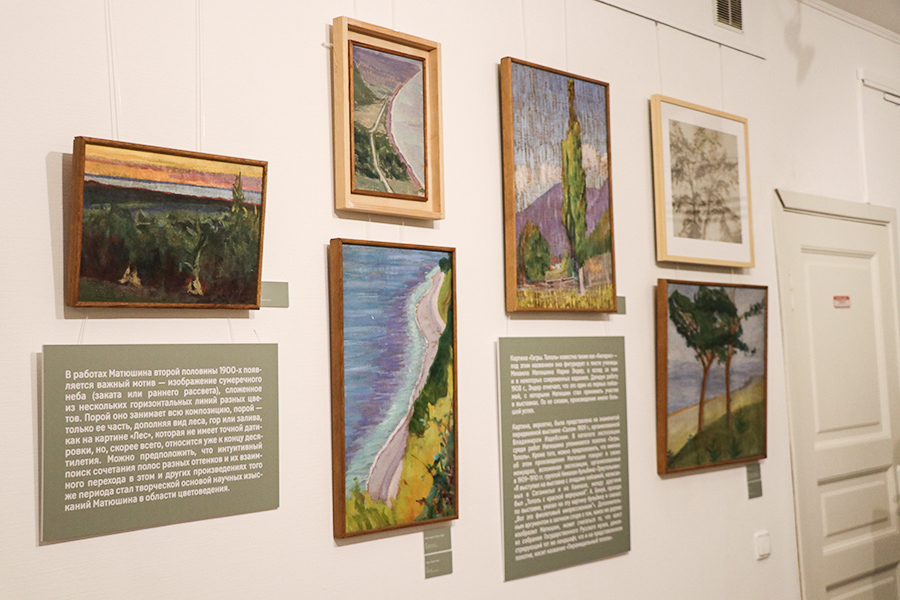
However, the main thing at the exhibition, of course, is painting and graphics. And they are placed just at eye level so that you can see the images in all the details, without glare and reflections. GMI SPb has the largest collection of Matyushin's works in the world, and the public sees many of them for the first time. Among such discoveries is a two—sided landscape from 1909. On both sides of the canvas — sunset (or predawn?) Sky: multicolored stripes merging into each other. But in the first case, the composition is complemented by a haystack. And this image has been shown before. Turnover — never. Although it is even more interesting, because it breaks almost beyond the boundaries of object art, foreshadowing future discoveries, up to the famous masterpiece "Movement in Space".

As for the graphics, there are also works unknown to the public and even to specialists. For example, an amazing panorama of the Gulf of Finland or a pencil sketch of the sky, paradoxically combining realism and abstraction. Textbook things, for example, the late "Landscape. The Entry of Spheres", where myriads of multicolored strokes swirl into two giant vortexes that meet in metaphysical infinity.

For Matyushin, nature is not only forests and lakes, fields and mountains, but also the visible physical world. It is also a "portal" to the mysterious fourth dimension, the vibrations of which the artist saw in everything, including natural phenomena.
While working en plein air, Matyushin sought to develop the ability to see the landscape not only with ordinary vision, but also with the occipital, literally absorbing everything around him with his whole body. It was one of his principles: always learning, always learning new things. He became an artist at a very mature age, when he was well over 30. He started exhibiting after 45.
And at 48 he made his debut as a composer, having mastered another profession. By the way, he even has images of nature in his music: at the exhibition you can listen to a fragment of the suite "Autumn Dream", where the author finds "the motif of the ringing of grasshoppers", "the motif of a low-humming stormy wind" and so on.
It was nature that became, perhaps, his main teacher, no matter what kind of art he mastered. The title of the exhibition refers to Matyushin's appeal — "do not imitate nature, but learn from it!" He himself gives us a lesson in beauty. In the era of revolutions, wars, and social upheavals, the painter's art remained surprisingly harmonious and peaceful, no matter what stylistic metamorphoses (impressionism, cubism, pointlessness, realism...) it experienced. Maybe that's why it has become so popular with the public today?
Переведено сервисом «Яндекс Переводчик»
