
Autumn frosts: the market expects the key to remain at 17% in October

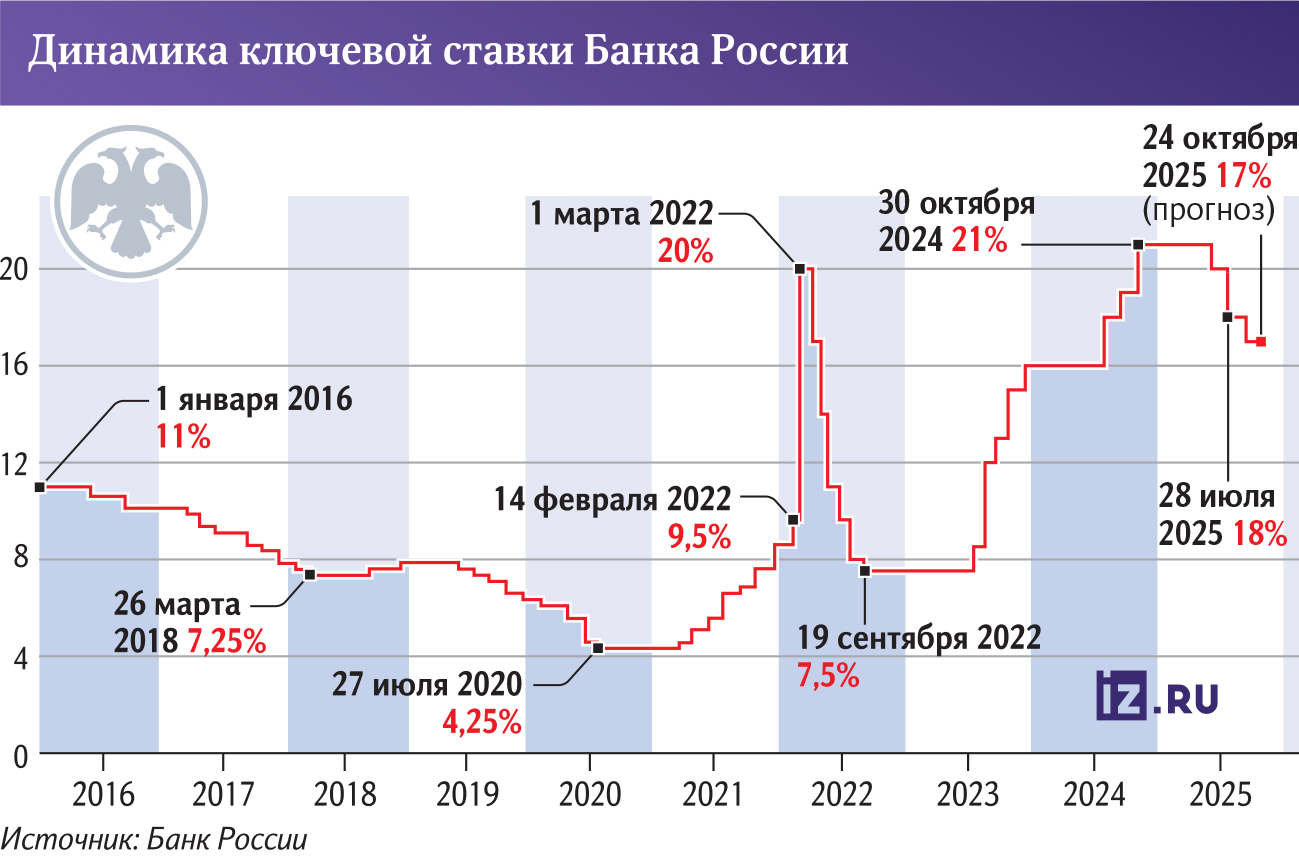
The Central Bank will keep its key rate at 17% in October, according to Izvestia's consensus forecast. The reasons are the high inflation expectations of the population, the increase in the cost of fuel and credit. The Bank of Russia is not yet sure about the trend towards a slowdown in price growth, so it will prefer to take slower steps. The shortage of personnel in the market and high inflation can force the regulator to keep the key level at the same level until the end of the year. What will influence the decisions of the Central Bank is in the Izvestia article.
Why won't the rate be lowered in October
The Central Bank will pause in easing monetary policy - it will keep the key rate at 17% following the meeting on October 24. 17 out of 20 analysts and market participants surveyed by Izvestia are convinced of this. Four of them still allow for a rate cut in the range of 0.5–1 percentage points. Of these, only three experts expect a rate cut to 16% in the baseline scenario.
The pause looks justified: in September, inflation accelerated, while its stable components remain above the target 4%, said Olga Belenkaya, head of the Macroeconomic Analysis Department at Finam. Weekly data from Rosstat confirms the acceleration of inflation in October. The main factors are rising prices for fruit and vegetable products and gasoline, as well as rising prices for food, medicines, electronics and imported cars.

Labor market tensions remain high, with unemployment reaching a historic low of 2.1%, Olga Belenkaya said. Salaries are growing at a high rate — 16% by the end of August, which fuels an increase in demand, said the Director of Macroeconomic Analysis at Dom Bank.Russian Federation" by Zhanna Smirnova. In August, consumption of non—food products doubled, and catering services jumped to 9.1%, showing that demand in the economy remains high.
— Business activity has objectively slowed down, and its cooling is noticeable, that is, monetary policy has had the expected effect, - said Dmitry Kulikov, Senior Director of the ACRA Group of Sovereign and Regional ratings.

Another extremely important factor for the Central Bank, inflation expectations, retains its negative impact. According to the regulator, the indicator decreased to 12.6%. However, this level is considered high, said Pavel Paevsky, Head of the Credit Analysis and Macroeconomics Department at RSHB Asset Management. This means that the population still believes that prices will rise in the future — this accelerates consumption at the moment and does not allow it to slow down.
— There is also an acceleration in the growth of lending and consumption in July – August, which increases inflationary pressure, — said Olga Belenkaya.

The pause in October will give the regulator time to assess the effect of the policy easing that has already been carried out, the expert believes. In the time before the next meeting, the influence of pro-inflationary factors should decrease, which will give the Central Bank more opportunities to reduce the key rate.
Can the rate be maintained until the end of the year
The base forecast assumes a reduction in the rate to 16% by the end of 2025, according to Pavel Verevkin, senior analyst at KIT Finance's financial markets analysis department. This may happen as early as the October meeting or, with a slightly higher probability, in December. More drastic steps are unlikely due to the continuing inflationary risks.

Nevertheless, there is a threat that the rate will not decrease until the end of the year. According to Rosstat, the economy is slowing down, but in July – August, growth in consumption, lending and wages accelerated — all this supports demand in the economy, which the regulator is trying to slow down. Surveys show that the labor market situation is gradually improving, and the shortage of workers has decreased slightly, but in any case, monetary policy rigidity may persist in the coming months.
The most noticeable factor now is fuel, said the Director of Macroeconomic Analysis at Dom Bank.Russian Federation" by Zhanna Smirnova. An increase in its value against the background of a decrease in supply affects overall prices and inflation expectations. In general, pro-inflationary risks have increased compared to the summer.

Economic growth may slow down to 0.8% this year after 4.3% in 2024, Mikhail Vasiliev, chief analyst at Sovcombank, expects. This is due to a general decline in business activity, lower investments and moderate consumption growth, he added.

Maintaining the key rate at 17% has already been taken into account by the market and should not affect the ruble exchange rate, however, in the medium term, a high rate will support it, increasing the attractiveness of ruble savings and reducing demand for imports and foreign currency, Mikhail Vasiliev noted. In the coming weeks, the national currency is likely to remain strong, trading in the range of 76-82 per dollar, 10.6–11.4 per yuan and 88-95 per euro.
 At the same time, due to the rise in prices of basic goods, Russians' inflation expectations may rise significantly in October, said Viktor Grigoriev, chief analyst at Bank Saint Petersburg. Such a price increase is predictable, but if the growth in inflation expectations exceeds the forecasts of the Bank of Russia, the regulator will have a strong argument to postpone the reduction in the key rate.
According to Alexey Zabotkin, deputy chairman of the Central Bank, after inflation slows to 6-7% by the end of 2025, the economy will return to "persistently low inflation" next year at the 4% target. However, according to Mikhail Vasiliev, the risks of its entry into the upper part of the range of the Central Bank remain.
Переведено сервисом «Яндекс Переводчик»
