- Статьи
- Science and technology
- Brushes and paints: scientists have created the world's first "smart" prosthesis with light control

Brushes and paints: scientists have created the world's first "smart" prosthesis with light control

The world's first bionic prosthesis with optical sensors will be available to Russian patients as early as January 2026. The developers of the technology told Izvestia about this. It is suitable for people with weakened muscles — after frostbite, electrical injuries and other injuries. The device reads signals from the tendons of the wrist, which ensures the most natural movement control. According to experts, this is an important step towards more comfortable control of bionic limbs.
The world's first prosthetic hand with optical sensors
A Russian company has presented the world's first bionic prosthetic hand with optical control Omni Hand. The main feature of the device is the use of optical sensors (OMG) that read signals not from muscles, as in traditional prostheses, but from the tendons of the wrist. This is a fundamentally new approach: it allows you to install a prosthesis for people with weakened muscles — after electrical injuries, frostbite or other injuries — and provides the most natural movement control.

Sensors are installed on the wrist, they read the electrical activity of muscles like traditional systems, and also record changes in the light transmission of tissues that occur during tendon movement — when a person strains or relaxes the arm, blood flow and ligament position change. These micro-movements are detected by sensors that transmit a signal to the prosthesis, the developers explained to Izvestia.
When a user performs a "phantom" gesture, such as mentally clenching a fist, showing a "pinch" or a "gun," the prosthesis recognizes this movement and accurately repeats it in real time. Unlike most prosthetics, where gestures need to be switched sequentially, the Omni Hand can play them in any order, making operation intuitive and fast.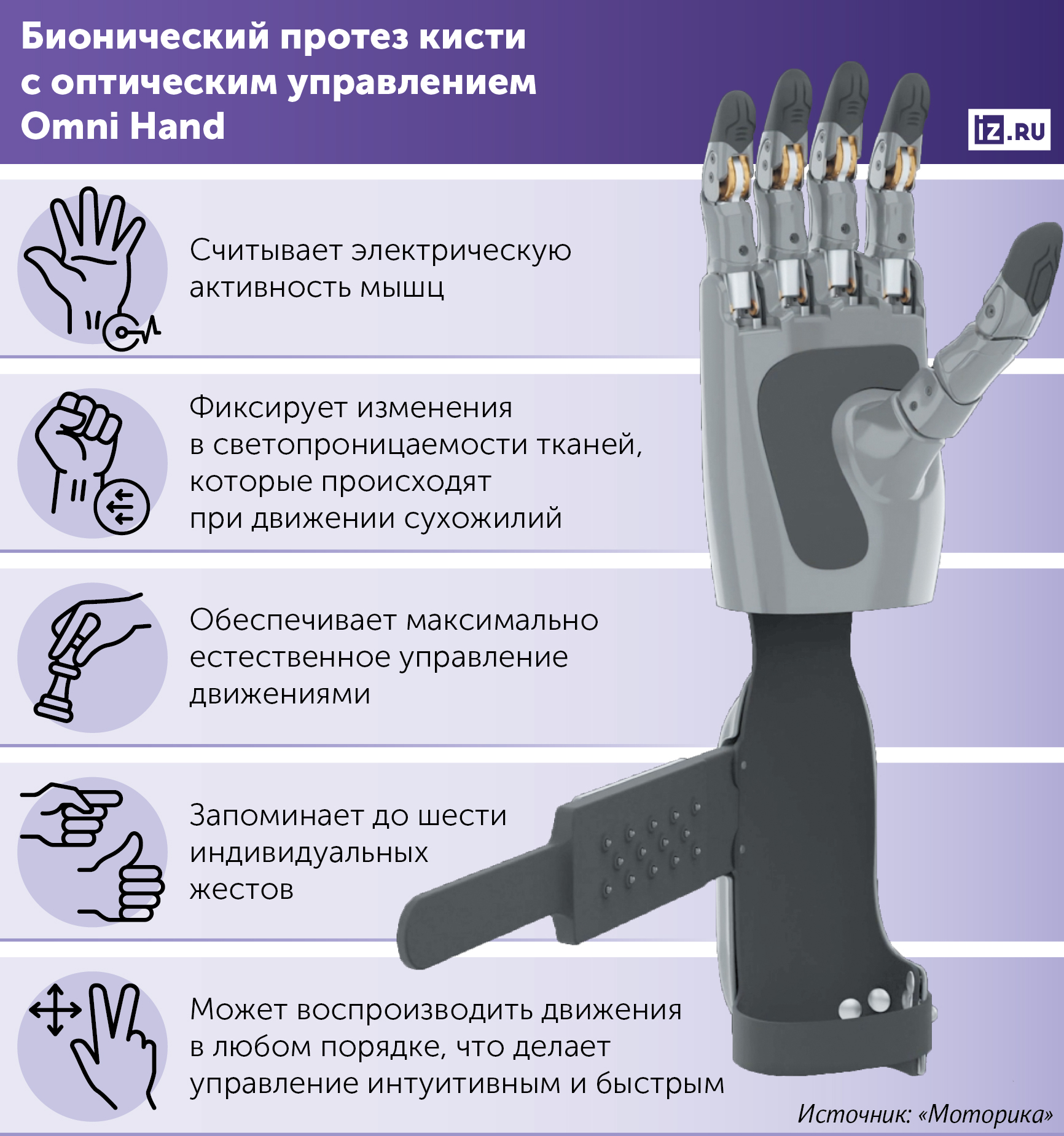
— This is a new level of human-technology interaction: it does not just react to movements, but understands the user's intention. This is a step towards truly natural control of bionic prostheses," Andrey Davidyuk, CEO of the Motorika development company, told Izvestia.
How a bionic brush remembers "phantom" gestures
The bionic brush remembers up to six individual gestures. Their choice is powered by a User Decision Support System (CPPR). It analyzes the signals, adapts to each user, and becomes more accurate over time. Thanks to this, the prosthesis "learns" with the person, improving the response and increasing the accuracy of movements.
Serial production of this model will begin in January 2026. The first eight users have already received prosthetics as part of the pilot tests, and they continue to use them on an ongoing basis. Although optical sensors in prosthetics are already being studied by some scientific groups abroad, the Russian developer was the first to bring the technology to a real product and already apply it in practice.

The domestic market of assistive technologies is constantly developing, which is facilitated by new technologies and the expansion of competencies among companies, Dmitry Lapin, head of the department of ANO Technologies of Opportunities (part of the Neuronet NTI infrastructure center), told Izvestia.
— Obviously, the reasons are primarily related to the focus of attention to the industry from government agencies. In this regard, it is worth mentioning that the government commission for Scientific and technological development recently approved a draft strategy for the development of the rehabilitation industry of the Russian Federation until 2030, which states that one of the priorities is the creation of biocompatible materials, which we can include optical sensors that can read signals from tendons. - the specialist noted.

This development can really be called a new word in prosthetics, said Vladimir Ermishin, head of the laboratory of bionic exoprostheses of the upper and lower extremities with the neuro-management of the competence center for NTI "Bionic Engineering in Medicine" at SamSMU.
—The approach with optical recording of tendon signals and recognition of phantom gestures looks particularly promising for users with atrophy and denervation — for those who until recently had "smart" prostheses were practically inaccessible," he said.

If the device proves stable in real-world conditions, where sleeve displacement, sweating and mechanical stress are possible, this will be a major leap in accessibility and functionality for a wide group of users. In general, the development is an important step towards a more natural control of the prosthesis, the expert noted.

As explained in the company, the prosthesis will be available to citizens of the Russian Federation for free — at the expense of the federal budget. There are two options for obtaining technical rehabilitation equipment (TSR) in this way: under a government contract and the purchase of a device using an electronic certificate issued by the Social Fund of Russia.
Переведено сервисом «Яндекс Переводчик»
