
It's easier by the hour: the countries with the shortest working week are named

The Netherlands, Armenia and Azerbaijan were among the countries where the working week lasts 31-35 hours, according to a study by the General Confederation of Trade Unions. Over the past year, the idea of introducing a four—day working week in the Russian Federation (now it is a 38-hour week) has been actively discussed. Experts urge careful handling of such a discussion, as it will be necessary to reallocate tasks for the remaining days, and this will lead to excessive employee fatigue and a decrease in the quality of work. About how many people work in the world and what are the prospects for reducing the working week in our country — in the material of Izvestia.
Which countries have fewer employees
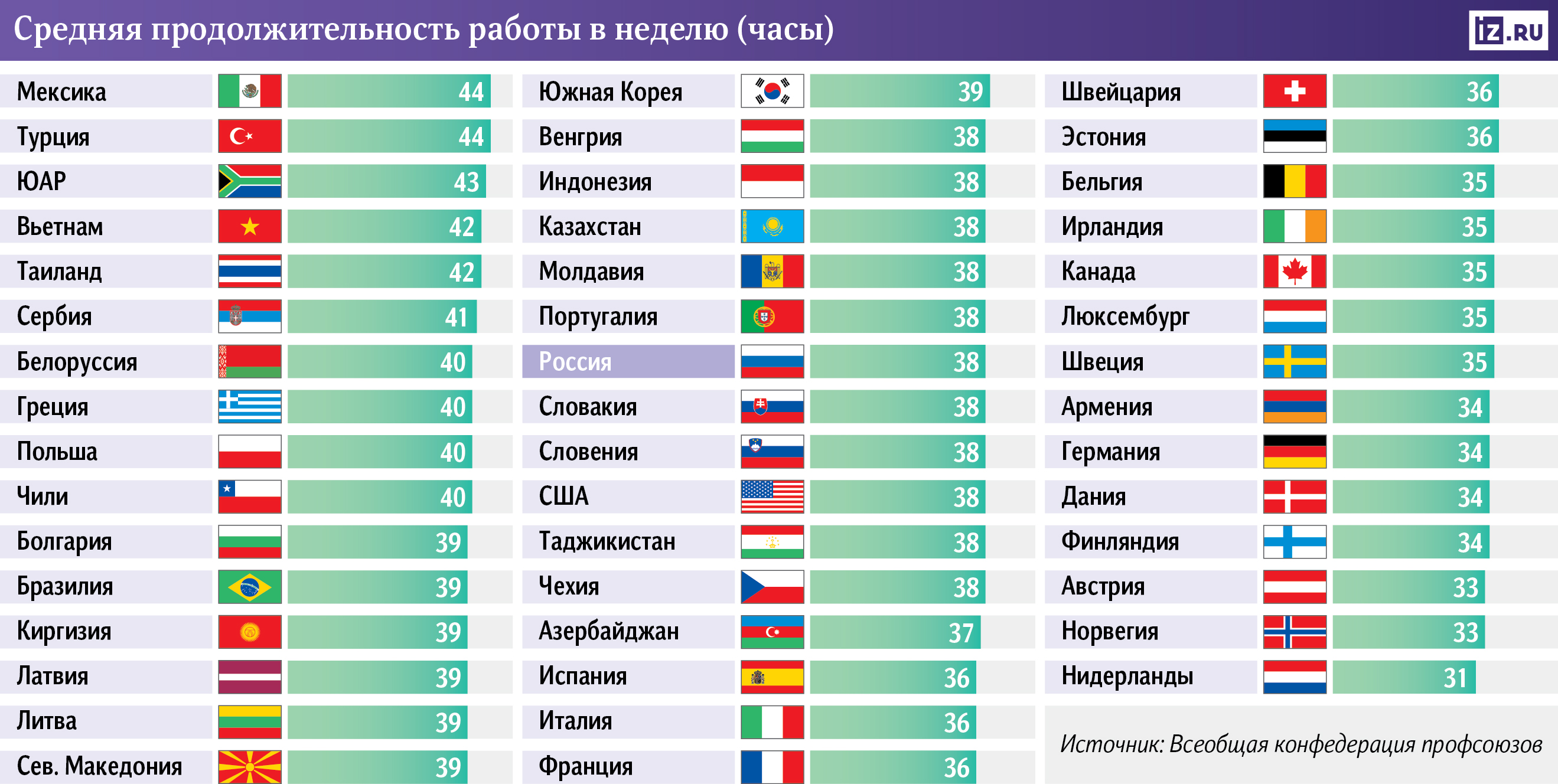
The normal working time in most countries of the world is 40 hours per week. It is this norm that is fixed in the labor legislation of the CIS countries, the USA and Canada, as well as in a number of European and Asian countries. However, for example, in the Netherlands, Armenia and Azerbaijan, the working week lasts 31-35 hours, according to a study by the General Confederation of Trade Unions (Izvestia has it).

Belgium, Germany, Denmark, Ireland, Spain, Italy, Luxembourg, Norway, Finland, France, Switzerland, Sweden, and Estonia are also among the countries with a short working week. On average, employees work up to 36 hours a week. In Russia, the working week is approximately 38 hours.
The European model of working time regulation also uses various tools to limit overwork, the report says. For example, the "right to disconnect": an employer restricts interaction with its employees outside of official hours.
"In the post-Soviet countries, the regulation of working hours is similar in its basic structure, based on the 40—hour norm and the limitation of overtime," the document says. — As well as the legislative consolidation of reduced work hours for certain categories: minors, persons with disabilities, those engaged in harmful work, persons with family responsibilities."
Residents of Mexico, South Africa, Turkey, Thailand, Vietnam and Serbia work over 40 hours a week.

Will there be a four-day holiday in Russia
The introduction of a four-day working week in Russia began to be actively discussed in 2019 after Dmitry Medvedev, then Prime Minister, spoke at the International Labour Conference in Geneva. He announced that he would not rule out the transition of the global economy to such a schedule in the future. According to him, technological progress leads to a reduction in working hours and an expansion of people's leisure time. He later added that this proposal would not be used to cut salaries.

The four-day event was put into practice in the UK, Spain, Iceland, the United Arab Emirates, Belgium, Kazakhstan, Lithuania, and Japan. The results of the experiment are different: some companies have returned to the standard five-day schedule, while others have continued to work in a new format.
The issue is still being actively discussed at various levels, but so far this initiative has not been fixed in legislation. In 2024, a bill was submitted to the State Duma, according to which it was proposed to establish a shorter working week for women with two or more children. But in February 2025, it was rejected.
In recent months, several more bills have been submitted to the State Duma, suggesting significant changes to established norms: in February 2025, it was proposed to fix the reduction of the working day by one hour before the weekend with a five-day week, without changing the weekly norm. In March, it was proposed to set the working week at 30 hours for most categories of workers, with the possibility of an additional one-hour reduction in time for single parents.

In July, a draft was submitted proposing the introduction of flexible hours for parents with many children, including part-time work, remote mode or part-time work at the request of the employee. All these initiatives are under consideration and public discussion and have not yet entered into force.
According to a recent study by the job search service SuperJob, the introduction of a four-day work week was supported by more than half of the Russians surveyed. At the same time, 87% of employers refuse to even discuss the possibility of changing their working hours due to staff shortages.

How recycling is regulated
The Russian Labor Code does not explicitly specify a four-day work week. There is only a law stating that working hours cannot exceed 40 hours per week. However, employers have the right to set flexible hours within the framework of current legislation.

Overtime work is usually understood to mean that which is performed in excess of the established normal working hours. According to international standards, such work should be the exception, not the norm, and accompanied by increased pay or compensatory rest.
For example, in the USA and Canada, overtime is paid at a rate of at least 150%. In the CIS countries, overtime is allowed only with the consent of the employee and under certain conditions, except in urgent cases, and is paid at an increased rate of at least 150% (Armenia, Kazakhstan) or 200% (Azerbaijan, Belarus, Tajikistan, Turkmenistan, Uzbekistan). In Kyrgyzstan, Moldova, and Russia, the minimum payout varies from 150% in the first two hours to 200% in the following hours.
According to article 99 of the Labor Code, an employer can involve an employee in overtime work both with written consent and without such a document, said Sofya Lukinova, head of the legal department of VMT Consult.
"Consent must be obtained if it is necessary to finish work that cannot be completed on time, as well as if the property of the employer or the state, or the life and health of people, will suffer in the event of withdrawal," she said. — Overtime by mutual agreement is appropriate if it is necessary to restore the employer's equipment or if the shift worker does not appear, if continuity of the process is necessary.

Consent is not required if an emergency situation occurs in the event of a refusal, for example, the operation of urban networks is disrupted, as well as in the case of an official martial law.
At the same time, the employer cannot involve women in the position and employees under the age of 18 in overtime work. It is allowed to involve disabled people, single mothers and fathers, fathers with many children and mothers with their written consent.

What is the threat for recycling
As a result of some ongoing initiatives to introduce a four-day week, positive effects are noted: reduced stress levels, reduced absenteeism, and increased productivity, the CPSU noted.
"In some cases, employees are actually forced to continue working on the fifth day informally due to workload redistribution, which may be accompanied by a drop in productivity and efficiency," they said.
The warning of the General Confederation of Trade Unions about shortening the working week contains an extremely important and often overlooked psychological aspect, said Anastasia Helemelya, a consultant psychologist. Switching to a four—day week is not just a mechanical reduction in time, but a fundamental restructuring of the work rhythm, the so-called task compression.
"When they try to fit the amount of work designed for five days into four, the cognitive load and work intensity increase dramatically," she said. — Instead of reducing fatigue, we get a classic burnout scenario: chronic stress caused by time constraints and the need to constantly work at the peak of concentration.

This leads to a decrease in the quality of work — the brain, trying to cope with overload, begins to save resources, which manifests itself in mistakes, decreased creativity and emotional exhaustion.
The length of the working week is directly related to the sustainability of the economy and the efficiency of production processes, said Anastasia Gorelkina, Deputy Chairman of the Board of Directors of HC SDS JSC, member of the Board of Directors of KAO Azot.
—The experience of countries where it is 33-35 hours shows that reducing working hours requires not only a revision of the schedule, but also a profound change in the structure of employment and productivity," she said. — For Russia, such steps now look premature, since the domestic economy largely depends on human resources, and not on fully automated processes.
Reducing the number of working hours without adapting technologies and management approaches will lead to the fact that some tasks simply will not be completed on time. This can cause an "overheating" effect — when employees, trying to meet the reduced time, experience increased workload, lose concentration and the quality of work decreases. As a result, shortening the week will not give the expected productivity growth, but on the contrary, it will slow down business processes and hit economic indicators.

To successfully translate a shortened workweek into a sustainable practice, it may be necessary to competently transform work processes, said Roman Yerkhov, CEO of TuBi recruiting company. In particular, tasks will need to be reworked, work roles reviewed, and the organizational model optimized to reduce the risk of productivity loss. Before full implementation, a pilot project of 3-12 months should be conducted to assess its impact.
If a person is forced to recycle, such cases should be recorded, Sofya Lukinova emphasized. Correspondence, audio messages, and evidence of oral orders will do.
"If an employee does not want to work overtime, it is possible to refuse, referring to Article 99 of the Labor Code of the Russian Federation," she said. — The refusal can also be recorded in writing. If recycling has occurred, we recommend that you set and save information about the exact processing dates. This will be useful for filing a complaint.
In case of further coercion, you should contact a trade union to protect your rights — if the employee is there. If there is no such body at the enterprise, you can first threaten to file a complaint with the labor inspectorate, and if this does not work, you can draw it up and file it. The same should be done if the employer refuses to pay for the processing. Any evidence will be useful, the specialist added.
Переведено сервисом «Яндекс Переводчик»
