
Who they pretend to be: more than half of job seekers lie on their resumes

Over the past year, 65% of Russian companies have encountered false information in their resumes. Most of the lies relate to non-existent skills, hiding real jobs, or overstating seniority. Most often, employers reveal these facts at the interview stage. Lying affects the reputation of an employee, and if discovered after employment, it can lead to dismissal and financial losses for the employer, experts interviewed by Izvestia believe. They are sure that the lies in the resume are dictated by the demands of modern society for success and fears of not meeting the expectations of relatives and friends.
Experimentally
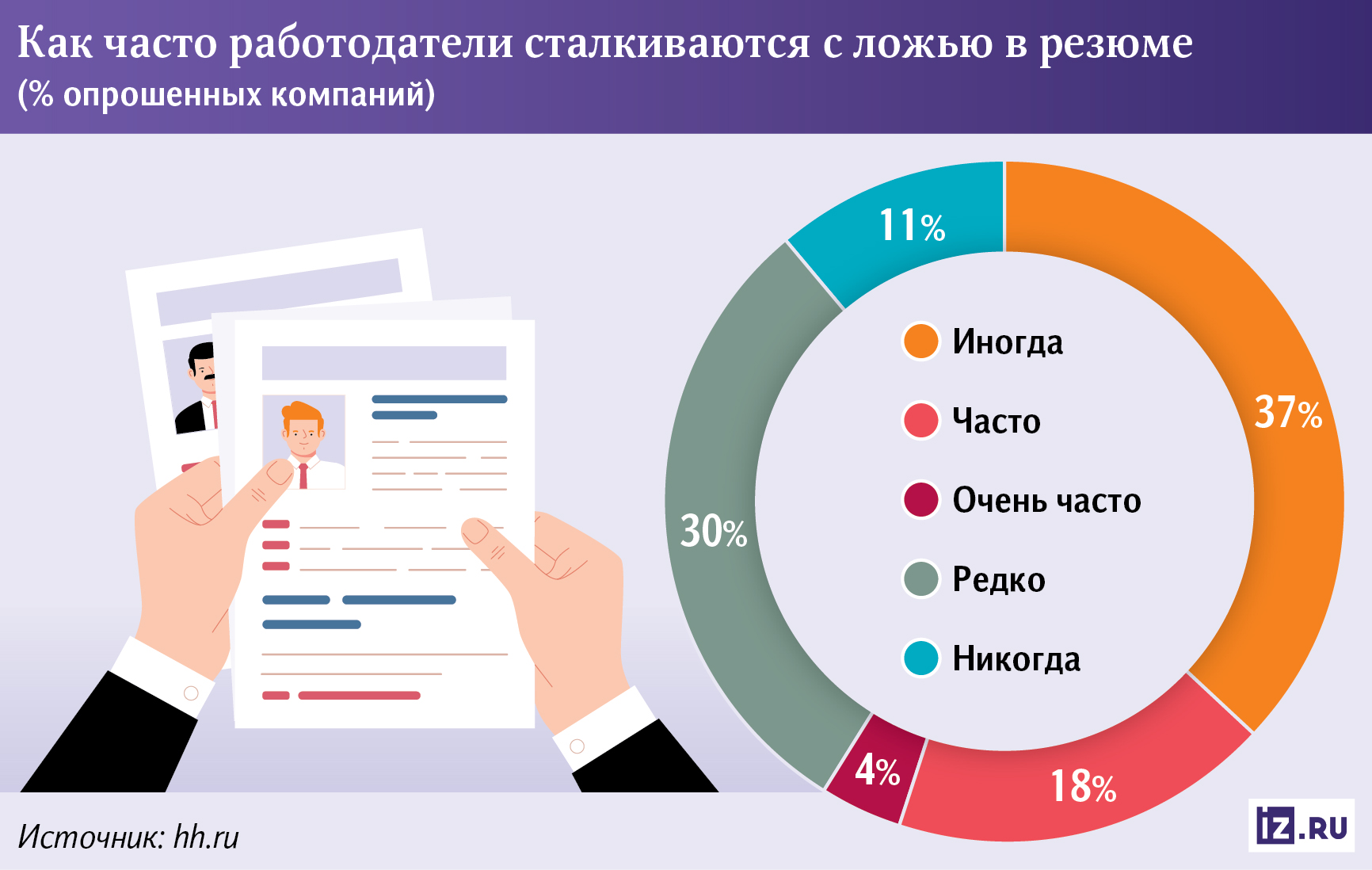
More than half of applicants lie about themselves in their resumes — 65% of Russian companies have encountered false information about candidates over the past year when applying for a job, analysts told Izvestia. According to the service hh.ru 37% of employers encounter lies in their resumes "sometimes", another 18% — "often", and only 4% — "very often", 30% noted that such cases are rare for them, while the rest stated that they had never encountered false data.
"Embellishing experience is an old practice, but in conditions of high competition for jobs, it becomes more noticeable," said Maria Ignatova, Director of research at the service.
The most common distortions in resumes are related to professional experience, hh noted. According to the service, they lie about age, education, conceal the reasons for leaving previous jobs, frequent dismissals and periods of unemployment.

According to the study, candidates also hide individual jobs in their resumes, indicate positions that do not correspond to their real responsibilities, "wind up" with experience, or indicate companies in which they did not actually work.
According to SuperJob, candidates exaggerate their proficiency in specialized software or a foreign language, add non-existent courses and trainings to their resumes, and distort information about awards. Compared to 2024, employers are more likely to note unfair job descriptions and distortions in the list of professional skills.
Most often, false information in the resume is indicated by candidates aged 19-30 years, less often by 31-45 years, analysts emphasized.
—Young professionals explain the lies in their resumes with the desire to increase their chances of finding employment or accelerate their career growth," they added.
Representatives of the SuperJob job search service confirmed this trend.
— Every fifth HR officer has seen the resumes of applicants who distorted personal data. There is indeed more false information," they noted.

The job search service Finder.work emphasized that the advent of AI generators allows you to "tighten up" experience and skills in minutes, and the market's transition to a skill-first approach, that is, when hiring a person, priority is given to specific skills rather than his position or long-term experience, increases the price of specific competencies, due to what makes applicants more likely to embellish information about their abilities.
According to hh, in most cases, fraud is discovered during an interview, less often when checking with a work record or when checking past jobs.
"Every sixth employer found out the truth after being checked by the security service, and 9% — by studying the candidate's social networks," they added.
According to the study, 37% of companies regularly check their resumes with their workbooks, while 44% do so only when in doubt.

Who are all these people
Most of the false data is found in the resumes of sales and customer service specialists, among top management, administrative staff and IT specialists. Deception is also common in marketing and retail, hh told Izvestia.
Among those who work in the IT field, programmers and developers, project managers and testers are more likely than others to add false experiences to their resumes. It's also not uncommon for product managers, designers, UX specialists, and development team leaders to embellish professional history, the analysts noted.

A little less often, according to their data, exaggerated experience is found among system administrators and technical writers, data scientists, analysts, CIO directors and heads of analytical departments.
Career consultant Elena Ragozina confirmed to Izvestia that resume lies are very common in the IT field. Also, according to her, it is found among designers and representatives of other creative professions.
— Career consultants sometimes teach themselves what can be embellished in a resume: which facts to focus on and which to omit. But a gross lie is criminalized. Basically, criminal liability can threaten those who have bought a diploma or a license," she noted.
How to detect untruth
Lies are more often revealed at interviews through clarifying questions, situational cases and tests, less often when checking recommendations and diplomas, Vitaly Amelechkin, head of the Finder.work job search and employee service, told Izvestia.
"The lies are especially noticeable in the first weeks of work, when the real level quickly manifests itself," he noted.
ProfiStaff, the Moscow recruitment agency, said that during interviews, recruiters ask the candidate direct questions about his professional experience, focusing not on what he did, but how.
— If a candidate has provided false information in his resume, it will be difficult for him to describe real work processes in detail and consistently. The specifics and direct clarifying questions make it possible to identify inconsistencies fairly quickly, the company is confident.

Another good indicator is the numbers.
— Candidates who have actually participated in projects, as a rule, confidently operate on specific indicators: sales volumes, deadlines, number of customers, and performance metrics. Those who embellish or invent achievements often cannot name the exact data or get confused about them," the agency explained.
They added that if doubts remain, they check recommendations from previous jobs at the final stage before the offer.

Another option to identify lies in the candidate's skills is a test task, added in the online job search service " <url>".
"The test results will quickly show where a person has exaggerated their capabilities and where they have told the truth," the company stressed.
You can also understand about lying by human behavior. The service explained that experienced recruiters can see which topics a candidate is nervous about, avoids accurate answers, and shuts down. But such signals are not an accurate marker of a lie, but only a reason to ask additional questions.

Psychologist Natalia Naumova agreed that the cases of lying in the resume have become more frequent. According to her, this trend has emerged against the background of the fact that in recent years society has increasingly begun to evaluate a person by his success and career advancement.
— The fear of rejection motivates people to lie on their resume. Most often, those who lie in their resume had to earn praise from their parents and loved ones in childhood and adolescence," she stressed.
Maria Ignatova noted that false information in the resume carries reputational risks for the candidate.
— It is important for applicants to understand that simply "cheating" the experience has long been no solution to the problem, — said the expert.
The CEO of Gderbot agreed with her.<url>" by Ekaterina Agaeva.
— If the lie was insignificant, the company is ready to forgive the mistake and cooperate with a specialist. But in the long run, the winners are those who are truthful with their professional environment and are ready to confirm their words with deeds," she stressed.

According to Finder.work, the chance of getting a position by "lying" is minimal, since today eight out of ten employers make a background check. And ProfiStaff reminded that lying in a resume can lead to the termination of an employment relationship and to financial losses for the company.
When identifying false data, employers do not always take harsh measures, analysts noted. According to the study, 43% consider lying in a resume to be a reason for rejection, 32% are ready to consider the candidate further, and another 25% found it difficult to answer.
However, career consultant Anna Mukhina noted that not only job seekers lie, but also employers.
"An employer who is interested in an employee may lie about delays at work or the amount of a possible bonus," the expert emphasized.
Lies on both sides have always been and will always be, she is sure.
Переведено сервисом «Яндекс Переводчик»
