
Treatment is difficult: medicines in Russia have risen in price by 14% in a year%

The cost of medicines in Russia has increased by an average of 14% over the year, Izvestia has learned. With prices rising, consumers are starting to save on drugs — they buy larger packages and look for the cheapest deals through online pharmacy services. The increase in consumer prices is due to an increase in operating expenses for all participants in this field: pharmacies, pharmaceutical manufacturers and distributors. Izvestia investigated what was happening to the market.
How much have medicines become more expensive
The weighted average cost of a package of a medicinal product in January – August 2025 in pharmacy chains was 416 rubles, which is 13.6% more than in the same period of 2024. This is stated in the review of the analytical company DSM Group, which was reviewed by Izvestia.

RNC Pharma leads to a similar dynamic. According to the company, the packaging of the medicine in January – August cost an average of 375.2 rubles, which is 14% more than in the same period a year earlier. The minimum dosage unit (one tablet) cost an average of 18.3 rubles— which is 10.2% more expensive than in January–August 2024. According to the Central Bank, annual inflation in August was 8.1%. Thus, the cost of medicines exceeded it by 1.7 times.
The price increase is also confirmed by official statistics. So, ketorol in January — August rose in price by 30%, to 55 rubles per pack of 10 tablets, calculated by Izvestia based on Rosstat data. Nasal drops of naphazoline — by 25%, up to 62 rubles per pack of 15 ml, and the antispasmodic with the international nonproprietary name (INN) drotaverine, which is produced by Sanofi under the trade name "No-shpa" — by 15%, up to 462 rubles per pack of 100 tablets.
In addition, corvalol with a volume of 25 ml increased in price by 14%, to 53 rubles per pack, analgin (INN metamizole sodium) — by 13%, to 39 rubles per pack of 10 tablets, enalapril — by 13%, to 27 rubles per 10 tablets, follows from Rosstat data. Painkillers ibuprofen and citramon rose in price by 12%, to 51 rubles and 42 rubles for 10 tablets, a pack of activated charcoal — by 10%, to 20 rubles.

Since the beginning of the year, the main price increase has been observed among medicines not included in the list of essential and essential medicines (VED). In January, the price increase for drugs not on the VED list was about 2% versus 1% for drugs on the list, according to the DSM Group review. In May and June, the increase in prices for non-VED accelerated by 4-4.8% against VED by 0.5–1%, and in August continued to increase, amounting to 5.1%, which is more than five times higher than the dynamics for drugs from the VED list (about 1%), the study says.
At the same time, according to the analytical company, sales of drugs in eight months in physical terms decreased by 2.3%, to 2.8 billion packages compared to a year earlier, and according to RNC Pharma — by 1.1%, to 3.1 billion packages. In monetary terms, sales increased by 11% year-on-year, to 1.1 trillion rubles, the DSM Group estimated, while RNC Pharma's market volume in rubles increased by 13.6%, to 1.18 trillion.

Consumers are looking for ways to save money
According to Alexander Tyukin, head of the electronic commerce department at Zdravcity, there is a tendency for Russians to save money when buying medicines. Thus, the average check in the organization decreased by 12% year-on-year, to 1,699 rubles, he noted. At the same time, operating costs are increasing: for example, the costs of photography, logistics, maintenance of IT infrastructure, etc. are increasing.

Rising energy prices also affect the increase in costs, Nikolai Bespalov, Executive Director of RNC Pharma, pointed out. Almost all domestic logistics is tied to vehicles, so an increase in the cost of gasoline and diesel leads to higher costs and the need to index drug prices, he notes. Since the beginning of 2025, average gasoline prices at gas stations increased by 9.22% by September 29, surpassing the growth rate of overall inflation (4.29% since the beginning of the year), according to Rosstat data.
All these are "significant factors" in increasing the financial burden on pharmacy chains, Alexander Tyukin added. The business is forced to compensate for general inflation and rising costs, the CEO of Megaptek agrees.<url>" Dmitry Chirkov. For buyers, these changes are becoming noticeable, so more and more people are moving online, where they can compare different offers and choose the best price, he explained. Drug sales are growing at double-digit rates here. In the first eight months of 2025, the company's drug sales amounted to 12.8 million packages, which is 43% more than in the same period of 2024. In terms of money, this figure increased by 47%, to 9.3 billion rubles, he added.
In Zdravcity, drug sales jumped 1.5 times over the same period, to 13.6 billion, with an increase of 42% in physical terms (the company did not disclose absolute values).

This trend is related to the redistribution of demand — Russians continue to buy medicines, but they do it "more rationally," Dmitry Chirkov noted. According to him, the purchase of drugs through online channels is becoming for many a way to maintain the usual level of treatment without compromising the budget.
The content of tablets in packages varies depending on consumer preferences, the economy and the policy of manufacturers, Nikolai Bespalov added. In recent years, manufacturers have increasingly expanded packaging, for example, instead of packs of the same drug, 10 tablets are sold for 20, he explained. In terms of one tablet, large packages sometimes become cheaper for the consumer.
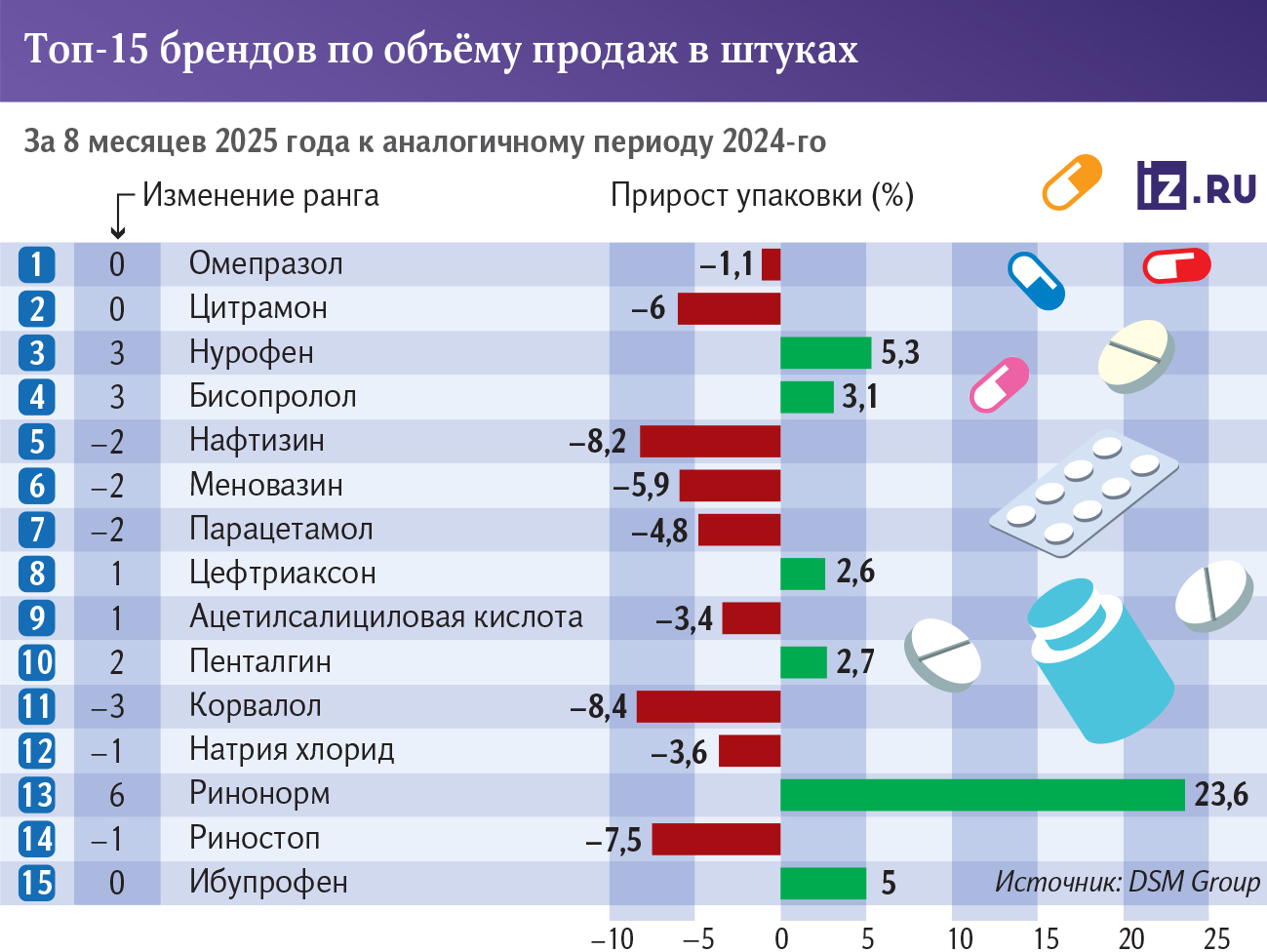
According to him, the reduction in sales in individual pharmaceutical groups was influenced by a decrease in the incidence of influenza and acute respiratory viral infections in early 2025. This has affected the demand among consumers of the relevant groups of drugs (antipruritic, antitussive, antiviral, antibacterial, etc.), the expert said. For example, in January of this year, the sale of medicines in the pharmacy chain "36.6" decreased by 3% to 13.7 million packages. Russians were less sick due to the warm winter this year, the representative of this network agreed.

What's going on with the market
The growth rate of the pharmacy market is slowing down, according to the DSM Group review. Its monetary volume in January – August amounted to 1.5 trillion rubles, which is 12% more than the same period in 2024. A year earlier, the growth was 17%. The increase in the number of new pharmacies stopped against the background of increased market consolidation by large players — their share increased from 46.6% in 2022 to 62.8% in 2025, the review says. The three largest pharmacy chains control 30.9% of the market, a year earlier this figure was 25.7%, in 2023 and 2022 — 21.9% and 19.7%, respectively.

According to the results of the first half of the year, the leadership belongs to the Rigla network (part of Vadim Yakunin's Protek Group) with a share of 11.9%, the study says. In second place is the April chain (11.5% share), owned by Krasnodar businessman Vadim Anisimov. At the same time, four Izvestia sources in large pharmacy chains and pharmaceutical distributors name the ultimate beneficiary of April, the founder and former owner of Magnit, the president of FC Krasnodar, businessman Sergei Galitsky. Izvestia was unable to contact him.
Planet of Health closes the top three with a 7.5% share, owned by Perm businessman Alexander Brovarts. His business partners are director Andrei Konchalovsky and his wife, TV presenter Yulia Vysotskaya, according to the Unified State Register of Legal Entities.
Representatives of these three networks did not respond to requests from Izvestia.
There are no prerequisites for pharmacy products to become cheaper everywhere, believes Alexander Tyukin. But in highly competitive conditions, companies monitor price fluctuations in order to adjust the cost of medicines in time, he concluded.
Переведено сервисом «Яндекс Переводчик»
