Silence and gold: the art of one of the most expensive Soviet artists was shown in Moscow
- Статьи
- Culture
- Silence and gold: the art of one of the most expensive Soviet artists was shown in Moscow


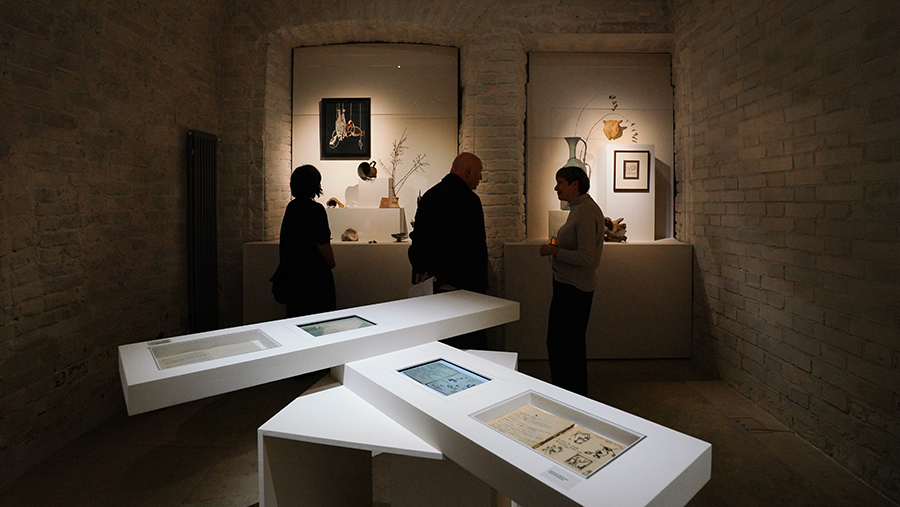
Objects from Dmitry Krasnopevtsev's paintings have become reality. Twigs, vases, roots, books, and even dried fish literally came off the canvases and became works of art themselves. A retrospective of "Krasnopevtsev. The Balance of the Unequal" on the occasion of the 100th anniversary of the birth of the Soviet artist, one of the main nonconformist artists of the sixties, not only shows classic paintings, but creates a total installation from it, offering paintings to enter into a dialogue with the historical space and artifacts from the workshop. Izvestia plunged into an unusual world.
Quiet and hidden
Monographic exhibitions of nonconformist artists have been held with enviable regularity in recent years, not to mention the participation of their works in group exhibitions. Along with the fashion for the Russian avant-garde, this is a big and steady trend in modern Russian art life. And to a large extent, the reason for this was the efforts of the AZ Museum, whose name contains the initials of Anatoly Zverev, another important representative of the same galaxy of masters. Starting with its main character, the AZ Museum soon began to tell about other sixties artists: Dmitry Plavinsky, Evgeny Mikhnov-Voitenko, Vladimir Yakovlev... Now it's Krasnopevtsev's turn to "solo".
However, even before the current museum boom, Krasnopevtsev was tasted by collectors: his art is in steady demand at the world's largest auctions. In 2006, the record was the sale of a still life at Sotheby's for $957,000. Other works of the painter over the years went for hundreds of thousands of dollars. In a way, this success is paradoxical. The work of a strange reclusive loner is deliberately apolitical, devoid of that Soviet (and, moreover, anti-Soviet) specificity that became so beloved in the West during the years of perestroika. It's like it's outside of society.
This is not Ilya Kabakov with the aesthetics of communal apartments and the existential problems of a small person, not Komar and Melamid with their ernic dissection of "red" mythology. And at the same time, there is not the emotionality, flashiness, rebelliousness and obvious virtuosity that captivate the same Zverev. Krasnopevtsev's skill is different. Quiet, hidden.
A 3D effect for the unreal
Krasnopevtsev's main genre was still life. Moreover, it is not the one that celebrates abundance, caresses the eye with bright colors or gastronomic bounties. The artist's mature works are almost monochrome, and they depict not flowers and dishes, but clay vessels, sticks, and potsherds. And if it's a flower, it's withered. The thorn. On the one hand, the meditativeness of the images attracts, fascinates with its Buddhist tranquility. On the other hand, it is not easy to exhibit such paintings precisely because of their detachment, detachment, and lack of something designed for an external effect.
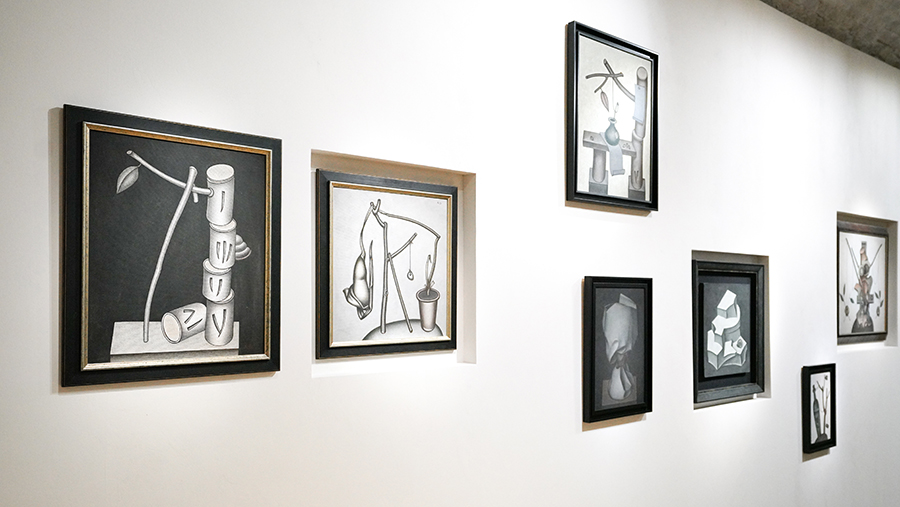
This is a challenge for the site and the curators. And AZ/ART, the branch of the AZ Museum in the historical chambers of the 17th century on Maroseyka, received him with passion. The works of art are complemented here by real objects, including those from the artist's studio. In the spacious storefronts, they form something like installations. Here, for example, is a "Still Life with flounder" — and right next to it is a real dried fish perched on a stack of books. Or, "Two green bowls with objects": the painting is surrounded by pebbles, flasks, vessels, which do not even seem to be a duplication, but a continuation of the image. It turns out to be a kind of 3D effect.
Here, of course, it can be noted that Krasnopevtsev's art is characterized by a departure from three-dimensionality. He refuses perspective, the depth of space. But the transformation of reality that the artist undertakes becomes all the more vivid. Krasnopevtsev not only eliminates color shades and smoothes the texture, turning nondescript gizmos into symbols, signs. He also violates the laws of physics, forcing his objects to balance in space in a strange way. Some of them may well be lying on the surface, but in such a way that it seems as if they are about to fall off. In most still lifes, we see suspended objects: ropes maintain a delicate balance, which is also, of course, unrealistic.
The Silent Art
Krasnopevtsev painted in oil on hardboard, a material that, unlike canvas, was not intended for such purposes. It absorbs and absorbs pigment. And therefore, the process of creating works itself becomes a test that requires patience and perseverance. The paint should be applied layer by layer, waiting for the previous one to dry. But it also gives a special depth of color. It becomes not flat, it acquires some kind of hypnotic power.
There are many such works in the exhibition. But it is important that they are complemented by two early still lifes, where Krasnopevtsev has not yet come to his own individual style: the colors here are more diverse, the details are drawn out with academic care. For skeptics, this is excellent proof that the artist was well trained and knew how to paint not only his gray "potsherds and sticks"; for connoisseurs, it is an opportunity to see the evolution of the style. And — try to see the sprouts of a future stylistic turn even in these youthful works.
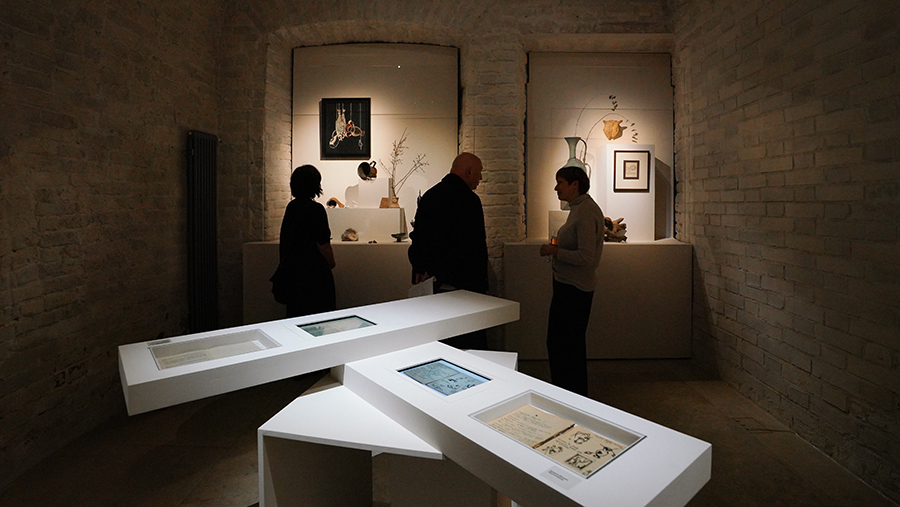
The immersion in Krasnopevtsev's laboratory begins with a graphic: pencil sketches from the early 1960s turn out to be the artist's "dictionary". Various objects are drawn on the sheets that are not connected into a single composition — the very ones that the painter will later combine with rare ingenuity in his paintings. If you count it, the "vocabulary" turns out to be quite modest. But Krasnopevtsev's art is generally laconic. Moreover, tacitly. That is why the soundtrack of the exhibition is so successful here, delicately highlighting this silence.: the noise of crumbling pebbles and other imaginary noises of the Krasnopevtsev workshop.
Perhaps the main difference between Dmitry Krasnopevtsev and many of his contemporaries is that his art is not about the Soviet era or people. It's about eternity. It is timeless. Above him. That is why the space where the exhibition dedicated to the centenary of the artist takes place seems so appropriate. The 17th-century building with exposed brickwork itself turns out to be part of Krasnopevtsev's world. As evidenced by the mysterious work "Walled-up niche with a fallen piece" from the collection of the AZ Museum. The view literally falls into the blackness that opens under the ancient stone vault. So the exhibition, following the painting, invites you to infinity. And it's hard not to accept this invitation.
Переведено сервисом «Яндекс Переводчик»
