
Deprive of sweets: how Denis Shtengelov could withdraw 21 billion rubles from Russia

Billionaire Denis Shtengelov could withdraw money from Russia using the dividend payment scheme, but bypassing the decrees of the President of Russia, which impose restrictions on how non-residents can dispose of such funds, Izvestia found out. The Prosecutor General's Office believes that since 2022, the main owner of the KDV Group holding (produces products under the brands Yashkino, Kiriyoshki, etc.) illegally withdrew 21 billion rubles from Russia and sent them, among other things, to finance the Armed Forces of Ukraine. On September 23, the Tverskoy District Court of Moscow will consider the claim of the SOE to recover the entire property of the holding company and recognize Denis Shtengelov and his father Nikolai as extremists. What other methods of illegal withdrawal of money could be used by the owners of KDVGROUP, and how these funds were used to acquire business assets around the world and luxury real estate - in the investigation of Izvestia.
Ukrainian connections
On September 23, the Tverskoy District Court of Moscow will consider the claim of the Russian Prosecutor General's Office against billionaire Denis Shtengelov, his father Nikolai Shtengelov and JSC Konectrus Kom, the parent company of the KDV Group holding. The agency is trying to ensure that the Shtengelovs are recognized as extremists, and all the assets of the holding company are turned into state income.
To date, Denis Shtengelov's fortune is estimated by Forbes at $1.4 billion. KDV Group is the largest producer of snacks and sweets in Russia. The company unites 15 factories and produces more than 700 types of products under well-known brands such as Yashkino, Kirieshki, and others. KDV Group is developing a network of about 700 Brighter! stores, an online trading and delivery service, Brighter Plus, and even a football club. The consolidated group has more than 40 legal entities involved in food production, trade and related fields.
Denis Shtengelov himself has been living in Australia for about a decade and a half, and his father runs a business in Ukraine. From the very beginning, Denis Shtengelov tried in every possible way to protect himself from the attention of the Russian authorities. He has not publicly spoken about the situation around Ukraine. The only time his position was mentioned was in March 2022 by the Dutch media. Referring to a press release from Dutch canned food manufacturer HAK (Stengelov is the majority shareholder of the company), journalists wrote that the billionaire called his company a "monstrous and irreparable mistake," and HAK itself announced its intention to send humanitarian aid to Ukraine.

Subsequently, Shtengelov did not make any more public statements on the subject of his work. Perhaps because, according to the Ukrainian register of legal entities, the Unisnek Production company, registered in the Dnipropetrovsk region and engaged in the production of food products, is under the control of KDV holding.
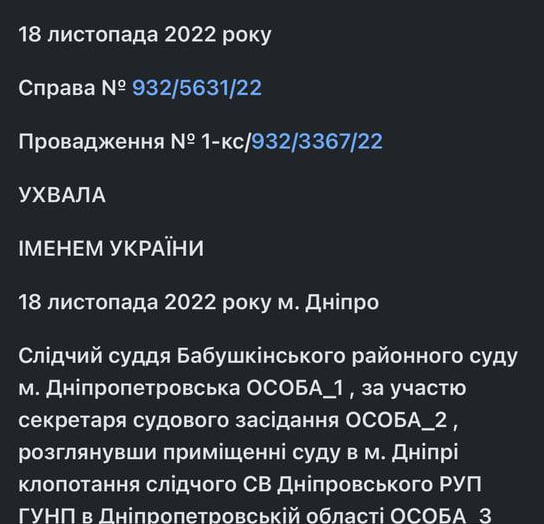
Such caution did not help. In October 2022, Denis Shtengelov was added to Ukraine's sanctions lists for 10 years, and a month later, the Babushkinsky District Court of Dnepropetrovsk seized the company's production and warehouse complexes at 91K Sichevykh Streltsov St. and 169 Bogdan Khmelnitsky Avenue.
Both objects were recognized as material evidence in a criminal case initiated in July 2022 on the grounds of the article "Collaborationist activity". In both cases, the judge granted the request of the investigation.
The problems of the businessman's son, however, did not affect his father, Nikolai Shtengelov, who also operates in the agricultural sector of Ukraine. In Zaporizhia, where he comes from, Shtengelov Sr. still owns the agricultural enterprise Tom, which grows grain and legumes, and he heads the Primorsky Regional Employers' Organization.
It is worth noting separately that in 2017, the businessman's father, being a deputy of the Primorsky District Council of the Zaporizhia region, actively participated in collecting humanitarian aid and supporting Ukrainian law enforcement agencies, for which he was awarded a diploma from the administration of the Zaporizhia region. In the same year, he was awarded the Order "For the Development of Ukraine".
Until the spring of 2021, Nikolai Shtengelov was also listed as a beneficiary of Petrovskoye LLC (laying and cultivating crops, producing flour, bread and other bakery products), to whom his son's parent company generously lent money. At the beginning of 2022, the Primorsky District Court of the Zaporozhye region decided to forcibly recover 64 million rubles in local currency from Petrovsky in accordance with the decision of the Arbitration Court of the Tomsk Region that came into force — the previously received loan and interest on it. After the start of the CBO, in December 2022, this decision was reversed.

The financial relationship between the business structures of Shtengelov's father and son may be one of the elements of a scheme to withdraw money from Russia, Izvestia's interlocutors did not rule out, as this is a common practice.
— When it comes to "illegal withdrawal of funds," the wording is extremely broad. In practice, it can hide a variety of designs. The most common are the use of foreign subsidiaries: funds are withdrawn under the guise of paying for consulting or marketing services, licenses, royalties, and other contracts. A loan mechanism is often used: a foreign entity "credits" a Russian company, and interest repayment becomes a convenient way to legalize capital transfers abroad," said Maria Bakakina, adviser to the Criminal Law Practice at Sokolov, Trusov and Partners.
Shtengelov's foreign assets
In addition to Russian and Ukrainian assets, Denis Shtengelov has businesses in other jurisdictions that are hardly friendly to Russia.
For example, since 2021, he has been the main shareholder of the Dutch agricultural holding HAK, whose products - canned vegetables, cereals, fruit puree and protein kits — are popular on supermarket shelves in northwestern Europe. In the Netherlands alone, the company held 38% of the market for ready-made vegetables, and its annual turnover, according to journalists, exceeded 100 million euros. At first, Shtengelov controlled the agricultural holding directly through KDV, but in November 2022, the Dutch declared that they were no longer part of the Russian holding: apparently, in order to avoid political risks, control was transferred to the Arab company Flexway owned by Shtengelov.
Also in 2021, KDV acquired the American company Liberty Orchards, a manufacturer of Aplets & Cotlets nut and fruit candies in Kashmir, Washington, surrounded by apple and pear orchards. The value of the deal was not publicly announced, but as a result, KDV became the first Russian pastry chef to enter the American market, and the wholesale company Vostok-FEA from Kemerovo, which is part of the perimeter of the group, took the place of the main trading partner of the Americans.

In 2024, Stengelov acquired a controlling stake in the Croatian Zvechevo food factory for $30 million.
However, the main overseas assets of the Shtengelov family are located in Australia. Judging by the materials of the Australian courts reviewed by Izvestia, since 2017 KDV has been building and operating a large sports complex in Carrara, which occupies 12 hectares of the Gold Coast. The exclusive project of the Shiro architects bureau includes the Elite Golden Coast Elite Hotel.
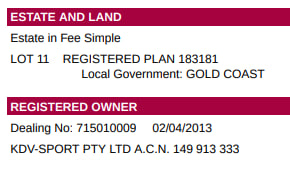
According to the register of legal entities in Australia, the company itself belongs to an offshore company from the British Virgin Islands — TWON PORTFOLIO LTD. The owner of the offshore company is unknown, according to indirect evidence, the Shtengelov family may be related to him. In particular, this is indicated by the fact that the company's directors at various times were Shtengelov himself and his sister Yulia, and now the company is headed by Maria Karzhilova, a native of Tomsk, who may be the billionaire's wife: this is evidenced by their common registration address in Tomsk on Kartashova Street.
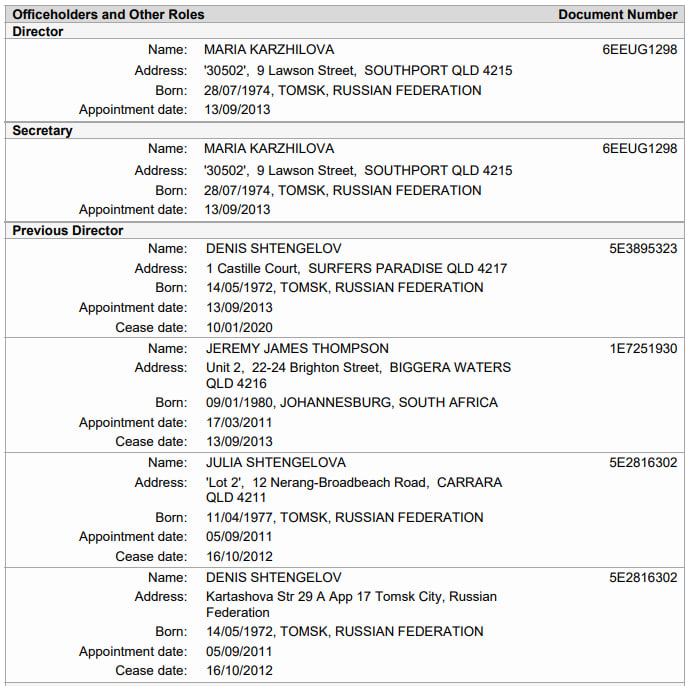
In addition to hotels and sports facilities, KDV-SPORT PTY LTD is also engaged in business that is familiar to Stengelov: the company imports snacks from Russia to Australia, of course, from KDV. And here is another Australian company, 36O PRODUCTIONS PTY LTD, which organizes events and makes films, and can even boast of a number of awards from Sri Lanka.
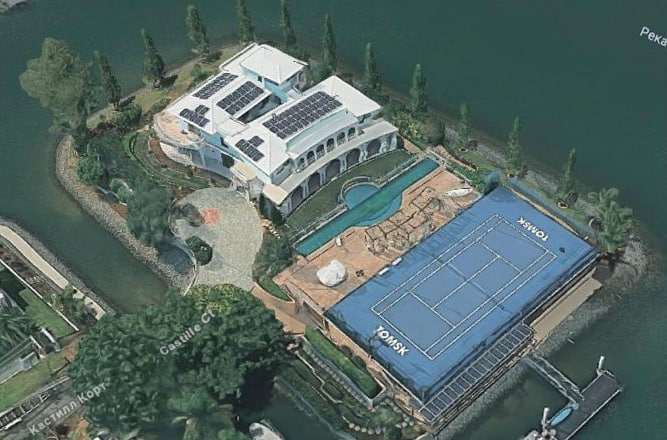
Shtengelov also has personal real estate in Australia — a mini-island with a mansion designed for Maria Karzhilova. The satellite shows that in addition to the villa (the Network claims that it was purchased in 2011 for $ 2.5 million), the island has a tennis court decorated with the patriotic inscription TOMSK. Officially, Shtengelov lives here, and his wife lives in a more modest apartment complex with cafes, restaurants and a swimming pool at 9 Lawson Street (according to open sources, apartments in the complex are sold for $500-700 thousand.
"If different business lines are located in different countries and regions, the movement of liquidity and then the withdrawal of capital can be organized in various ways," explains independent economist Andrei Barkhota. — The first option is to organize subordinated loans within the entire business scheme — one legal entity issues a loan to another. The latter develops financing and pays dividends to the beneficiary. The second option is to create a complex and cross—ownership structure of shares of different companies. As a result, the profits from businesses in the form of dividends will flow to one point, from where the beneficiaries will take it.
According to the expert, there may be many prerequisites for nationalization. One group is associated with inefficient management of the company, the second — with the crimes of the owners.
How could the money be withdrawn
According to the Prosecutor General's Office, investments in business abroad were carried out, among other things, from funds that Denis Shtengelov withdrew from Russia. Sources interviewed by Izvestia believe that the main scheme could be the payment of dividends to Shtengelov from his companies. These are huge sums.
For example, in 2023, KDV Group paid 7.1 billion rubles in dividends. The share capital structure of Confectionary Com JSC (the holding's largest asset) has never been disclosed, but it became known in 2021 due to the purchase of Dolinsk Bank by Shtengelov. It turned out that Shtengelov owns 78.8% of Confectionary Com, 17.9% from his partner Igor Semenov, and another 1.8% from another partner, Maria Karzhilova. The remaining 1.5% belongs to the minority shareholders.
Thus, Denis Shtengelov's share of this dividend payment alone amounted to 5.6 billion rubles. In total, in 2023, Shtengelov's business structures paid him and related persons about 10.7 billion rubles.
In 2024, Confectionary Company allocated 12.5 billion rubles for dividends, and again Shtengelov got the lion's share.

There is nothing illegal about the payment of dividends. But in the case of Denis Shtengelov, there was probably a disregard for two decrees of the President of the Russian Federation at once, the interlocutors told Izvestia. We are talking about Decrees No. 95 and No. 254 of March 5 and May 4, 2022, respectively. They introduced protective measures against the withdrawal of money from Russia by foreign shareholders of Russian companies (and Denis Shtengelov, as a non-resident, fell under this definition). In particular, the 95th decree establishes that a non-resident must open a special account of type "C" in a Russian credit institution, to which dividends will be transferred.
— This is a special account, it is really limited in rights, there is a certain procedure for its use, — Stanislav Vasiliev, partner of the capital markets practice at Branan Legal, explained to Izvestia. — If a Russian company transfers dividends to a non-resident shareholder, then, in theory, he does not have the right to withdraw this money abroad. But inside the country, you are free to spend from this account. For example, to make investments, to buy OFZ. Specifically with Denis Shtengelov, I think it is already the task of the investigation to determine exactly how the shareholder in his person violated these protective mechanisms.
In addition, experts say, price manipulation in foreign economic transactions is widely used for the illegal withdrawal of capital abroad: equipment or raw materials are formally purchased, but the money eventually settles in the owner's offshore company, which resells the goods at the market price, leaving the difference in foreign accounts.
— As for the accusation of financing the Armed Forces of Ukraine, here we see a qualitatively new stage, — said Maria Bakakina. — Previously, nationalization through a lawsuit filed by the Prosecutor General's Office was a tool for redistributing property inherited by an unscrupulous recipient in the dashing 90s. Now the focus is on the current business activities and the perceived threat to national security.
If the court's decision is in favor of the Prosecutor General's Office, assets worth 497 billion rubles will be transferred to the state's revenue (this is how the agency estimates the current capitalization of KDV Group. The annual income of the holding is 756 billion rubles, and the gross profit is 139 billion rubles.
Переведено сервисом «Яндекс Переводчик»
