The good is in condition: the top 35 sustainable regions of Russia are named


The Yamalo—Nenets Autonomous District, Chukotka and the NAO became the leading regions of socio-economic sustainability in the first half of the year. This conclusion was reached by analysts of the Civil Society Foundation (FoRGO) based on data from the Ministry of Finance, Rosstat, the Federal Treasury and the Federal Tax Service, who prepared a rating of the top 35 subjects. The authors of the study point out that freedom and sanctions have stopped affecting Russians' incomes and expenses, while experts note that since the beginning of the year, the cost of living in Russia has increased by 16.7%, and wages by only 15%.
Which regions were among the leaders
Yamalo-Nenets Autonomous Okrug topped the rating "Regions — leaders of socio-economic sustainability. Top 35".Thus, it reconfirmed its position as the strongest territory in the country. The top ten also includes Chukotka, the Northern Administrative District, the Magadan Region, Moscow, the Khanty-Mansi Autonomous Okrug, the Sakhalin Region, Yakutia, St. Petersburg and the Murmansk Region.
Such a study was prepared by the Foundation for the Development of Civil Society (FoRGO) based on the results of the first quarter of this year. Izvestia got acquainted with his data. The rating is based on the indicators of the subsistence minimum, average salary, and the ratio of the regional product amounts (the amount of goods shipped, works performed, and services rendered by region) to the number of economically active population.
The Krasnoyarsk Territory, Moscow, Irkutsk Regions, Kamchatka Territory, Leningrad Region, Tatarstan, Komi, Amur, Sverdlovsk and Tyumen regions were in the second ten.
The third group includes the Tula, Kaluga, Kemerovo Regions, Zabaikalsky, Khabarovsk, Primorsky Territories, Chelyabinsk, Lipetsk Regions, Perm Territory and Tomsk Region.
Novosibirsk, Samara, Nizhny Novgorod, Belgorod regions and Khakassia complete the ranking.
— The ratio of the average wage to the average cost of living in the whole country on January 1 was 5.41. This is a 12% increase compared to the same period in 2024 (4.83). As of June 1, we see a figure of 3.92, which is 3% more than in the corresponding period last year (3.83). In other words, it can be noted that the dynamics of this indicator as a whole does not demonstrate dependence on external factors (CBOs, sanctions), but rather shows its absence," Konstantin Kostin, head of FoRGO, explained the results of the study to Izvestia.
According to him, the cost of living (a fixed set of goods and services excluding the cost of housing and utilities), according to Rosstat, increased from 21.5 thousand rubles (as of January 1, 2025) to 25.4 thousand (as of August 1). As of July 1, this figure was 25,075.7 rubles. Overall, the six-month growth was 16.7%.
Konstantin Kostin also noted that on July 1, 2025, the average monthly salary in the Russian Federation as a whole increased by 15% compared to the same period in 2024 and amounted to 115.4 thousand rubles.
— If we talk about the dynamics of places in the ranking, we see that Moscow, St. Petersburg and resource-producing regions traditionally continue to lead in terms of socio-economic sustainability due to the relatively high volume of production per capita and high wages, — explained the head of FoGRO.
He also noted that during the second quarter of 2025, they improved their position by more than three positions: the Kaluga Region (from 33rd to 22nd place) - due to an increase in sales of commercial products per capita; the Trans-Baikal Territory (from 32nd to 24th) — the ratio of the average salaries per capita to the subsistence level; Primorsky Krai (from 31st to 26th) — the ratio of the average monthly salary to the minimum cost of living; Nizhny Novgorod Region (from 43rd to 33rd) - sales volume and the ratio of the average monthly salary to the minimum cost of living.
At the same time, the following regions have maintained their positions since the beginning of the year: Yamalo-Nenets Autonomous District, Magadan Region, Yakutia, Murmansk Region, Krasnoyarsk Territory, Sverdlovsk Region, Perm Territory. According to FoRGO, all this indicates the relative stability of the economy and the social situation in these regions.
What influences the growth of well-being
The first places in the ranking are mostly occupied by oil and gas regions, where the incomes of the population are very high, Georgy Ostapkovich, scientific director of the HSE Center for Market Research, explained to Izvestia.
— The first place in terms of salary in Russia is occupied by Chukotka, the Yamalo-Nenets Autonomous District is in second place, Moscow is only in third place along with Khanty-Mansi Autonomous Okrug. Therefore, the places of these regions in such studies hardly change from year to year," the expert explained.
According to him, welfare is certainly important for the population of these regions — these people can afford to buy real estate and durable goods. Therefore, they pay little attention, for example, to the harsh northern weather conditions or the remoteness from the center of Russia, where they can move at any time.
— The bad thing, of course, is that other regions are not making efforts to enter such a rating, — said the expert.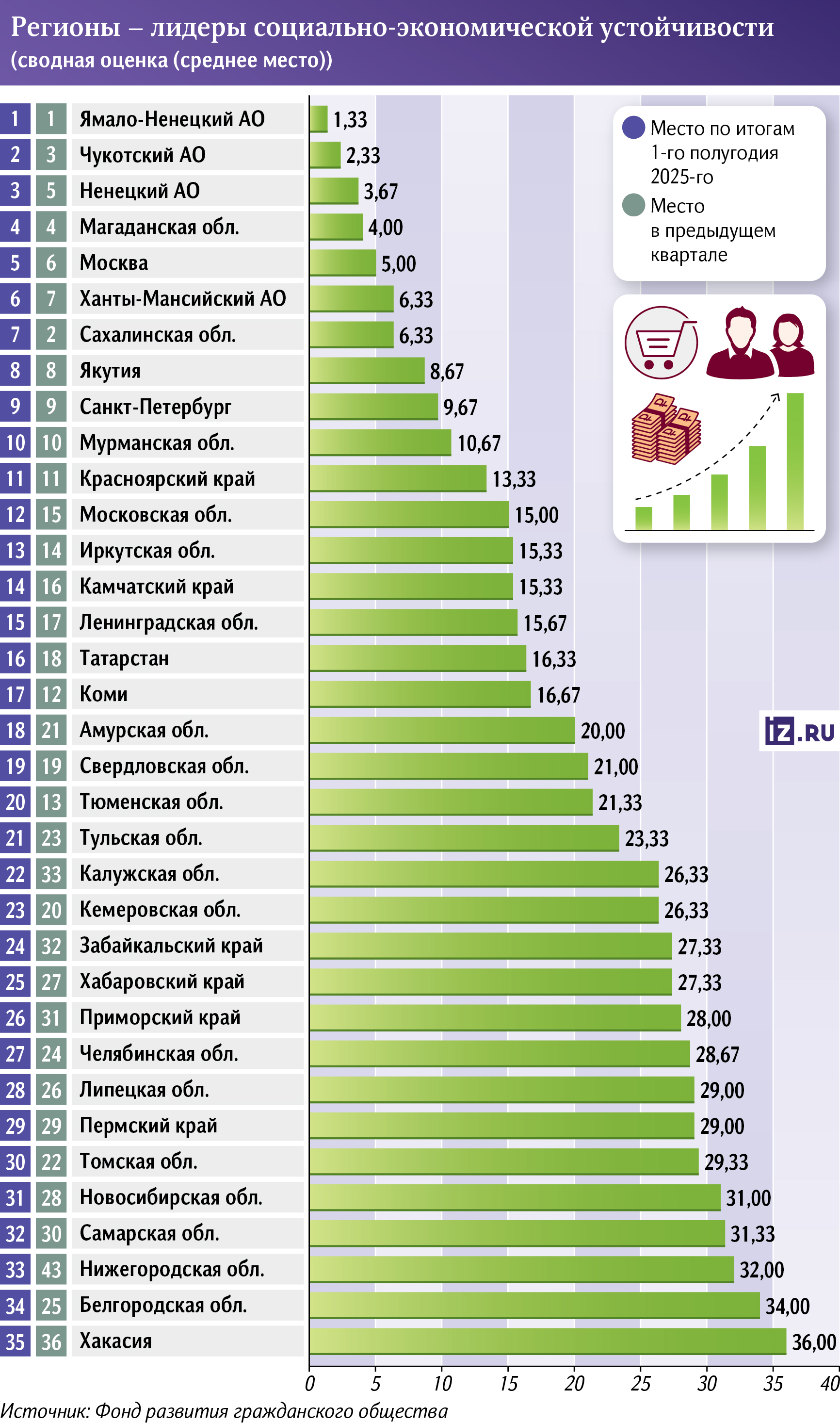
Konstantin Kalachev, head of the Political Expert Group, agrees with this opinion, noting, however, that in addition to high salaries in such subjects, other factors also attract. According to him, the leaders have high budgets and can afford to make high-quality infrastructure for the population: to build schools, swimming pools, kindergartens, cafes, shops next to the houses.
Переведено сервисом «Яндекс Переводчик»
