A study of the political field on the eve of the EDG 2025 in the Russian Federation has been published
- Новости
- Local news
- A study of the political field on the eve of the EDG 2025 in the Russian Federation has been published


Elections of state authorities and local governments will be held in Russia on September 12-14, 2025.
The main focus is on the analysis of the participation of Russian parliamentary parties in the election campaign within the framework of the EDG-2025: United Russia (EP), Liberal Democratic Party of Russia (LDPR), Communist Party of the Russian Federation (KPRF), Just Russia - For Truth (SRDP), New People (NL) They are the ones who are steadily gaining the vast majority of votes and parliamentary mandates in the current electoral cycle. They are also conducting the most active, as well as organizationally, ideologically and resourcefully prepared election campaigns in the framework of the ongoing preparations for the EDG-2025. Research and expert opinions show that other political parties are not able to compete with them at the federal level, and only some have the opportunity exclusively for local campaigns in certain regions and municipalities.
This study analyzes various aspects of the activities of political parties within the framework of the EDG-2025: the nomination of candidates, the results of sociological research, primarily election ratings based on polls, campaigning, the main slogans, narratives, participation in the campaign of leaders of political parties and their presence in the political media.
The fact that elections to the State Duma will be held in 2026 gives special importance to the election campaign within the framework of the EDG-2025. The course and results of the current election campaign make it possible to predict the course and results of the election campaign for the State Duma elections.

Nomination and registration of election candidates
Based on the results of the work on nominating candidates for elections, it is possible to judge the presence and size of a regional network of active members and supporters of political parties, the resources available to the party, their administrative weight, as well as the quality of central and local management.
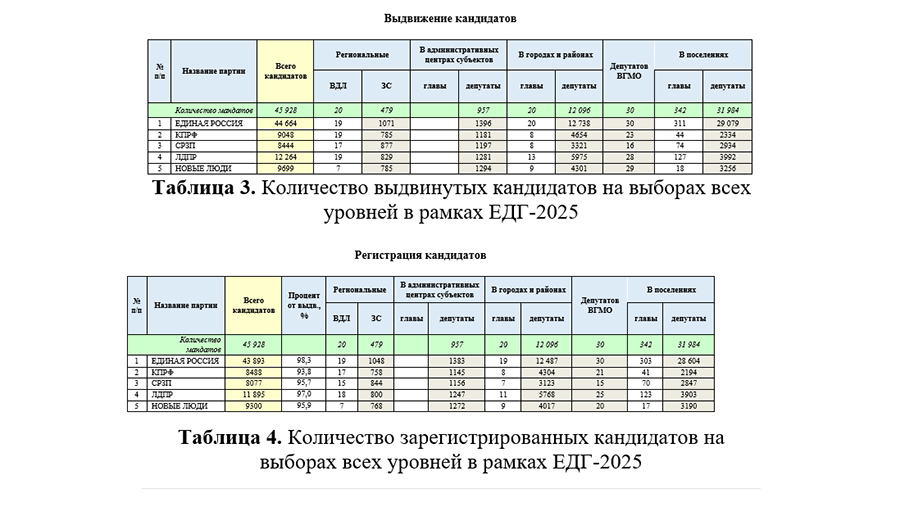
As of August 25, the following picture emerged in all election campaigns. The EP nominated the most candidates at all levels — 44,664 candidates. The second place has been taken by the Liberal Democratic Party for the second year in a row — 12,264 candidates. The NL came in third place, nominating 9699 candidates, which is almost a quarter less than the LDPR. The Communist Party of the Russian Federation unexpectedly dropped to fourth place in this indicator — 9,048 candidates. In fifth place is the SRZP.
We observe similar results of the parties based on the results of registration of the nominated candidates. Representatives of the EP were expected to be in the lead — 43,893 representatives of the party received electoral registration from election commissions of various levels, the LDPR — 11,895 registered candidates, the NL — 9300, the Communist Party — 8488 and the SRZP — 8077.
It is interesting to note the number of candidates who did not complete the registration procedure. The EP has 771 such candidates, but as a percentage of the total number of those nominated, this is quite a bit. The SRDP (367 candidates), LDPR (369 candidates) and NL (399 candidates) have a very small difference in the number of unregistered candidates. Compared to other opposition parties, the Communist Party of the Russian Federation is the worst off, having lost 560 people at the registration stage.
In terms of the percentage of registered candidates out of the number of nominated candidates, the results are as follows: the EP registered 98.3% of the nominated candidates, the LDPR - 97.0 , the NL — 95.9 , the SRZP — 95.7%. The best EP result is quite expected. Interestingly, for the second year in a row, the LDPR has achieved the best results among opposition parties in this indicator. At the same time, the Communist Party of the Russian Federation has the worst indicator here (93.4%), which was unable to properly organize the process of preparing its candidates for registration, which clearly indicates the presence of systemic managerial, organizational and personnel problems.
A steady trend that has persisted in recent years is the LDPR's second place in both nominating and registering candidates. The party confidently demonstrates its own growing competencies of the central administration, as well as the organizational capabilities of regional and local branches. If the party manages to maintain this momentum, it may be in much better shape by 2026 compared to other opposition political forces. Of particular note is the fact that the Liberal Democratic Party is in second place in terms of the number of registered candidates for the election of heads of regions (18, ahead of only United Russia — 19).
A relatively new trend is the rather deep decline of the Communist Party of the Russian Federation, which was inferior in terms of nomination and registration not only to the EP and LDPR, but also to the "New People", who until recently showed the most modest results among the "parliamentary five" parties. Of course, we can say that the previous situation, when the Communist Party of the Russian Federation had a serious reserve in the form of a significant local party network that had remained since Soviet times and consisted of active supporters embedded in its work, is gradually becoming a thing of the past due to the party's inability to withstand the new challenges of the time and attract new young party members. Obviously, the Communists have serious problems with replacing the asset.
Finally, the last place of the SRDP in terms of the number of nominated and registered candidates reflects an obvious trend, indicating an internal crisis of the party and a weak regional party network.
The NL has the worst positions among the "parliamentary five" parties in terms of registration of candidates for the election of heads of regions — only 7. The NL also ranks last in terms of registration of candidates for deputies of legislative assemblies of regions under the majority system — 173 candidates. This fact, apparently, indicates a shortage of personnel in the ranks of the NL. At the same time, the selection of NL candidates sometimes took place from those who had already visited different parties, left there with a scandal or disappointed. Despite the fact that the party retains the rather dubious name "New People" from the point of view of compliance with reality, they are clearly not new to the Russian political landscape, and one would expect better results from them.

An important criterion for the effectiveness of future potential deputies is their compliance with the current agenda of the country's public life. For example, Russian President Vladimir Putin has stated about the special role of participants in a special military operation in the socio-political life of Russia. In his Message to the Federal Assembly, Putin said that the participants of the SVR, workers and warriors, should be considered the elite of Russia, participate in its management and major projects. The participants of the SVO are most represented among the representatives of the EP — 951 candidates. The LDPR became the second parliamentary party to provide accurate data on the number of nominated participants in the SVR, with 89 candidates.
Other parties from the "Duma five" were unable to provide in the public space the exact figures of the nominated candidates participating in their own. The SRWP claimed, for example, that they had sent "more than 100" candidates with combat experience to the polls, while the Communist Party announced the nomination of "about 50" veterans. The New People's press service stated that they had also nominated veterans of the SVR for elections at the regional and municipal levels, but did not provide specific figures. Such ignorance by representatives of parliamentary parties of the composition of the corps of candidates, especially the participants of their OWN, raises legitimate questions about consistency and responsibility in working with candidates who have confirmed their patriotism and desire to serve the Fatherland, which can play a very important role in a deputy position.
Opinion polls: trends and prospects
One of the main indicators determining forecasts regarding the results of the upcoming elections is sociological research, primarily mass polls. Polls conducted by the most reputable sociological centers, VTsIOM and FOM, enjoy the greatest confidence among the expert community, voters, and representatives of political parties themselves. The data from the weekly ratings of the popularity of parties among voters convincingly show the following trends.
The EP, the Liberal Democratic Party and the Communist Party of the Russian Federation are almost absolutely likely (even taking into account the fact that elections to the State Duma will take place in a little over a year) to join the State Duma of the ninth convocation. At the same time, the SRZP and the NL are likely to fail to overcome the five percent barrier and may lose their federal parliamentary representation.
Other political parties, as a rule, gain no more than 1% in popularity ratings, which is significantly lower than the margin of error in the relevant polls and makes it possible to assess their prospects for joining the State Duma as close to zero.
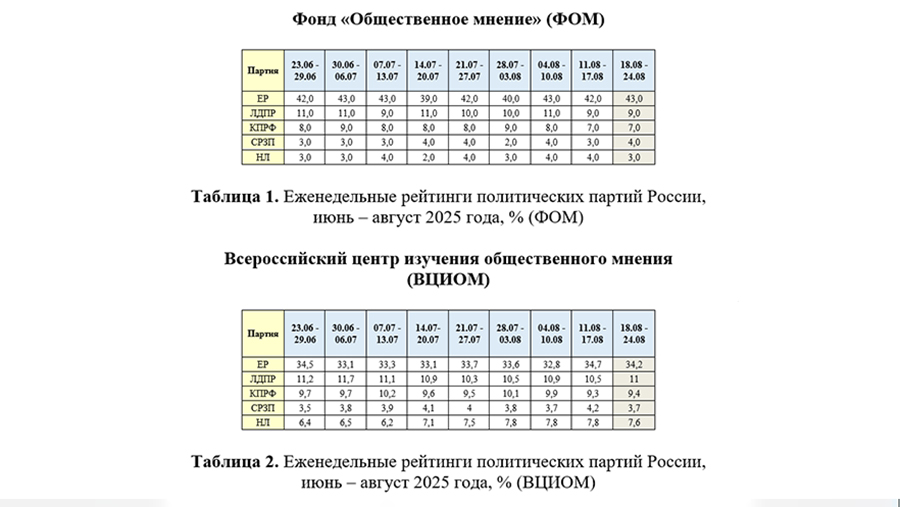
The results of public opinion research allow us to draw a number of conclusions.
Since the announcement of the elections to state and local government bodies within the framework of the EDG-2025, the EP has not only not increased its advantage over other parliamentary parties, but has also slightly worsened its rating positions (by an average of 3%) according to the results of a number of pre-election weeks. This is understandable: beyond the time limits of election campaigns, the EP enjoys virtually absolute dominance in the traditional mass media (television, radio, print media), and during the election campaign, other parties have additional opportunities to convey their position to voters, guaranteed by electoral legislation.
In addition, some parties of the parliamentary opposition are trying to play on the electoral field of the EP. For example, the SRP habitually works on the social agenda, while the NL develops initiatives to develop entrepreneurship and support student youth, in fact, trying with varying degrees of success to take part of the electorate from the parliamentary majority party, as can be seen from the results of polls, when the arithmetic increase in NL and SR corresponds to the negative dynamics of the EP.
There is an obvious tendency to consolidate the LDPR in second place in the ratings. At the same time, the ratings are stable and approximately close to both FOM and VTsIOM. During this period, the LDPR's rating fluctuated in the range from 9.0 to 11.0%, and VTsIOM's from 10.3 to 11.7%, while the general trend towards an increase in voter support for the party led by Leonid Slutsky continued. It can be seen that not only the results of public polls, but also data on the nomination and registration of candidates for elections indicate that the LDPR, a year before the main elections of the electoral cycle, looks like perhaps the most dynamic force in the country's party system, having significantly updated and strengthened its ranks, primarily regional branches.
The Communist Party of the Russian Federation is no longer the main rival of the EP, having moved to a stable third place for the second year in a row. At the same time, the gap even from the LDPR, which came in second place, is not decreasing, despite the pre—election work of the communists, but, for example, according to the FOM, it is even increasing - from 2 to 3%. Only twice during the study period, the Communists (according to VTsIOM) were able to surpass the psychological mark of 10%.
The electoral decline of the SRP continues. According to both the FOM (from 2 to 4%) and VTsIOM (from 3.5 to 4.1%), the party has never been able to overcome the five percent barrier during the observation period, even during the election campaign period, which casts doubt on both the party's prospects within the framework of the EDG-2025, and, moreover, moreover, in the elections to the State Duma in 2026. Thus, according to public opinion polls, as well as the results of the nomination and registration of candidates, the SRWP has the worst positions among the "parliamentary five". In this regard, it is quite possible to predict the imminent exodus from the party of resource deputies of regional/local parliaments or the State Duma, who do not want to sink along with the party ship of the SRDP and put an end to their political careers. There is less and less time left before the federal elections, and such situations are likely to increase, exacerbating the already difficult situation for the SRWP.
NL ratings are quite contradictory: from 2-4%, according to the FOM, to 6.4 - 7.8%, according to VTSIOM. The NL's prospects in the elections are therefore very uncertain. The persistent difference in the ratings of the party among the two leading sociological centers of the country, which has no scientific explanation, also raises questions for this party alone.

The party's political agenda and the course of the election campaign
The course of the election campaign shows that almost all the parties of the "parliamentary five" are actively campaigning in a number of areas: legislative activity at the federal level and in the regions, trips of party leaders, primarily to the territories where the most important elections within the framework of the EDG are taking place, the activity of regional party leaders.
During the pre-election period, the secretary of the General Council of the party, V.V. Yakushev, shows quite active media activity. He visits Russian regions (for example, the Novgorod Region, Tyumen Region, Khanty-Mansi Autonomous Okrug), and puts forward federal initiatives, participates in various forums (for example, the United Russia Women's Movement).
From the point of view of the activity of party leaders, the most intense campaign is being conducted by Leonid Slutsky, Chairman of the Liberal Democratic Party, who personally headed the lists of candidates for elections to regional legislative (representative) authorities, as well as parliaments of regional administrative centers. This suggests that he is ready to take personal responsibility for the party's election results.
Slutsky's "regional agenda" was exceptionally intense. In preparation for the EDG-2025, he has already visited 17 regions, having traveled 1/5 of the country's territory and all the main electoral regions: the DPR, St. Petersburg, Tatarstan, North Ossetia–Alania, the Komi Republic, Ryazan, Tula, Orel, Pskov, Kostroma, Rostov, Lipetsk, Belgorod, Tomsk, Novosibirsk, Chelyabinsk and the Voronezh region. As a rule, these trips were not officially announced as pre-election, they were often related to the current activities of the party (an off-site meeting of the LDPR faction in the State Duma, a meeting of the party's Economic Council), but the arrival of the party's top official, a meeting with the leadership of the region and party activists, appearances on regional television cannot but influence the political situation. on the eve of the upcoming elections. It should also be noted that Slutsky visited many regions that are in the zone of military clashes and terrorist attacks by the enemy during his military operations.
The leaders of the SRDP and the Communist Party of the Russian Federation as a whole are conducting a mostly "metropolitan" campaign, putting forward primarily federal initiatives. The number of trips by the leaders of these parties to the regions is extremely low. There is a great danger that these parties with such pre-election tactics risk becoming "Garden Ring parties". A visit to Kaluga by Communist Party leader Gennady Zyuganov at the end of August, at the end of the election campaign, is unlikely to change this assessment.
At the same time, the leaders of the National Assembly are actively visiting the regions of Russia, meeting with party activists and the leadership of the regions. It is noticeable that, in fact, the NL has a certain "three-headedness" - Alexey Nechaev, Vladislav Davankov, and Sardana Avksentieva visit the subjects of the Russian Federation on behalf of the party, which may raise well-founded questions among voters.: who is the real leader of NLP?
A distinctive feature of this election campaign was the active copying (which less correct researchers would call theft) of LDPR ideas by other opposition parties. Especially in this regard, the NWFP "distinguished itself" by acting as an absolute spoiler of the LDPR and demonstrating an obvious crisis of ideas.
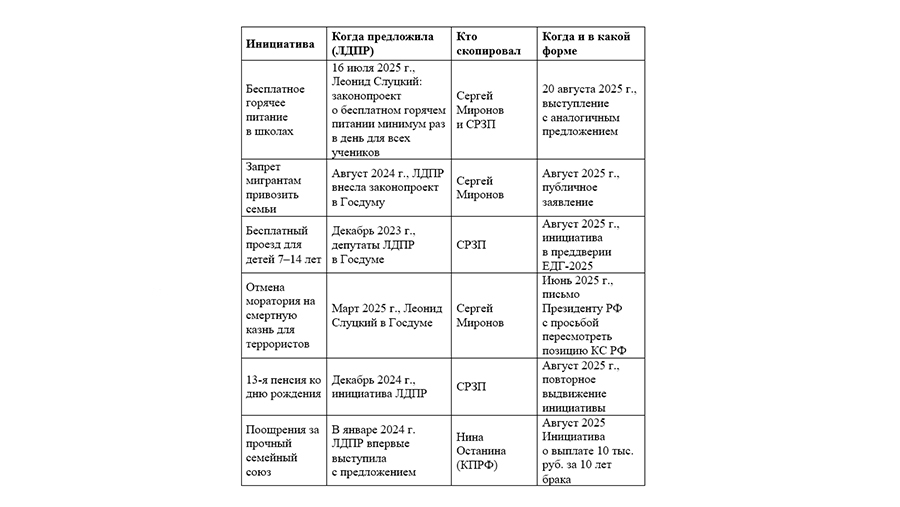
The same can be said about the problem of affordable mortgages. For example, Slutsky proposed to reduce the family mortgage rate for large families to 0%. Almost immediately after this proposal, Sergey Mironov proposed writing off mortgage debt to families at the birth of three children.
The topic of solving problems in the field of migration, which has historically been associated in the political field with the Liberal Democratic Party, causes a wide response and support from voters. This fact contributes to the fact that other parties, in the same spoiler manner, are trying to intercept the LDPR's migration agenda. Both NLP and SRP have been actively working on this topic.

In general, the election campaign within the framework of the EDG-2025 demonstrates the expected leadership of the EP.
It is impossible not to note the powerful breakthrough, even in comparison with the previous elections (EDG-2024), which is demonstrated by the Liberal Democratic Party, which is conducting a federal election campaign and has taken a strong second place in nominating and registering candidates, including in the most technologically difficult elections (heads of regions and single-mandate candidates in the elections of legislative assemblies of the subjects of the Russian Federation), She put forward a number of ideas that are important to the majority of voters and have become resonant. A distinctive feature of the party's election campaign is its stitching between different regions and election levels, when all LDPR candidates, from candidates for regional heads to regional and local deputies, broadcast common meanings, slogans, stylistics and demonstrated propaganda materials taking into account local specifics.
The SRWP as a whole is trying to come up with initiatives that copy the activity of the EP and the LDPR, bringing a populist touch to them. But opinion polls show that the party would not have been elected to the ninth State Duma if the elections had been held now.
The Communist Party of the Russian Federation obviously needs to restructure its management system and reboot the network of its regional and local branches, which are no longer able to adequately fill vacant elective positions with candidates, as well as administer their registration. According to this indicator, the party has fallen not only below the LDPR, but also below the PL. The old "nuclear" electorate of the party is shrinking, and the influx of new ideas and leaders from the Communists is not observed.
Despite its rather active position, the NL has not yet formed powerful structures in the regions. Their legislative initiatives often look not only populist, but also disconnected from the lives of ordinary voters. The party's image and position were seriously undermined by the scandal with deputy Alexander Ivanov in Yakutia, who stated in an interview with a Turkish blogger about the desire of the Yakut people to "become free" in the future, which was rightly interpreted by a number of politicians, experts and media representatives as a call for separatism.
Thus, the course and content of the campaign allow most experts to assert the preservation of the EP's leading positions in the country's party system, the consolidation of the LDPR as the country's first opposition party, the decline in popularity of the Communist Party of the Russian Federation, which is losing even prospects for maintaining the second position, and the extremely uncertain prospects of the SRDP and the PL, calling into question their inclusion in the new composition of the State Duma of the Federal Assembly of Russia. The Russian Federation in 2026.
Переведено сервисом «Яндекс Переводчик»
