
Power from Siberia: Russia and China launched the largest gas project in the world

The Power of Siberia–2 gas pipeline project and the Soyuz–Vostok transit route through Mongolia have been given the green light. Gazprom and China's CNPC have signed a memorandum of strategic cooperation: gas supplies will be carried out over 30 years in the amount of 50 billion cubic meters. m per year. And their total volume will increase to 106 billion per year. According to experts, revenues from these exports will exceed $27 billion annually, and full-fledged deliveries may begin as early as 2031. The expansion of export capacities will pay off, and will also allow gasification of a number of Russian regions, including the south of the Krasnoyarsk Territory, they added. In the long term, Russia will become a key and reliable supplier of energy resources to China's growing economy. How much will the expansion of capacities cost and what prospects open up for the Russian Federation and China — in the material of Izvestia.
What was agreed upon in China
Gazprom and the China National Petroleum Corporation (CNPC) have signed a legally binding memorandum on the construction of the Power of Siberia–2 gas pipeline to China and the Soyuz–Vostok transit gas pipeline through Mongolia, Alexey Miller, Chairman of the Management Board of the Russian company, said following talks between the leaders of the three countries in Beijing on September 2. The document exchange ceremony took place in the presence of Russian President Vladimir Putin, Chinese President Xi Jinping and Mongolian President Uhnaagiin Khurelsukh.

President of the Russian Federation Vladimir Putin, President of the People's Republic of China Xi Jinping and President of Mongolia Uhnaagiin Khurelsukh (from left to right) during a conversation at the House of People's Assemblies
According to Alexey Miller, "this will be the largest, most ambitious and most capital-intensive project in the gas industry in the world." The new gas pipeline will allow delivering up to 50 billion cubic meters of natural gas from Russia to China. The deliveries will be carried out for 30 years, he added.
The parties also agreed to increase exports under the existing Power of Siberia from 38 billion to 44 billion per year, and under the Far Eastern Route project from 10 billion to 12 billion cubic meters. Deliveries under the latest contract will begin in January 2027. Thus, the total volume under the new and expanded agreements may reach 106 billion cubic meters per year.
Alexey Miller did not name a specific gas price for China, but noted that it would be objectively lower than for Europe due to the shorter transport shoulder.
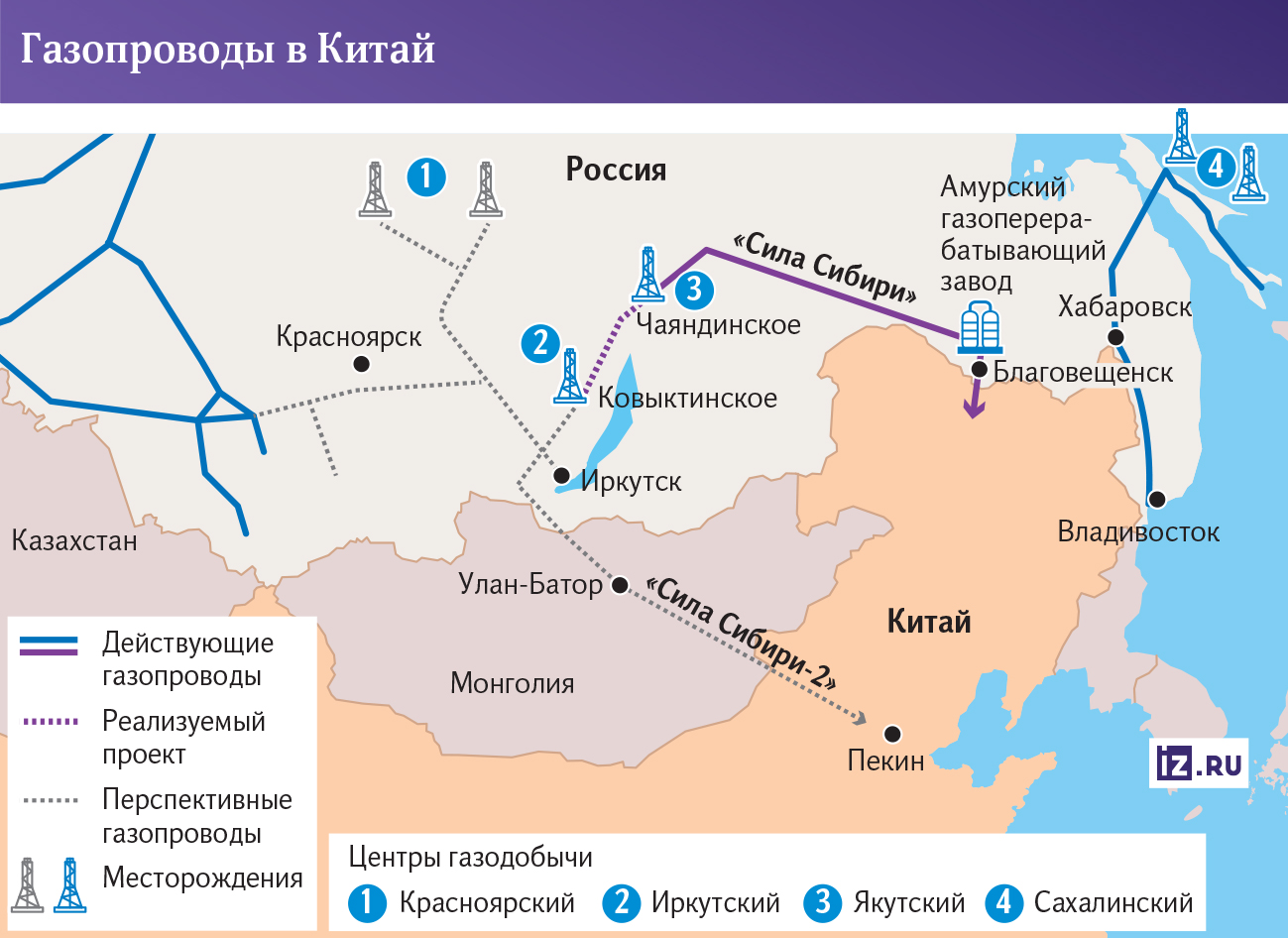
The Power of Siberia–2 project is supposed to connect the gas fields of Yamal and Western Siberia with China through Mongolian territory. Mongolia agreed on the route in April 2025. The project capacity of the pipeline is 50 billion cubic meters of gas per year. The implementation of the "Power of Siberia – 2" faced a number of obstacles. The main reason is the lack of a final contract between Gazprom and the China National Petroleum Corporation. The negotiations, which began back in 2020, were delayed due to disagreements over the price of gas. China insists on a cost close to subsidized domestic tariffs in Russia, while Gazprom is targeting higher export rates.
About the issue price and investments
Alexey Grivach, Deputy Director of the National Energy Security Fund, noted that the expansion of existing capacities was initially envisaged when designing the route and the necessary infrastructure.
— After the successful withdrawal of the Power of Siberia to contractual volumes, China has shown interest in obtaining these additional volumes. And now it has been documented. In fact, the investments are not that big. The pipe actually exists, it will be necessary to slightly expand the production capacity and add another processing line at the Amur Gas Processing Plant, which was envisaged at the design stage," he explained.

According to him, Gazprom will carry out investments in the Russian territory under the financial obligations of the Chinese side as part of the addendum to the long-term gas supply contract.
As for the Power of Siberia – 2, according to estimates by the Reuters news agency, its cost is about $13.6 billion.

According to Dmitry Kasatkin, managing partner of Kasatkin Consulting, the increase in capacity on the Power of Siberia and the Eastern Route is mainly an additional compression and modernization of nodes, that is, investments in the range of several billion dollars.
— The Power of Siberia – 2 is much larger: almost 2,600 km of pipe, including the Mongolian section with five compressor stations, and the cost estimate for the pipeline alone ranges from $10-15 billion. Plus the cost of supplying resources and infrastructure. As a result, this is a large project, but economically justified due to a 30-year contract," he said.
According to Grivach, the pipeline will certainly pay off, even at the current price for China of $260 per 1,000 cubic meters.
According to Ekaterina Kosareva, managing partner of VMT Consult, with such a fuel cost, China will pay more than $27 billion annually when launching all Gazprom's pipeline capacities.
When will the new facilities be built and what will it give Russia?
Speaking about the start of deliveries for the Power of Siberia – 2, Alexey Miller recalled the timetable for the Power of Siberia project: after signing the contract in 2014, they began in 2019.
— I can say that you need to focus on the deadlines that we had for the Power of Siberia. We built it six months earlier. We had a target date of May 2020, and deliveries began in early December 2019. In 2024, a month earlier, on December 1, we reached the planned design capacity for the Power of Siberia. In other words, cooperation with our Chinese friends has shown that we are working clearly and smoothly, and Gazprom is fully fulfilling its obligations," he said.

According to Ekaterina Kosareva, Alexey Miller clearly made it clear that the start of deliveries can be expected as early as 2031-2032.
— Of course, so far only a memorandum has been signed. No one will talk about any exact dates right now, but an approximate time lag has been outlined," she said.
According to Alexey Grivach, within the framework of the Power of Siberia – 2 project, it is planned to gasify a number of regions, primarily the south of the Krasnoyarsk Territory and the city of Krasnoyarsk, the only non-gasified millionaire in our country.

Valery Andrianov, associate Professor at the Financial University under the Government of the Russian Federation, believes that if new projects are successfully implemented and the Eastern Route is expanded, gas can be sold in the Far East, primarily in the Khabarovsk and Primorsky Territories. He recalled that, according to estimates by Gazprom representatives, the demand for gas in this region will grow from 4.3 billion cubic meters. m in 2021 to 22 billion in 2035.
Russian fuel supplies to China via the Power of Siberia gas pipeline began in 2019 as part of a long-term purchase and sale agreement between Gazprom and CNPC. In 2024, 31.12 billion cubic meters of gas were exported via the pipeline. On December 1, 2024, the daily figures were brought to the maximum contractual level (38 billion cubic meters m in annual terms). In the first eight months of 2025, Gazprom increased natural gas supplies to China by 28%.
In August 2018, the development of a project to extend the existing Sakhalin-Khabarovsk–Vladivostok gas pipeline to China (built in 2011) began. In February 2022, Gazprom and CNPC signed a long-term contract for the supply of 10 billion cubic meters of natural gas per year to China via the Far Eastern route, which was named the Power of Siberia – 3. The technical agreement on the construction of the gas pipeline was signed as part of SPIEF 2022. The offshore fields of the Sakhalin-3 project will become the resource base. It is planned that deliveries along this route will begin in 2027.
Dmitry Kasatkin believes that export gas pipelines do not directly solve the problem of gasification of regions, but create a supporting infrastructure.
— New routes through Eastern Siberia and Mongolia allow connecting certain regions — Irkutsk region, Buryatia, and Transbaikalia. The development of compressor capacities increases the stability of the entire system and reduces the "island" character of the eastern regions, which indirectly facilitates access to gas, he said.

In general, according to Tamara Safonova, General Director of the Independent Analytical Agency for the Oil and Gas Sector (NAANS-MEDIA LLC), an increase in gas exports to China under the three announced projects will allow Russia to become a key and reliable supplier of energy resources for the growing Chinese economy in the long term.
"The development of pipeline projects will allow Beijing to ensure energy security, reduce imports of liquefied natural gas, primarily from the United States and Australia, and ensure economic growth by reducing costs and supply efficiency," she said.

Dmitry Kasatkin agrees with his colleague. According to him, Russia receives long-term guaranteed sales in the growing Asian market and reduces dependence on the difficulties associated with LNG exports, while simultaneously loading its machinery and pipe industry.
— China is increasing the share of stable pipeline gas in the energy mix and thereby reducing price risks during peak seasons. Both sides benefit from financial calculations as well: some of the contracts will be in national currencies, which reduces dependence on the dollar," he said.
For the global market, this means that part of the demand will leave the LNG segment for "pipe" gas, which will increase competition in Asia in the early 2030s, the expert concluded.
Переведено сервисом «Яндекс Переводчик»
