
You can not be rude to feed: where is the best service in cafes and restaurants

Russians are best served in cafes and restaurants in Krasnodar, Nizhny Novgorod and Vladivostok. This is the conclusion reached by the compilers of the Waiter Index, the Security 2.0 monitoring center. The rating took into account the speed of service, the courtesy and professionalism of the staff, and the honesty of calculations. Catering outlets in Rostov-on-Don, Sochi and Kazan became the worst. The social activists sent their rating to the regional authorities and the government, suggesting that it be made annual. Rospotrebnadzor listed the main violations recorded in Russian cafes and restaurants to Izvestia. Staff starvation forces institutions to recruit untrained staff, and only a few can afford to invest in their training, industry representatives complained.
Where is the best and worst service
Restaurants in Krasnodar, Nizhny Novgorod and Vladivostok demonstrate the highest quality of service this year, according to the Security 2.0 monitoring center (operating under the Russian Peace Foundation). They developed a "Waiter Index" that takes into account the speed of service, the courtesy of the staff, the professionalism of the staff (knowledge of the menu, presentation, appearance) and the accuracy of calculations.

Analysts checked the quality of service in the 10 most visited Russian cities, based on data from the Association of Tour Operators of Russia. Tourists most often come to Sochi, Anapa, Kazan, Kaliningrad, Nizhny Novgorod, Yekaterinburg, Krasnodar, Rostov-on-Don, Vladivostok and Novosibirsk. Moscow and St. Petersburg were excluded from the rating as cities of federal significance that distort the overall picture, explained Elena Sutormina, First Vice President of the Russian Peace Foundation and head of the Security 2.0 monitoring center.
"Against the background of unique modern opportunities for domestic tourism and the development of the hospitality industry in our country, it is very important to develop universal and modern methods of independent assessment," she said. — In our Waiter Index, we have combined data from the analysis of independent experts of the center, surveys of respondents from the studied cities, and an analysis of these reviews on the main platforms using neural networks.
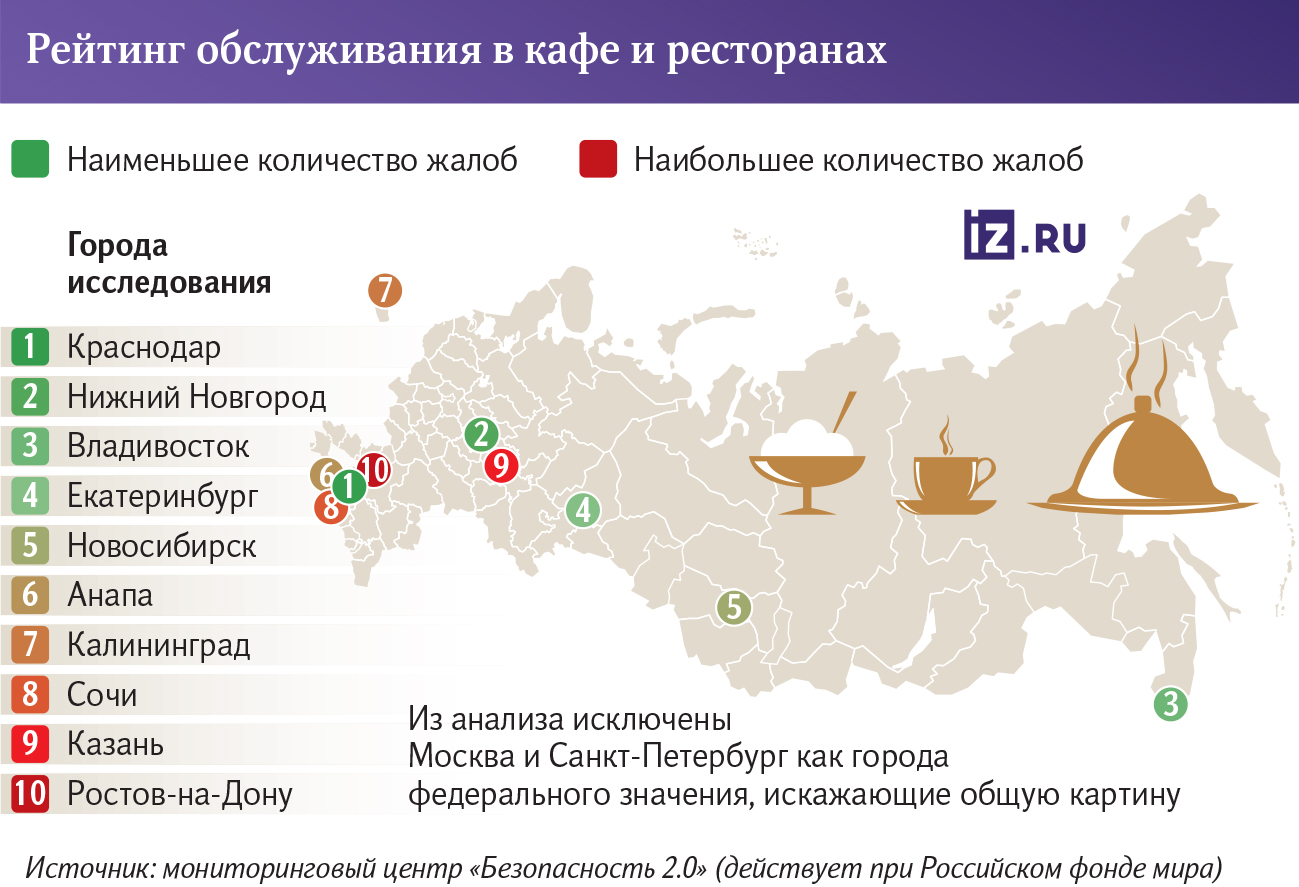
It turned out that the least complaints about the quality of service in establishments in Krasnodar. Yekaterinburg and Novosibirsk are also among the top five cities with the best service. The cafes and restaurants in Sochi, Kazan and Rostov-on-Don serve visitors the worst.

Krasnodar
Krasnodar also became the leader in terms of service speed. Interestingly, the service there is the most honest and at the same time the most rude: the city took the last place in the rating of "courtesy and communication of waiters". The most polite waiters are in Kaliningrad. The most professional are in Yekaterinburg, and the least qualified are in Novosibirsk. In Rostov-on-Don, visitors most often complained that they had been shortchanged.
The main problem that catering customers complain about is the speed of service. As a result, they get cold food, and the waiters have to wait a long time. The second most common problem is dirty tables and dishes, as well as the unsanitary conditions of the institution as a whole. Other complaints from tourists include staff rudeness, rudeness, ignoring guests, and overly insistent demand for tips.
Izvestia has already written that 60% of Russians have experienced clear signs of unsanitary conditions in institutions this year. Most often, these are unmade tables, dirty floors and untidy staff.

Such an independent assessment of service in institutions should be implemented at the federal and regional levels, Elena Sutormina believes.
— We have sent our analysis to the regional authorities and the Ministry of Economic Development with a proposal to consider the possibility of its implementation on an ongoing basis. This will make it possible to use the Waiter's Index as one of the indicators for assessing the hospitality system," she said. — It seems to us that such an analysis can be implemented on the principles of public-private partnership with the involvement of relevant public organizations.

How catering is struggling with staff starvation
The personnel situation in the hospitality industry remains difficult, experts interviewed by Izvestia noted. This reduces the motivation for staff training for both establishments and applicants themselves, says Dmitry Alekseev, a restaurant critic and publisher of the 50 Best Tastes of Russia guidebook.
— This definitely affects the service level of Russian restaurants. Unfortunately, in the last few years, even in expensive Moscow restaurants, you can encounter a waiter who, for example, does not know not only the menu, but also does not tell you where the guest toilet is located in the hall. A person just recently got a job and, as experience shows, they will just as quickly switch to a new one, where the pay is better or the workload is less," he explained. — It doesn't make sense for a restaurant company to invest in training such a "fleeting" employee.

Often, employers themselves in catering do not look at the qualifications of the applicant, but his willingness to start work as soon as possible and for a small salary, added Ekaterina Kosareva, managing partner of the analytical agency VMT Consult.
— The level of establishments here plays a role only partially. Yes, premium restaurants may require a basic understanding of the service or the skills of working with the wine list, but even there, staff shortages force us to lower the bar," she stressed. — No one is particularly ready to invest in staff training. We are not talking about one-time introductory trainings, but about system development, which is practically not done in the industry.
There are exceptions to the rule when a company tries to retain staff by providing training opportunities at the expense of the restaurant, Dmitry Alekseev added. But this, according to him, more often concerns not the entire staff, but individual positions, such as the director or sommelier.
At the same time, the fee for the actions of unqualified employees for business may be too high, said Igor Minevich, General Director of the Stolichny Vkus cafe chain.

— The margin in catering has decreased, and everyone has strict cost control. No one can afford unplanned expenses as a result of a mistake. The market has become very large, and there is equally fierce competition in all price segments. Therefore, the need to increase investments in personnel training is equally acute for all participants in the catering market," he explained.
Most institutions do not have a risk management system, added Valery Alekseev, head of the investigation bureau of the Popular Front.
— This is a mandatory element of monitoring critical points of sanitary safety. Each catering facility had to develop it for itself, keep logs, instruct employees and thereby reduce the risk of mass infections," he said.

There are no mass system inspections of catering establishments now, as there is a moratorium, he added.
As reported to Izvestia in Rospotrebnadzor, the main violations at public catering enterprises were:
— the discrepancy between the produced dishes and the area of the produced premises;
— lack of documents confirming the origin, quality and safety of incoming food raw materials;
— non-compliance with the storage conditions and shelf life of food products.
In addition, timely repairs are not carried out in production and storage facilities, there is no production control, and the staff does not have medical records or has not passed a medical examination and hygienic certification. Also, in catering establishments, violations of the washing and disinfection of dishes are recorded, the absence of markings on cutting equipment, the lack of ventilation in industrial premises, and the absence of a toilet for visitors.
"As part of the control (supervisory) measures, all necessary and legally prescribed measures are being taken, including the temporary suspension of the facility's activities," the agency assured.
Переведено сервисом «Яндекс Переводчик»
