
Track marking: Russia will launch new gas supply routes bypassing Ukraine

Russia and Serbia are discussing the construction of gas pipelines capable of changing the energy map of Southeastern Europe. Ukraine has refused to transit fuel from Russia, but Moscow and Belgrade have found an opportunity to circumvent this barrier. As Izvestia found out, the new route through the Balkans will be useful for at least two more of Russia's European partners, Hungary and Slovakia. Serbia openly declares its intentions: It plans to purchase even more gas from Russia, although its share has already reached a record 93% in 2024. Moscow, Belgrade and Budapest are also conducting a financial assessment of the launch of an oil pipeline with a capacity of up to 3 million tons per year, which will connect Serbia with the Druzhba pipeline in Hungary. Serbian officials clarified that they do not intend to abandon the implementation of this project.
New gas pipelines in the Balkans
Serbia and Russia are closely cooperating on the potential construction of new gas pipelines, a source in the republic's cabinet of Ministers told Izvestia.

— The government and Serbiyagaz are working closely with Gazprom on the potential construction of new gas pipelines, including to Hungary. The decision will be made only jointly if Gazprom needs this route," the source told Izvestia. — Serbia has become an important transit country for Russian gas to other European countries, so new gas pipelines will strengthen its role.

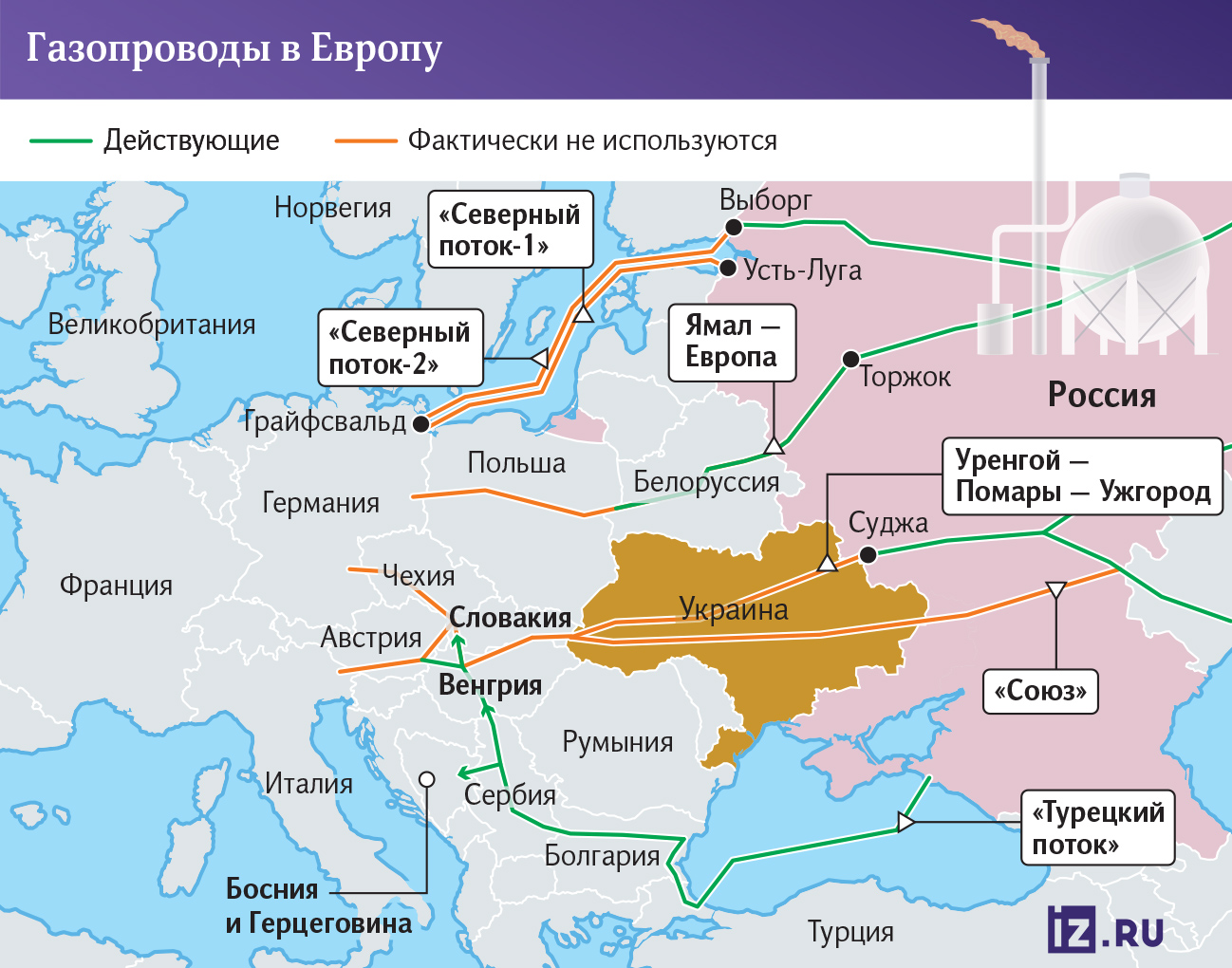
Izvestia sent a request to Serbiyagaz and Gazprom. The most likely option is a gas pipeline from Serbia to Hungary, through which it is possible to increase supplies to other EU countries, such as Slovakia and Austria.
Belgrade plans to receive as much Russian gas as possible in the future through the Balkan Stream (a continuation of the Turkish Stream), the Ministry of Mining and Energy of Serbia confirmed to Izvestia.

— The Russian Federation is a reliable partner of the Republic of Serbia in the field of gas supplies. Serbia pursues a sovereign policy, and we intend to continue doing so, that is, to continue receiving as much gas as possible through the Balkan Stream in the future," the ministry said.
In 2024, Serbia imported 93% of its gas from Russia, and in the first half of 2025, supplies from Russia amounted to more than 80%. The remaining volume came from domestic sources and Azerbaijan, the ministry said.
Central European countries have stopped receiving Russian gas through Ukraine due to Kiev's decision not to extend transit after January 1. Now Hungary and Slovakia consume blue fuel only through the Turkish Stream and Serbia. Pumping through it increased by 7% in the first half of 2025, reaching 8.3 billion cubic meters. m. Pipeline gas from Russia to Europe no longer flows via other routes: Nord Streams was disabled in September 2022, the Yamal-Europe gas pipeline stopped working due to Poland's position in the spring of the same year. of the year.

The leak site on the Nord Stream gas pipeline
Kiev and Brussels are trying to completely stop the pumping of gas to Europe via the Turkish Stream. In January, Ukrainian drones tried to attack the Russian compressor station, the entry point of the route. After that, Serbian President Aleksandar Vucic and Hungarian Prime Minister Viktor Orban called the protection of this pipeline a priority for both countries.

Given the EU's decision to abandon Russian gas by 2027, the construction of a new pipeline from Serbia to Hungary will be risky for Gazprom. In addition, Slovakia and Hungary still have enough volumes received on current routes, so their modernization is more likely in the future, Igor Yushkov, an expert at the Financial University and the National Energy Security Fund, told Izvestia.
Liberalization of the Serbian gas market
However, there are forces in the Serbian government that oppose an increase in Russian gas supplies. Earlier, Izvestia wrote that the republic plans to announce the liberalization of the gas market. This may lead to a diversification of supplies and thus to the loss of Gazprom's status as the main supplier.
The Ministry of Mining and Energy of Serbia then confirmed that "three laws on oil and gas are being prepared, aimed at regulating the conditions for reliable, secure and high-quality supply of consumers with these energy sources." Serbian Minister of Mining and Energy Dubravka Djedovic-Handanovic, in particular, said that negotiations on concluding new gas contracts with Azerbaijan to increase supplies to 1 billion cubic meters will begin in the near future. Another option is to purchase American LNG with delivery via Turkey and Bulgaria, experts say.
"If the gas market is liberalized, there is no certainty that Gazprom will retain Belgrade's transit role, and there may not be enough gas even for Serbia itself," a Serbian government source says.

The West is putting pressure on Belgrade to force it to abandon energy imports from Russia. In January, the US authorities imposed sanctions against NIS, a leading Serbian oil company, demanding the complete withdrawal of Russian capital. The restrictions have not yet entered into force, and Serbia has already received its fifth postponement until the end of August. Gazprom Neft has 44.85% of NIS shares, Gazprom has 11.3%. Another 29.87% of NIS securities are owned by Serbia, the rest by minority shareholders. Belgrade offers Russia to buy out its stake in NIS for €600 million in order to avoid the introduction of restrictions.
In addition, pressure is being exerted on Serbia by Brussels, which itself intends to abandon Russian energy supplies in the near future. The EU demands to join the sanctions against Russia in exchange for advancing the process of Belgrade's European integration. However, the authorities of the republic adhere to a sovereign political course and maintain close relations with Russia, solving emerging problems, for example, the scandal involving the supply of Serbian-made weapons to Ukraine.
Construction of an oil pipeline between Serbia and Hungary
Meanwhile, Moscow, Belgrade and Budapest are conducting a financial analysis of the construction of an oil pipeline that will connect Serbia and Hungary, the Serbian Ministry of Mining and Energy told Izvestia.
"In cooperation with MOL (Hungarian energy company) and NIS (Serbian energy company), Serbia is considering options for transporting crude oil with a capacity of up to 3 million tons per year," the Serbian Ministry of Energy told Izvestia.

Earlier, Hungarian Foreign Minister Peter Szijjarto, Russian Deputy Energy Minister Pavel Sorokin and Serbian Energy Minister Dubravka Jedovic-Handanovic discussed the construction of a new route. The 180 km long oil pipeline is planned to be commissioned by 2027.
Belgrade is not considering the possibility of suspending the construction of this oil pipeline, despite the EU's decision to abandon Russian energy supplies by the same date, the Serbian authorities stressed.
— This will increase the reliability of supplies, diversify the sources of oil production, and in this regard, an intergovernmental agreement has been signed with Hungary. We are closely coordinating all steps with Hungary and the government of the Russian Federation," a representative of the Ministry of Mining and Energy of Serbia told Izvestia.

Russia is interested in direct participation in the construction of a new oil pipeline from the Serbian city of Novi Sad to the Hungarian city of Szeged in order to connect to the Druzhba system, the Russian Embassy in Belgrade told Izvestia.
— The successful implementation of the project will significantly increase Serbia's energy security. It is designed to reduce logistical costs and stabilize fuel prices, bypassing transit risks. We are also talking about creating new jobs and modernizing the existing transport network. An increase in Russian oil supplies will give an additional incentive to the development of the Serbian economy," the Russian diplomats stressed.

Druzhba Oil Pipeline
Currently, Serbia covers only 20% of its oil demand due to its own production, statistics show. The main import channel is Croatia, which receives it in ports and sends it to Serbia via the Janaf oil pipeline. According to media reports, Kazakhstan and Iraq supply oil to the Balkan republic.
Croatia has been unable to accept Russian oil by sea since December 2022 due to sanctions. Currently, the fuel is supplied via the Druzhba oil pipeline to Hungary, from there to Croatia, and only then pumped to Serbia. Therefore, the pipeline is needed to ensure reliable oil supply and shorten the route, Igor Yushkov believes. Zagreb may block this transit at some point, for example, due to pressure or decide to voluntarily implement the EU roadmap, the expert concluded.
On the other hand, there are doubts about the need to build a new oil pipeline. According to a source in the Serbian government, the capacity of the NIS refinery in Novi Sad is limited, and the Serbian market does not require additional volumes. The new pipeline may lead to higher prices for raw materials, since now it will be necessary to pay for the operation of two routes at once: from Croatia and from Hungary.
Переведено сервисом «Яндекс Переводчик»
