- Статьи
- Economy
- Blow down the price: the number of Russian regions with double-digit inflation has halved

Blow down the price: the number of Russian regions with double-digit inflation has halved

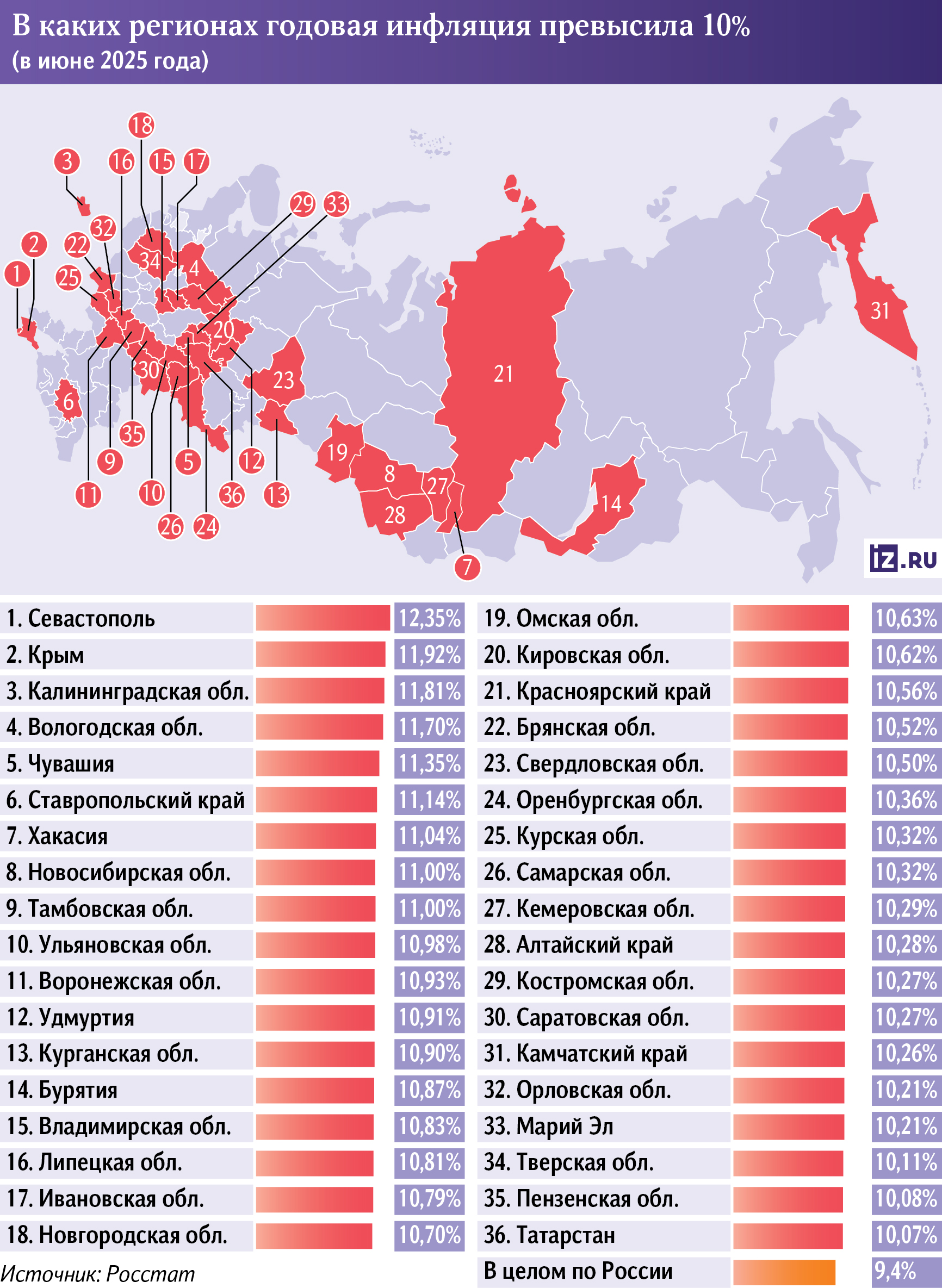
The number of Russian regions with double-digit inflation has almost halved. From March to June, it fell from 57 to 36, the Central Bank's press service told Izvestia. However, this is still higher than the December values. Nationwide, price growth has started to slow down slightly, but it remains at a high level of 9.4%. Sevastopol became the leader in inflation (above 12%), Chukotka was the least affected (about 5.2%) — the difference between the regions remains significant, which affects the most vulnerable segments of the population the most. What is the reason for such inequality and what will be the inflation rate by the end of the year — in the material of Izvestia.
Price growth factors
By the end of the first half of 2025, price growth accelerated above 10% in 36 regions of the country. However, the number of regions with double-digit annual inflation under the influence of tight monetary policy is decreasing — for example, by the end of the first quarter there were 57 of them, the press service of the Bank of Russia told Izvestia.

At the same time, this is still lower than in December, when inflation was in double digits in 20 regions. The editorial board asked the Ministry of Energy to explain why the price level differs significantly in different regions.

According to Rosstat, consumer prices in Russia began to decline slightly — from July 29 to August 4, they decreased by 0.13%. However, deflation has been observed for only the third week in a row. Despite this, annual inflation is still high, at 9.4% in June. In addition, if we compare with June last year, the price increase is higher now — it was 8.6% back then.
At the same time, the main burden due to inflation falls on the least well-off segments of the population, Russian President Vladimir Putin said earlier.

The annual price growth remains at this level due to the effect of high accumulated inflation in the previous 12 months, Olga Belenkaya, Head of the Macroeconomic Analysis Department at Finam, said.
The main pro—inflationary risks include an increase in budget expenditures, which leads to an increase in the money supply and may increase inflationary pressure, said Marina Nikishova, chief economist at Zenit Bank. According to the latest data, Russia's budget deficit in seven months is already more than the authorities predicted for the whole of 2025, at 4.9 trillion rubles.
In addition, an important trigger of inflation remains an increase in prices for important consumer goods — gasoline, meat, medicines, which have a high weight in the consumer basket. This supports the high expectations of the population for an increase in prices, said Denis Popov, managing expert at the PSB Center for Analytics and Expertise.

Labor market tensions have decreased somewhat recently, with fewer companies reporting staff shortages. However, the shortage of workers also remains a risk factor for accelerating inflation, said the head of the Central Bank of the Russian Federation Elvira Nabiullina. "If domestic demand starts to grow rapidly again without a corresponding increase in productivity, it will quickly run into labor constraints and will largely lead to price increases," said the chairman of the regulator.
— In Russia, over the past two years, inflation has been influenced by a number of factors, in particular, the instability of the ruble exchange rate and logistical difficulties in securing imports. Due to these factors, inflation began to decline relatively recently — in the spring of 2025," added Dmitry Golubkov, Director of Macroeconomic Analysis at OTP Bank.

What will help reduce inflation
The main effect of the slowdown in inflation was the harsh policy of the Bank of Russia. From October 2024 to June 2025, the regulator kept the rate at a record high of 21%. At the beginning of the summer, he began to soften the PREP and lowered the key one for the first time in three years. At the last meeting on July 25, the regulator lowered the rate once again by 2 percentage points to 18%. As Izvestia wrote, by the end of 2025, it may be reduced to 14-15%.
The high rate helps to reduce the credit and increase the savings activity of economic entities, said Marina Nikishova from Zenit Bank. And this contributes to the cooling of consumer demand and underlies the reduction in the rate of inflation.

Also, the tight monetary policy of the Central Bank led to the strengthening of the ruble. According to the regulator, on August 8, the exchange rate was 79.3 rubles per dollar — since the beginning of the year, the national currency has strengthened by almost 25%. Even if this trend stops, the effect of the strengthening of the exchange rate that has already occurred may soon dry up — that is, the inflation rate will stabilize at a higher level, Olga Belenkaya from Finam reminded.
In general, if no external shocks occur, the price growth rate may reach about 7.5–7.7% by the end of the year, and the target of 4% by 2026. Success in reducing inflation depends on the general state of the Russian economy, which is seriously determined by the situation on the world markets of oil and gas, as well as other types of raw materials. If export prices do not fall, our country will be able to cope with the difficulties, Dmitry Golubkov believes.
Why does inflation vary so much in the regions?
The leaders in price growth at the end of June were Sevastopol (12.4%), Crimea (11.9%), Kaliningrad (11.8%) and Vologda Oblasts (11.7%), as well as Chuvashia (11.4%).
In total, inflation above the national average (9.4%) was recorded in 56 regions of the country, and in one region it coincided with the national average.

The indicator was below the average in 28 regions. At the same time, the Chukotka Autonomous Okrug was closest to the target of 4% (5.2%). The Magadan Region is slightly behind it, where the price increase reached 6.7%, and the Khabarovsk Territory was in third place (7.4%). Thus, the inflationary inequality of the regions amounted to more than 7 percentage points.
In the largest regions of Russia (in terms of consumption of goods and services and population), such as Moscow, the Moscow Region, as well as St. Petersburg and the Krasnodar Territory, annual inflation in June 2025 was below 10%, the press service of Rosstat noted.
The editorial board sent requests to the regional governments. For example, the Ministry of Energy of the Tula region reported that apples rose in price by 24.6%, potatoes by 2.5 times, onions and cabbage by 1.5 times, beets by 20.6%, cucumbers by 17.9%. And in the Tula region, the cost of foreign tours increased by 14.1%, passenger transportation — by 11.9%, sanatorium and wellness services — by 7.5%.
"In the period from 2016 to 2019, when the average national inflation was close to 4%, the spread of regional price growth rates was significantly lower than during periods of high inflation," the Central Bank's press service told Izvestia.

They added that targeting price increases helps not only to reduce the rate of inflation in the country as a whole. It also helps to reduce their regional heterogeneity.
The main reason for the inequality is the differences in the structure of the consumer basket. For example, in high—income regions, the share of services in citizens' expenses is higher, and in low-income regions, the share of food is higher, the regulator explained. As a result, overall inflation in low—income regions will be more determined by changes in food prices, while in richer regions it will be determined by changes in prices for services.

Inflationary inequality in the regions may be influenced by other factors. For example, in the southern regions of Russia, much depends on weather conditions. If they are unfavorable, then the volume of agricultural products decreases, which is why it becomes more expensive. And the severity of climatic conditions in many places does not allow growing fruits and vegetables, so they may be less accessible.

In addition, regional inequality is associated with the development of tourism in a number of regions. Thus, many citizens do not buy travel packages in advance, but begin to actively purchase tours in June, says Yulia Kovalenko, associate professor of the Basic Department of Financial Control, Analysis and Audit of the Main Control Department of Moscow, Deputy head of the Higher School of Finance of Plekhanov Russian University of Economics. Accordingly, the higher the demand, the more active the price increase, she added.
Переведено сервисом «Яндекс Переводчик»
