- Статьи
- World
- Atomic wave: Russia and Malaysia have started working on the supply of floating nuclear power plants

Atomic wave: Russia and Malaysia have started working on the supply of floating nuclear power plants

Russia and Malaysia have started working on an intergovernmental agreement on the supply of floating nuclear power plants (NPP), Rosatom CEO Alexei Likhachev told Izvestia after Vladimir Putin's meeting with King Sultan Ibrahim of Malaysia. Today, only Russia has a unique experience in the creation and operation of such stations. The country is already working with the countries of Southeast Asia in this direction, and the launch of domestic floating nuclear power plants on the international market is planned by 2030. How the Russian Federation is expanding global cooperation in the field of nuclear energy and who can prevent it — in the Izvestia article.
Russian nuclear project in Malaysia
Russia and Malaysia are preparing an intergovernmental agreement on the supply of floating nuclear power plants. Alexey Likhachev, CEO of Rosatom State Corporation, told Izvestia about this after Vladimir Putin's meeting with Sultan Ibrahim, King of Malaysia, on August 6.

Russian President Vladimir Putin and Malaysia's Supreme Ruler Sultan Ibrahim (from right to left)
"We have not yet started implementing the project, but now we are preparing an intergovernmental agreement that, in fact, will describe all the relationships," Likhachev told Izvestia.
Cooperation with Malaysia in the nuclear field is developing dynamically — for the first time, the interest of partners from Southeast Asia in Russian nuclear power plants became known just a couple of months ago. Then in May, the Russian president held talks with Prime Minister Anwar Ibrahim. And now the Malaysian side is already choosing specific power transmission technologies.
— Yes, they just want them badly. The Malaysians will choose a model of electricity supply, not the construction of a nuclear power plant or the transfer of a block to them, but the creation of a floating nuclear power plant and the sale of electricity directly "from onboard" to Malaysia's consumer network, Likhachev explained.
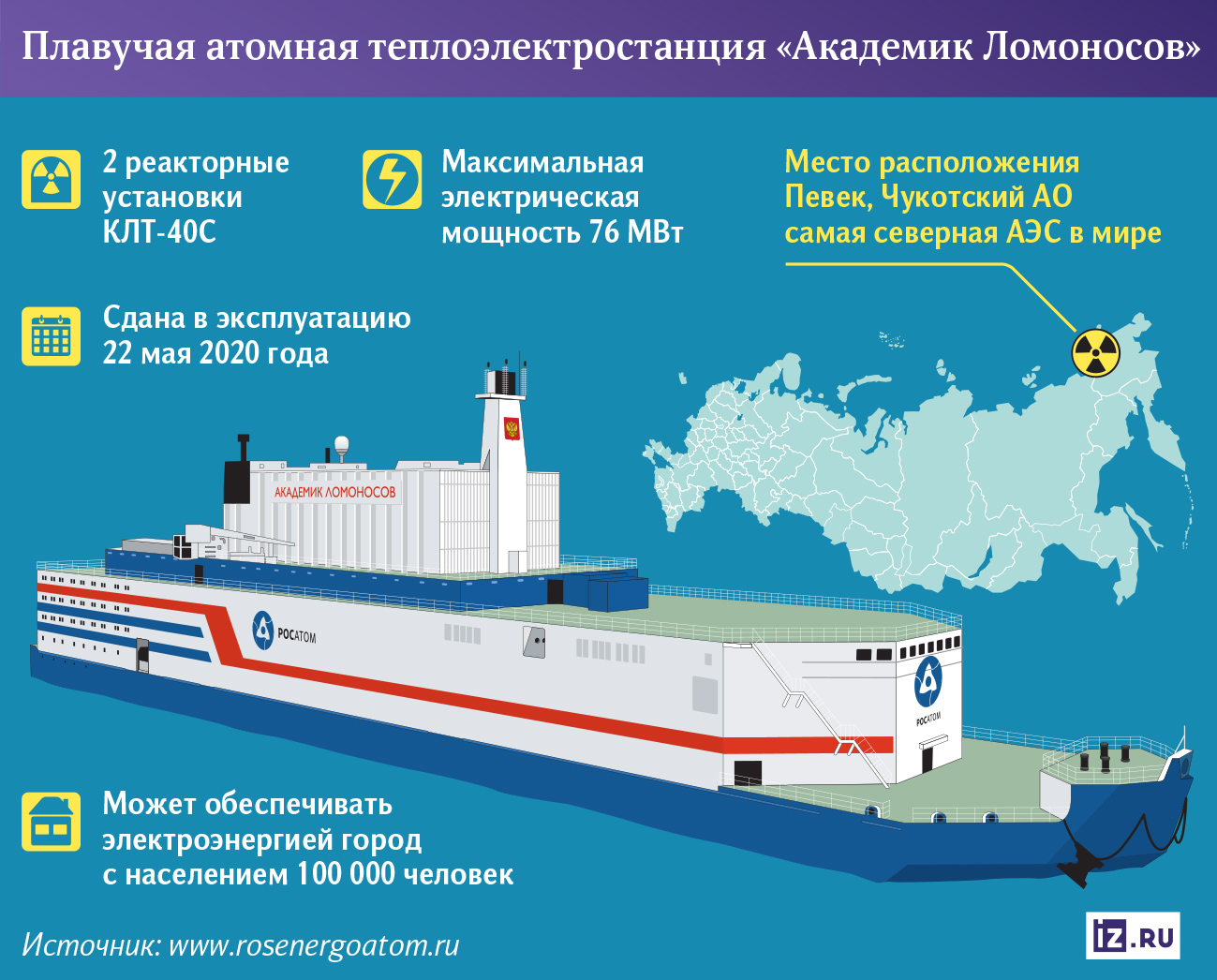
The Russian Federation is one of the world leaders in the operation of floating nuclear power plants. Rosatom State Corporation has created the world's first such station, Akademik Lomonosov, which has been successfully operating since May 2020 in the city of Pevek in Chukotka. Floating power units are built at shipyards and can be delivered by sea to any place in the world where there is a coastline.

Floating nuclear thermal power plant (NPP) of project 20870 Akademik Lomonosov in the port of Pevek.
It is not surprising that Malaysia chose the option of floating nuclear power plants, primarily because of the long coastline and island structure of the entire territory.
— Malaysians choose floating nuclear power plants with a capacity of 100 MW each with a fuel cycle of up to seven or eight years — in fact, floating batteries. They can be created here in Russia and brought there only for consumption," Alexey Likhachev said in an interview with Izvestia.

On June 27, the head of Rosatom discussed the prospects for nuclear cooperation with Malaysian Deputy Prime Minister Fadilla Yusof. In July, the Malaysian delegation visited the Leningrad NPP facilities for the first time, where they got acquainted with the design of power units with generation 3+ water reactors. These are the safest and most reliable power units that are operated not only in Russia, but also abroad. "We are aware of the successful implementation of such a project in Belarus, the construction of Russian—designed nuclear power plants in other countries, and we are ready to discuss prospects for cooperation in the field of nuclear energy with Rosatom," Fadilla Yusof said at the time.

The promotion of the nuclear sector is becoming more and more urgent — by 2030, Malaysia expects an increase in demand for electricity against the background of the development of data centers and industrial clusters.
Nuclear prospects of the Russian Federation in Southeast Asia
The advantages of Russian floating stations are mobility, relatively low capacity and, as a result, adaptability to local needs and environmental safety. At the same time, they are able to provide stable energy to a city with a population of up to 100 thousand people or several industrial facilities.
As the global transition to a sustainable and diversified energy sector progresses, Russian floating power units will become an effective solution for the development of coastal and isolated areas. This will increase energy security and create new jobs in the host countries.
Rosatom expects to officially enter the international market and start operating floating nuclear power plants by 2030, Deputy General Director of the state corporation Andrey Nikipelov, who oversees mechanical engineering, said in May.

And the Russian Federation is already actively working in this direction, developing projects of floating nuclear power plants in Southeast Asian countries. A similar issue of the nuclear power plant has already been discussed with Indonesia, and a roadmap for peaceful nuclear energy with Laos was recently signed.
"Russian nuclear power plants in conditions of increasing energy shortages can become a breakthrough solution and ensure our country's long—term presence in the region," Pavel Shaternikov, a junior researcher at IMEMO RAS, draws attention.

For the Russian Federation, nuclear energy is one of the main points of growth, and now also export. At the same time, there is a serious limitation for the supply of Russian thermal power plants — the "expensive ruble," says Pavel Maryshev, an expert in the oil and gas industry, sustainable development and energy.
— With a shortage of free capital, it is difficult to develop the capital-intensive branch of the NPP. Therefore, in order to maintain the competitiveness of the industry, additional financing or a specialized export support program is needed. But the direction should be developed "cautiously", since first it is necessary to assess the depth of effective demand. Point—to—point projects such as the nuclear power plant for densely populated and energy-intensive Malaysia are the optimal model for the medium-term development of the industry," the expert concluded.

Competition in this area is growing. Although the Russian nuclear power industry occupies a dominant position, the major players — China and the United States — are technologically not inferior, Maryshev emphasizes. He adds that Korea, Denmark, the United States and China are actively announcing the design of marine-type nuclear power plants. But for European countries and investors, eco-activists can become a serious obstacle when creating their own offshore nuclear power plants. At the same time, this problem is not so acute for China and the United States.
By the way, Beijing has historically considered Southeast Asia as a zone of its interests. At the same time, the United States periodically conducts anti-nuclear propaganda, claiming that this type of energy is dangerous, unprofitable and unecological. According to Shaternikov, their goal is obvious — to prevent the development of Russian nuclear energy in the region.
Переведено сервисом «Яндекс Переводчик»
