
Armory lad: Russia will respond to the activity of NATO nuclear forces

NATO is placing increasing emphasis on strengthening the role of nuclear weapons amid preparations for a possible military clash with Russia, Russian Deputy Foreign Minister Alexander Grushko told Izvestia. According to him, Moscow takes into account in its defense planning the actions of the alliance aimed at the possible connection of such weapons. Earlier, several B61-12 nuclear bombs were moved to the UK. The bloc's actions are an attempt to put pressure on Russia during the negotiations on Ukraine, but NATO will not achieve its goal, experts say. Moscow has already responded by lifting the moratorium on the deployment of intermediate-range and shorter-range missiles. About why the North Atlantic Alliance increases the risks of a potential clash with Russia - in the Izvestia article.
The Americans are transferring nuclear weapons to the Russian Federation
Russia sees that NATO's strategies and planning are increasingly focusing on strengthening the role of nuclear weapons, Russian Deputy Foreign Minister Alexander Grushko said.
— Of course. All this is taken into account in our defense planning and military construction," Grushko said, answering a question from Izvestia.

According to the Russian Deputy Foreign Minister, the redeployment of nuclear forces is evidence of the implementation of these plans.
"We are carefully assessing the situation and proceed from the fact that the whole essence of NATO's military activities is aimed at preparing for a possible military clash with Russia," the diplomat said.
Recently, the bloc has dramatically increased the activity of its nuclear forces. According to Bloomberg, in July, B61-12 nuclear bombs were transferred to the UK from the United States for the first time in 17 years.
The deployment of nuclear bombs in the UK was planned many years ago, and preparatory work was consistently carried out, Dmitry Stefanovich, a researcher at the IMEMO RAS Center for International Security, explained to Izvestia.
"In any case, a stable mutual nuclear deterrence remains between Moscow and Washington," the expert believes.

US President Donald Trump
"The deployment of tactical nuclear weapons (TNW) in the United Kingdom, probably at Lakenheath Air Base, indicates an increase in the potential of tactical nuclear weapons in Europe for the first time since the end of the Cold War, which, excluding "replenishment," amounts to about 100-125 units," Vasily told Izvestia, a researcher at the IMEMO RAS Center for International Security. Klimov.

The expert draws attention to the fact that the role of TNW in the military planning of the alliance is significant, special exercises are held on an ongoing basis, and tactical maneuvers are being practiced.
In recent years, NATO has begun to pay increased attention to nuclear weapons. In June 2024, the then acting Secretary General of the alliance, Jens Stoltenberg, announced the modernization of nuclear weapons in the countries of the bloc. In addition to the United States, Great Britain and France have this type of weapon in NATO. London intends to invest $20 billion in the development of its nuclear arsenal, and Paris has declared its readiness to provide a "nuclear umbrella" over the whole of Europe, including by deploying its carriers in other EU countries.

The Nuclear Sharing program also continues to operate, according to which Belgium, Germany, Italy, the Netherlands, Turkey and the United Kingdom host US nuclear weapons. It is stored at Aviano and Gedi air bases (Italy), Buchel (Germany), Incirlik (Turkey), Kleine Brogel (Belgium) and Volkel (the Netherlands). Non—strategic nuclear weapons are stationed here - about 100 B61 free-fall bombs (the United States has about 200 of them in total).
Previously, nuclear bombs were also based in Greece and Canada, and Romania and Poland may become their new locations. After the deterioration of relations between Ankara and Washington, the United States explored the possibility of relocating the B61 from the Incirlik base to Romania. And Warsaw itself called on the United States to deploy weapons of mass destruction on Polish territory.
How will Russia respond to the US actions
Recently, the US President has repeatedly said that he is dissatisfied with the course of the dialogue between Russia and Ukraine. He said he was giving Russia 10 days until August 8 to resolve the situation, threatening otherwise to impose sanctions against Moscow and its economic partners. In fact, the last chance for a peaceful dialogue may be the visit of US Special Envoy Steve Witkoff to Moscow on August 6 or 7.
At the same time, the United States has already begun to put pressure on India, forcing it to abandon purchases of Russian oil. New Delhi announced its intention to continue economic relations with Russia and drew attention to the fact that the United States itself buys raw materials and fertilizers from Moscow.

All this is unfolding at the moment of the successes of the Russian Armed Forces in the combat zone and the ongoing offensive of the Russian army. Given how rapidly the strategic picture in Ukraine is changing, it is obvious that the Russian terms of peace will also be transformed, which can put the reputation of the West in an even more difficult position, Tigran Meloyan, an analyst at the HSE Center for Mediterranean Studies, told Izvestia.

In response to NATO's actions, Russia is also modernizing its nuclear potential and increasing its use capabilities. In particular, in 2023, the Sarmat complexes with a range of up to 18 thousand km were put on combat duty. Even earlier, the Avangard complexes with a hypersonic guided combat unit were deployed. In addition, in November 2024, the Russian Federation used the Oreshnik missile system for the first time. On August 1, 2025, Vladimir Putin announced the start of its mass production, and the rocket entered the army. The geography of Russia's nuclear deterrence is also expanding: in 2023, non-strategic nuclear weapons of the Russian Federation were deployed on the territory of Belarus. By the end of the year, a "Hazel grove" will appear in the republic, now experts are choosing places to place it.

The doctrinal basis for the use of WMD is also changing. In November 2024, a new condition for the use of nuclear weapons was introduced into the "Fundamentals of state policy in the field of nuclear deterrence": a massive launch of means of aerospace attack and their crossing of the state border of the Russian Federation. Nuclear weapons will also be used in the event of a critical threat to the sovereignty of not only Russia, but also Belarus.
And on August 4, the Russian Foreign Ministry announced the lifting of the moratorium on the deployment of intermediate-range and shorter-range missiles, as the conditions for its preservation had disappeared. Moscow now "considers itself entitled, if necessary, to take appropriate measures and take appropriate steps," Russian presidential spokesman Dmitry Peskov said.

In addition to changing doctrines and lifting moratoriums, Russia's next potential response may be to conduct test launches and deploy missile systems closer to the borders of the United States and NATO, taking into account the characteristics of a specific type of weapon.
— In particular, Russia may deploy intermediate-range and shorter-range missiles not only in the European part, but also in the Asian region, and begin working on the issue of restoring the Anadyr-1 facility in the Chukotka Autonomous Okrug, from where the missiles will be able to reach Alaska and the continental United States. At one time, nuclear weapons were stored in the underground rooms of the military base, however, in accordance with the INF treaty, they were removed from there," said Tigran Meloyan.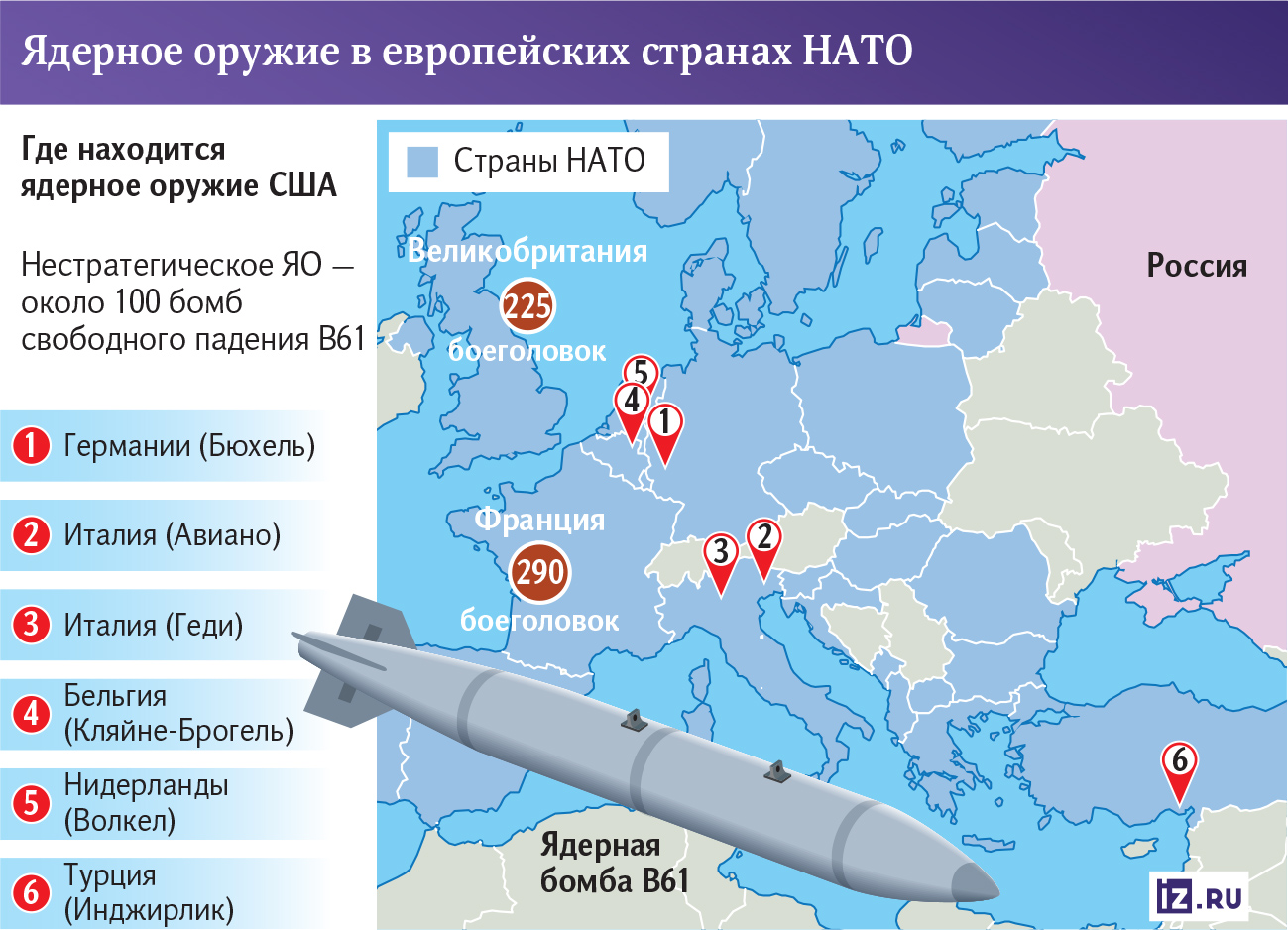
The current movements are more in the nature of a PR campaign, says Oleg Karpovich, Vice-rector of the Diplomatic Academy. However, given the tensions in Europe, psychological warfare can escalate into a real confrontation, and this should be taken into account.
Переведено сервисом «Яндекс Переводчик»
