Gaze Program: AI simulating human eye will find cracks in bridges


Russian specialists have developed an artificial intelligence-based system that is capable of independently finding dangerous cracks in bridges, tunnels and other structures. The AI is installed directly on the drone, which allows it to examine even hard-to-reach structures. Now such checks are carried out manually and three experts, and sometimes industrial climbers, have to be involved in one large object. For more accurate operation, the neural network simulates the principle of focusing the human gaze. According to experts, the technology will significantly facilitate human labor, but the machine must work under the control of the operator.
Searching for defects using AI
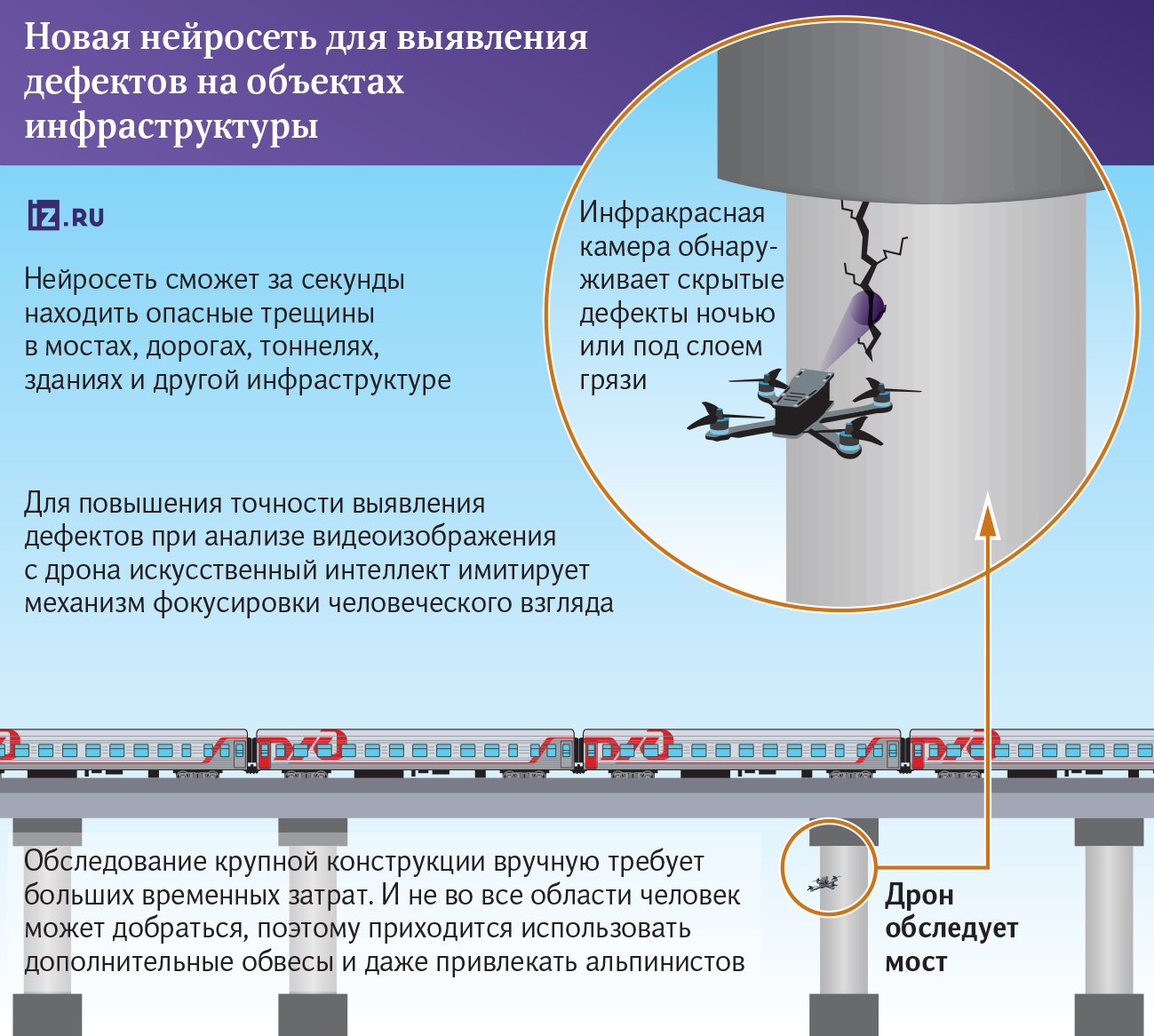
Scientists at Ural Federal University have created a neural network that finds dangerous cracks in bridges, roads, tunnels, buildings and other infrastructure in seconds. To improve the accuracy of detecting defects when analyzing a video image from a drone, artificial intelligence simulates the focusing mechanism of a human gaze. At the same time, he will use infrared data, which allows him to see the destruction that cannot be seen in a normal picture. The development has already shown an accuracy of 88.7% based on real examples from Russia and China. Currently, the condition of important facilities is monitored manually. At least three specialists are needed to inspect one building.
— Inspection of a large structure requires a lot of time. And not all areas can be reached by a person, so you have to use additional body kits and even attract climbers. In some cases, they try to use drone footage. However, you still have to watch large amounts of video later. Our technology will replace hours—long manual inspections, reduce the risk of accidents and save the budget on infrastructure maintenance," said Zoya Belyaeva, Head of the UrFU Department of Building Structures and Soil Mechanics.

Periodic inspections are carried out by specialized organizations in which for each type of object (bridge, tunnel, and so on) the relevant engineer is responsible. For particularly large structures, several experts are needed. One round takes up to two hours. The neural network is capable of processing images 100 times faster. The UrFU development will automate the work of specialists, the scientist added.
AI has a high processing speed of up to 232 frames per second. Thanks to the lightweight architecture, the system can analyze data using computing devices that are installed directly on the drone, rather than sending them to powerful remote servers for processing. This significantly speeds up the work, makes it possible to study images in real time and makes the system more reliable.
To reduce the number of false positives on shadows or water spots, researchers have implemented the SimAM attention mechanism in AI. It simulates the focusing of human vision and allows you to identify areas with cracks without calculating additional parameters. The algorithm is used to find the boundaries of objects. With the standard approach, the machine simply goes through different colors and their locations, and the imitation of the natural process is based on the search for familiar patterns, as a human does.
Now the team is adapting the system for real—world tasks - combining it with drones and adding support for infrared cameras, which will allow detecting hidden defects at night or under a layer of dirt.
— We are exploring the possibility of merging infrared and visible images in order to enhance textural information using the infrared spectrum and increase the ability of the model to detect cracks in low-contrast conditions. Although this work is still at the experimental stage, it lays the foundation for creating a system of round—the-clock and all-weather monitoring in the future," said Zhang Jiahui, co-author of the work, graduate student of the Department of Building Structures and Soil Mechanics at UrFU.
According to the developers, at this stage, a human should control the work of artificial intelligence, as there is still the possibility of error. Full automation is a matter of the future.

The operation of the neural network must be controlled by the operator
The use of automatic analysis technologies has already proven itself well in monitoring the condition of the roadway, said Yuri Vasiliev, Head of the Department of Road Construction Materials at MADI. The combined approach is most effective when a person and a machine work together.
— We use mobile road labs when a camera is installed on a car, and cracks and potholes are recorded during movement. Aircraft can be used in a similar way. Our experiments have shown that the best option is a semi—automatic system. The machine can recognize what a human cannot, but the operator must perform a control check. Given the development of AI, these technologies are very promising," he said.
When creating systems of this kind, issues of aircraft stabilization, camera resolution and other technical nuances come to the fore, he added.
The development will help optimize the experts' working hours and shorten the duration of bridge inspections. But its application will require a specialist with high qualifications and relevant experience, as it is necessary to understand the genesis of cracks, what causes them, and how dangerous they are, said Associate Professor of the Department of Reinforced Concrete and Stone Structures, head of the Laboratory for the Inspection of Buildings and Structures (LOSiS) at the Scientific Research Institute of Experimental Mechanics NRU MGSU Andrey Lapshinov.
— A visual examination is currently underway. This is a very important stage in the diagnosis of bridges, and the qualification of an expert is important here. Modern methods such as thermography, georadiolocation, 3D laser scanning and others are also used. But it's probably premature to expect that all these functions will be in one device. It will take another 5-10 years," he said.
In general, the technology is promising, but it will not replace humans. Therefore, competent specialists are needed to evaluate the results obtained by this neural network, Andrey Lapshinov summarized.
Переведено сервисом «Яндекс Переводчик»
