Over the course of circumstances: almost 900 people have drowned in Russia since the beginning of summer
- Статьи
- Society
- Over the course of circumstances: almost 900 people have drowned in Russia since the beginning of summer

Since the beginning of the summer of 2025, 867 people have died in Russian reservoirs, the Ministry of Emergency Situations told Izvestia, noting that the figure has decreased by 40% compared to last year. The main cause of death is swimming in unequipped places. The beginning of summer turned out to be rainy, with thunderstorms and a sharp drop in temperatures, and swimming in such conditions leads to tragic outcomes, meteorologists warned. What other causes of accidents on the water are in the Izvestia article.
How many emergencies have occurred on the water
Since June of this year, 867 people have drowned in reservoirs, including 146 children, the press service of the Ministry of Emergency Situations told Izvestia. "This is 40% less than last year's figure for this period," the ministry noted.
Since the beginning of the bathing season, employees of the State Inspectorate for Small Vessels of the Ministry of Emergency Situations have rescued 310 people, including 76 children. "Accidents most often occur in places that are not equipped for bathing. Children are drowning, left without adult supervision," the Ministry of Emergency Situations warned.
So, in July, in the village of Nekrasovo in the Kaliningrad region, an eight-year-old child died while swimming in a lake.
"The family was relaxing at the lake. After some time, the eight-year-old girl disappeared from the sight of her parents. The mother immediately contacted the emergency services. The father pulled the child out of the water without signs of life," the department's Telegram channel reported.
The Ministry of Emergency Situations noted that good swimmers can also become victims of underwater currents or get injured, and called for the complete elimination of alcohol consumption near the water. For example, in early July, a man drowned in the Amur region.
"As it turned out, he swam badly, but decided to reach the middle of the reservoir. It cost him his life. The depth of the lake does not exceed two meters," the department's Telegram channel says.
The Ministry of Emergency Situations said that daily raids and explanatory conversations with vacationers are conducted to prevent accidents.
For example, in Altai, inspectors give children inflatable armbands and safety instructions. In the Kostroma region, special attention is paid to violators who go out on the water on small vessels and boots without life jackets. Training events are also taking place in Irkutsk and Oryol regions.
Tatiana Pozdnyakova, a leading specialist at the Meteonosti news agency, noted that rainy weather with thunderstorms could be one of the reasons for the deaths this year.
— If a thunderstorm is coming, it is necessary to leave the bathing area. Also, if it's hot outside, the water may be cold, which can lead to severe hypothermia and cardiac arrest," she explained.
Tatiana Pozdnyakova also noted that the air temperature in Moscow could rise to +30 degrees over the weekend. And she called for swimming "without enthusiasm."
Why do people drown
Among the main causes of drowning in reservoirs are swimming under the influence of alcohol, injuries sustained in the water, and leaving children unattended, Maxim Dzhetygenov, head of the Moscow city branch of the All—Russian Student Rescue Corps and a member of the public council at the Ministry of Emergency Situations of Russia in Moscow, told Izvestia.
— People come to the reservoirs to spend their leisure time, for example, to relax with friends or family, to arrange corporate parties. At the same time, many consider it necessary to accompany the event with the consumption of alcoholic beverages. As a result, they lose their composure, stop calculating their strengths and assessing risks adequately. This eventually leads to tragic consequences," he said.
According to the expert, it is not uncommon for people to get injured while diving into the water, especially in unfamiliar places, from bruises to a broken head or fractures. Active games in the water can also lead to injuries.
— For example, in my practice, there was a case when a group of guys bungee jumped and one of the comrades did not make sure that the previous jumper swam away, made a jump and landed on the guy jumping in front of him. He broke his collarbone with his heel. The depth was small, and the company pulled the victim ashore, but it could have ended more tragically," Maxim Dzhetygenov said.
The expert also stressed that adults need to closely monitor the bathing of children in reservoirs.
— If you think that your child has learned to swim and is already quite an independent swimmer, do not leave him without attention, especially when the child is in the company of children, — he said.
According to him, children between the ages of three and six can avoid obvious threats, but they are not able to assess all the risks and consequences of their actions.
Olga Shuppo, founder and scientific director of the Grand Clinic network of immunorehabilitation, adaptive and preventive medicine clinics, noted that the risks of relaxing by the water are also associated with infection with bacterial and parasitic diseases.
Among the diseases after bathing, primarily in unequipped places, cercariosis (a parasitic skin disease), acute intestinal infections and hepatitis A are leading, added Zarema Omarova, a dermatologist and co-owner of the Omarov clinic network.
"These diseases have a serious impact on health and require a fairly long recovery," the expert emphasized.
When bathing, there is also a high risk of overheating and sunburn, or developing allergies to insect bites or from interacting with algae, said Sergey Maltsev, head of the emergency department at the Russian Railways-Medicine central polyclinic.
How to protect yourself and your loved ones
It is important to choose places for recreation on the water that are equipped with rescue posts, which means that they are officially permitted swimming spots in the summer, Maxim Dzhetygenov noted.
"Such recreation areas are checked by Rospotrebnadzor specialists and monitored throughout the bathing season," he recalled.
The press service of the Ministry of Emergency Situations said that safe rest is possible only on equipped beaches where professional lifeguards are on duty. And they urged not to swim far from the shore, to objectively assess their capabilities.
But, according to Maxim Dzhetygenov, people should not rely only on rescuers. You need to control your friends, children, and the elderly on your own. And Sergey Maltsev recommended strictly observing the restrictions of bathing areas, not swimming beyond the established boundaries, and carefully reading the information about underwater currents before starting a vacation.
In case of accidents on the water, Olga Shuppo recommended calling an ambulance and providing first aid to the victim.
— It is important to ensure the patency of the upper respiratory tract of the victim, laying him on his stomach on his knee, then proceed to cardiopulmonary resuscitation. When restoring breathing and cardiac activity, it is necessary to give the victim a stable lateral position, cover him so that he warms up," she said.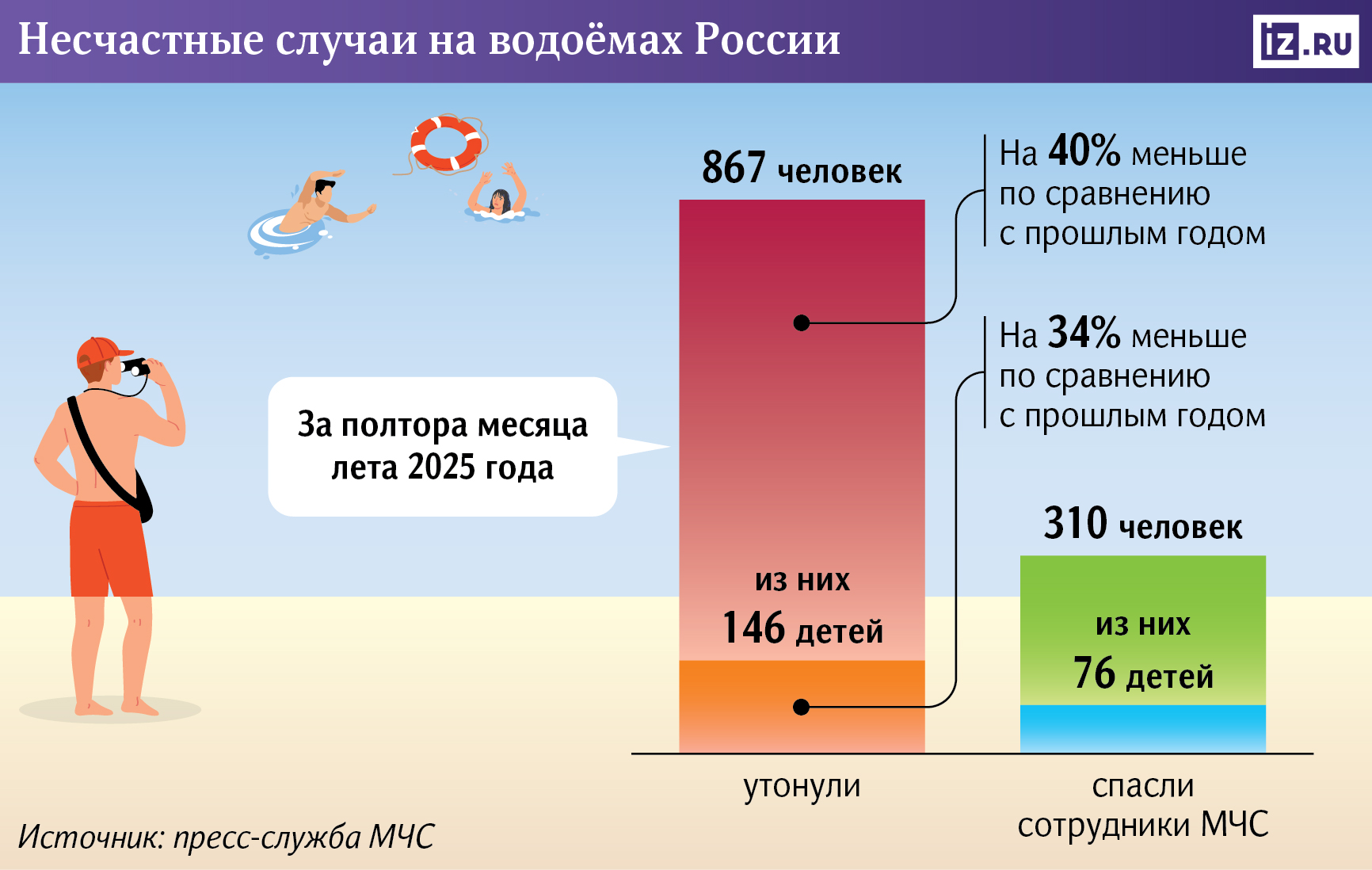
If a person is conscious, coughing and able to breathe on his own, you need to help him take a semi-sitting position, take off his wet clothes and cover him with a warm blanket, Sergey Maltsev added.
The expert recommended calling an ambulance, even if the victim's well-being seems satisfactory. According to him, the risk of late symptoms of secondary drowning persists for another three days. There may be an accumulation of water in the lungs and the development of inflammation.
Переведено сервисом «Яндекс Переводчик»
