Special support: how Russian synchronized swimmers continue to conquer the World Cup

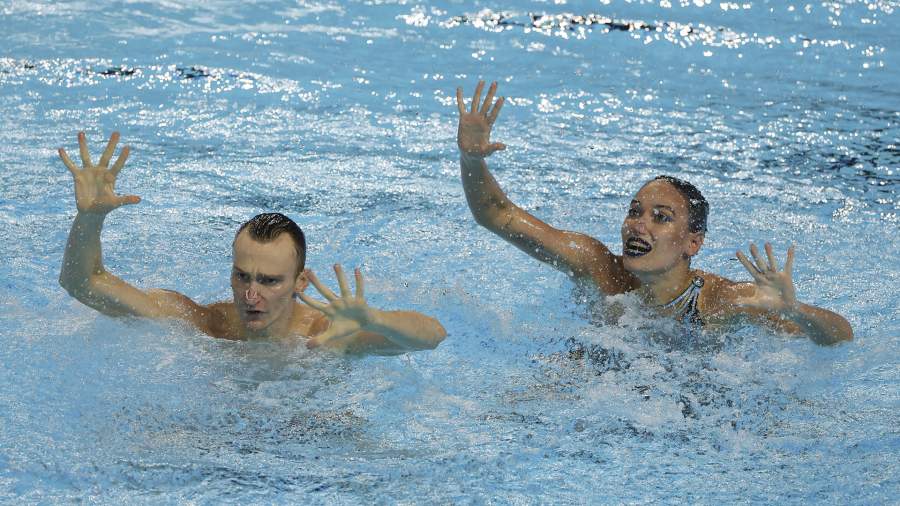
Russian synchronized swimmers Maya Gurbanberdieva and Alexander Maltsev won the mixed duet technical program at the 2025 World Championships in Singapore. The Russians (233.2100 points) beat Spain's Dennis Gonzalez Boneu./Mireya Hernandez Luna (230,4634) and the Italians Filippo Pelati/Lucrezia Ruggiero (228,0275). 26-year-old Gurbanberdieva became a three-time world champion after winning two gold medals at the 2019 World Cup in a duet with Maltsev. 30-year-old Maltsev took the third gold of the tournament in Singapore and became a seven-time world champion.
Feeling like a partner
Alexander Maltsev and Maya Gurbanberdieva brought the Russian team the third gold at the World Aquatics Championships in Singapore. Alexander and Maya won the previous gold in this discipline six years ago, in 2019, and now they have triumphantly returned after the admission of Russian athletes. Interestingly, there was no qualification in this discipline, it was just the final.
"I was upset when I found out, because it's a little easier to qualify,— Maya Gurbanberdieva told Izvestia. — In 2019, we had two preliminary starts, and we could try out the water, explore everything and confidently reach the finals. But here you have to do it all at once, and of course it's harder. Plus, emotionally, of course, it was also difficult, because Sasha went through two solos, and I was just exhausted after his starts, because I was very worried, I was sick, and I gave all my strength and nerves to him.
— And for me, it's probably better that the finals are right here, — Alexander Maltsev retorted. — Although there is a subjective factor — we perform at the beginning, the sport is subjective, so very often the first assessment may be slightly delayed. This doesn't always happen, but it does happen, so it's not a good thing that you don't have the qualifications. On the other hand, for me, since I'm doing four programs here, it's easier: if there were preliminaries, I'd have to perform eight times. That's why I'm really glad that we reached the finals right away.

The Russian duo won with a program called Welcome to the New World.
— In it, we talk about the cyber future, so we had to surprise, — Maya Gurbanberdieva continued. — As a result, we became the only duo in which the support is not provided by the partner, but by the partner. And it took us a while to do that. We had to get used to each other for a long time to catch the connection, let's say. Sometimes he got lost. A couple of weeks before the World Cup, we had runs where we just didn't connect, nothing worked. We're giving our best, and we seem to have the strength, even at the end of the program you're going to do it on purpose, but something goes wrong, one sooner, the other later. It is very important to find this feeling of a partner. I'm glad that everything worked out for us in Singapore.
The final of the technical mixed became Gurbanberdieva's first and only start at the championship. She won't be performing in Singapore anymore.
"I'll stay here, I'll cheer for Sasha and Olesya [Platonova] in the free skate, I'll be with them emotionally," the three—time world champion emphasized. — Now it will be the final start for mixed doubles, Sasha's fourth outing, Olesya's first. She also sits, waits, and is exhausted from waiting. This is her first World Cup, so, of course, it's emotionally difficult for her. In any case, I will give my nerves, my support, and all the strength I have left to them.
The sport of risk
It should be noted that so far our neutrals have won all the victories in non-Olympic disciplines. But the Russian synchronized swimming team failed to win the technical program, losing to China, but ahead of Spain. Our Chinese team was inferior both in terms of elements and in terms of the second assessment.
"I expected such a result," Tatiana Pokrovskaya, the head coach of the Russian synchronized swimming team, told Izvestia. — I needed this second place, the main thing was not to drop lower. The girls are just starting out, we need to go up gradually. No one would have given us the first place because there was a big break, we are now accepted as newcomers. Everything needs to be conquered again, four years of absence from international competitions is not a sneeze. There were only the BRICS Games and then there was life waiting. And suddenly, we're on our way. Let's move gradually, let's not scare our rivals, because they are worthy. China rightfully took the first place today, but who knows how we will perform in the future. Spain are good rivals. We are surrounded by good opponents.

During the World Cup and before it started, many athletes noted the new rules, which became more unpredictable in terms of the final score. Now the base in synchronized swimming does not guarantee anything anymore.
"Our sport has become a sport of risk," Tatiana Pokrovskaya continued. — Synchronized swimming has become different, especially for us, who have been missing for four years. Well, let's do this sport now. The new synchronized swimming. If we had gone back to our old rules, second place would have been a defeat, of course. But we have returned to a completely new synchronized swimming, new rules. We only heard from afar, not everything reached us. We weren't invited to seminars, and life was a bit slow. Therefore, of course, it is difficult for us to catch up now, but we will manage.
The synchronized swimming program at the World Cup will last two more days. On July 24, there will be a free program in women's duets, and on the 25th, mixed duets (free program) and team acrobatics will perform.
From July 26 to August 3, swimming and diving competitions begin.
Переведено сервисом «Яндекс Переводчик»
