Political analyst Drobnitsky pointed to the similarity of Trump and Biden in the context of Ukraine.
- Новости
- World
- Political analyst Drobnitsky pointed to the similarity of Trump and Biden in the context of Ukraine.

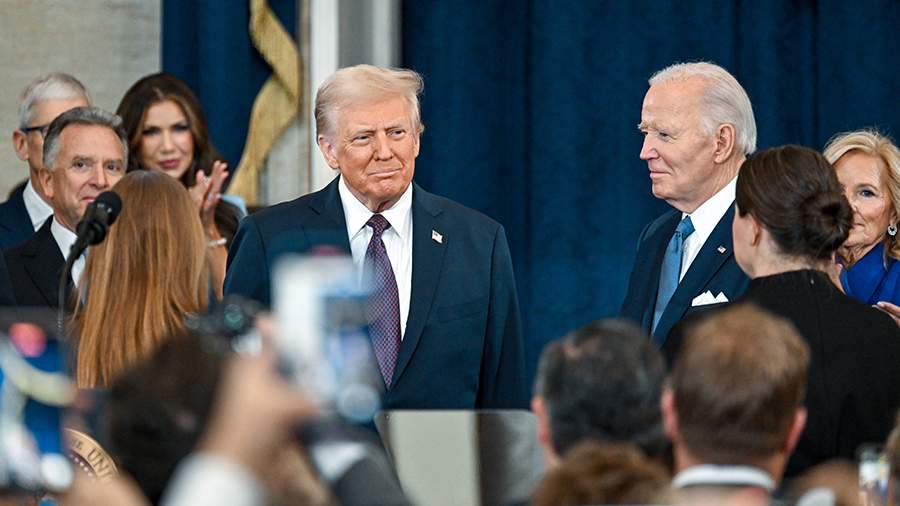
US President Donald Trump's position on the Ukrainian conflict was doomed to failure, as he is becoming more and more like his predecessor Joe Biden. Dmitry Drobnitsky, an American political scientist, told Izvestia about this on July 22.
The expert noted that Trump tried to get away from this situation, but the European and liberal elites of the United States found an approach to him and forced him to follow the path of the previous president.
"Trump would like to drop this conflict. He tried, he said it wasn't his <conflict>, it was a <conflict> Biden. But they told him, "No, Donald, you're not leaving him, this <conflict>. As President of the United States, you have an obligation to do what we tell you." <...> Trump is getting closer to Biden and further away from his campaign promises," Drobnitsky said.
According to the political scientist, the fact that there is less talk in the United States about the conflict between Russia and Ukraine is related to Trump's so-called 50-day ultimatum. It is clarified that it was initially clear that the American leader would not be able to resolve the situation.
Drobnitsky stressed that the US president's attempt to mediate in the negotiations was obviously doomed to failure, since there was no clear policy towards Europe, NATO, Ukraine and Russia.
Vladimir Mozhegov, an American political scientist, in turn, noted that Trump has now decided to distance himself from the Ukrainian conflict due to the fact that so far it has not been possible to achieve a settlement. According to the expert, business logic is visible in the actions of the US president.
"In this sense, he works like a normal rational businessman. The deal is not working out, so let's leave this matter and do something else. That's about what he thinks," Mozhegov clarified.
He also noted that Trump's foreign policy decisions may be influenced by the situation inside the country, including the case of financier Jeffrey Epstein, because of which he is losing the loyalty of his constituents. According to him, the American leader very much let them down with his decisions on this issue.
"After all, he came to power on these promises. Indirectly, this may affect his foreign policy decisions. He becomes weak inside, the support of those people on whom he relied disappears from under his feet," Mozhegov emphasized.
The European Union, according to the American expert, may well pull support for the military conflict in Ukraine without the United States, since it benefits members of the European bureaucracy. He added that they share the ideas of globalism, which, according to the political scientist, consist in the weakening of states and the emergence of a new world power over them.
According to the expert, in this regard, it would be beneficial for Russia to reach an agreement with Trump because of the similarity of his global foreign policy with the idea of a multipolar world promoted by Moscow.
"Trump's foreign policy [is] aimed at building a world with several centers of power. <...> It will be a balanced world of four or five major poles, which appeals to our geopolitical idea of a multipolar world. <...> Both Trump and We are anti—globalists," the political scientist concluded.

Earlier, on July 14, Trump announced his intention to impose 100% secondary duties on Russia if a settlement of the conflict in Ukraine is not reached within 50 days. The president also added that he was "very dissatisfied with the Russian position" on the Ukrainian issue.
Later, on July 21, American Congressman Don Bacon shared that Trump could change his rhetoric regarding the conflict in Ukraine because of his wife Melania. According to him, it is necessary to thank for such a contribution to changing the opinion of the US president.
All important news is on the Izvestia channel in the MAX messenger.
Переведено сервисом «Яндекс Переводчик»
